Color-matching Powder Coat Paints

[Zitt] is sharing some methods he’s honed for color-matching powder coat paint. He developed these techniques while restoring a 1982 Star Trek coin-op machine. The image above shows a paddle used for the game. The plate that houses the control was beat up, and he needed to repaint it but wanted to make sure it didn’t look out-of-place with the molded plastic that surrounds it.

He gets his powder paints from Harbor Freight, a favorite depot for hackable goods (like drill motors, or metal carts). Usually these paints would be applied by attracting them to the piece using electrostatic charges. [Zitt’s] not doing that, but applying them with a paint sprayer instead.

The first step is to match your color. He’s using an electronic color matching device which gives data to plug into a chart on the web for a color match. Once you’ve got a formula, mix up the powder coat, and then dissolve it into some Methyl Ethyl Ketone. This goes into the spray gun and is applied in an even coat. Before heading into an oven for curing, it’s important to wait for this coat to dry. [Zitt] observed some boiling MEK on a wet test piece that left an undesirable texture on the baked paint after curing. After running a few test pieces he picked the blend that was the best match and then painted all of his restored parts.

Motorcycle Turned Chicken Launcher

Those who frequently work with them will tell you that rubber chickens are actually pretty heavy. You’re not going to do much damage chucking them by hand and that’s why you need your own rubber chicken launcher. This most-excellent magazine-fed foul-flinger was built by artist [Sean Pace] as a senior project while working toward his fine arts degree at UNC Asheville. He reused the rear end of a motorcycle, purposing the spinning wheel to grab the birds out of an in-feed channel and fling them much like a mechanical football launcher would. It kind of makes us wonder if you could do the same thing with a pneumatic football launcher?

[Sean’s] contraption is built on a stationary base, but in the video after the break you can see it firing from a flatbed truck. Seems somewhat like a whimsical warthog if you’re a Halo fan.

Continue reading “Motorcycle Turned Chicken Launcher”

DIY Resin Cast Project Box

resin_casting

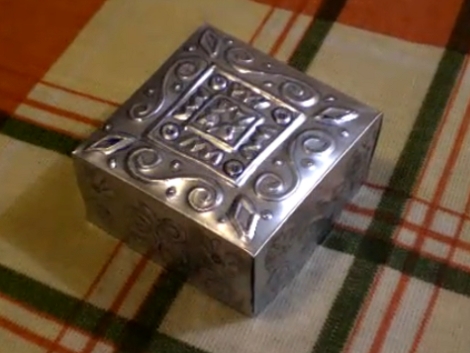
[Rhys] wrote in to share a custom project box he built from scratch using polyester resin. He states that in New Zealand, he tends to have problems finding the perfect project box. They are typically too big or small to get the job done, so he figured he might as well just build his own to spec.

Using Google SketchUp, he designed his ideal project box, then got busy building wooden molds. He scored some free melamine scraps from a local company, which he used to build the base of his molding rig. Once the inner and outer molds were built, he secured them to his base and mixed up some polyester resin.

A few hours later, he pulled apart his molds and smoothed out his project box with some sandpaper. He drilled and tapped screw holes, then prepared to make a lid and base for the box.

He admits that the process is quite involved, but there is something to be said for building yourself an enclosure made specifically for the project it is going to house. If you are looking to do something similar be sure to check out his blog – he offers up some sound resin casting tips, as well as some pitfalls to avoid.

Hacking Cakes With LEDs

led_cake

A large part of science is making mistakes and learning from them in order to make each subsequent design that much better. When your experimentation involves hacking cakes, each failure is an exercise in deliciousness.

[Craig] and his group of research partners often bake electronics-related cakes whenever part of the team departs in search of other opportunities. Over the years, farewell parties have seen renditions of anything from multimeters to quantum computers. This time around, he wanted to make something that contained actual electronics parts, while still remaining edible.

He settled on making an LED matrix inside of a cake, using silver foil wrapped licorice for wires. In the end however, he found the silver foil to be incredibly difficult to work with, and the matrix ended up being little more than a few randomly blinking LEDs.

Even though things didn’t work out quite how he planned, he is not discouraged. The cake was still quite tasty, and through this process he has discovered edible silver paint, which will undoubtedly make it into the next farewell cake.

Laser Tripwire Water Balloon Prank

laser_tripwire_prank

Even though it’s a bit late for April Fool’s jokes, [Ameres] wrote in to share a project guaranteed to catch your friends (or enemies) by surprise.

Like us, he had some old CD-ROM drives sitting around and thought that there must be some way to put them to good use. He gutted one, saving the laser’s carrier unit for use as his mechanical trigger. He placed the unit above a doorway, soldered a pin on to the end of the laser carrier, and positioned a water balloon at the end of the CD-ROM’s rails. The laser carrier’s motor was then connected to a photocell located about half way down the side of the door.

He mounted a laser on the far side of the door, which is pointed at the photocell. Once the laser beam is broken, the CD-ROM motor is actuated, popping the balloon over the unsuspecting victim.

It’s not the most high-tech prank out there, but how high tech does a water prank need to be? We just wonder how easy it would be to attach one of these things to our cube at work…

Have any ideas as to how he can make a bigger splash with his friends?  Share them with us in the comments.

Measuring The ~10 Kiloamp Output Of A Large Capacitor Bank

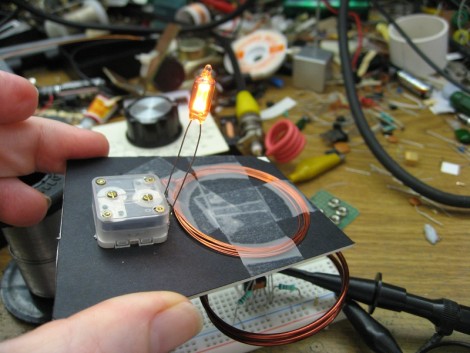
[Norman] put together a rather impressive 22,500 uF capacitor bank. In addition to find things to torture with the strong magnetic field generated by a sudden discharge, he’d like to measure the current pushed from the device. He’s found a way to do this using a digital storage oscilloscope. To protect the oscilloscope [Norman] built his own interface box that includes a 50x voltage divider, and interfaces a current sensor called a Rogowski coil. When it comes time to run the experiment, he turns the safety lock-out key on the bank charger, then discharges the stored potential with the flip of a switch.

Take a look at the video after the break to see soda cans and hard drive platters mangled by the device. The oscilloscope measures the output near 10 kA, giving [Norman] the data he set out to capture. He’s entered this project into the Tektronix contest where it’ll compete with the piano tuner and laser light show tester just to name a few.

Continue reading “Measuring The ~10 Kiloamp Output Of A Large Capacitor Bank”

Easter Egg Hacking

ateam_easter_egg

Spring is upon us and Instructables user [Mischka] decided it was a good idea to combine two flavors we never considered putting together: The Easter Bunny and the A-Team.

He decided to build the egg as an Easter gift for his brother, who is a huge fan of the A-Team. He found a slightly larger than normal plastic egg, and proceeded to paint the shell white, adding a printed picture of Mr. T once the paint had dried.

The guts of the egg are made up of a Picaxe 08M micro controller mounted on a Picaxe protoboard. Rather fond of buzzing, beeping audio, he decided to forgo a normal speaker and opted to use a piezo instead. To activate the music when the egg is shaken, a tilt switch was added to the board as well. He uploaded his software to the Picaxe, sealed up the egg, and called it a day.

We can imagine his brother will be pretty pleased with the creation – who wouldn’t be? We only wish that there was video of the egg in action.