Fidget Spinner Shreds With Bass Guitar Pickup

Hackaday continues to embrace our implacable spinning overlords-of-the-heart.

[zazzazzero] posted a YouTube video showing him fidgeting one of those spinners that had been hooked up to a bass guitar pickup. It makes a rather awesome rumbling sound as the pickup registers the bearings rolling around, and when hooked up to a Digidelay effects pedal he moved it beyond the rumble to more of an industrial growl like a factory hum. He also got interesting sounds by tapping on the spinner with a screwdriver.

Then he switched up to using an iPad audio app called Shaper to modify the resulting sound far beyond what he had before, with more effects options available at the touch of a button. All of these sounds can be modulated into the analog synthesizer chain, making this spinner a for-reals musical instrument.

We’ve published more than a couple pieces on music hacking, including this ASDR envelope generator project and the Atom Smasher guitar pedal.

Continue reading “Fidget Spinner Shreds With Bass Guitar Pickup”

Spice Up Your Bench With 3D Printed Dancing Springs

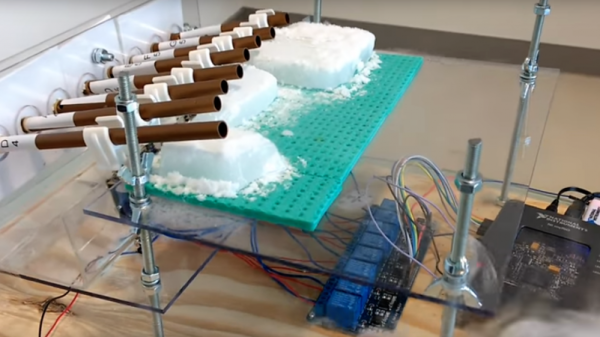
Not all projects are made equal. Some are designed to solve a problem while others are just for fun. Entering the ranks of the most useless machines is a project by [Vladimir Mariano] who created the 3D Printed Dancing Springs. It is a step up from 3D printing a custom slinky and will make a fine edition to any maker bench.

The project uses 3D printed coils made of transparent material that is mounted atop geared platforms and attached to a fixed frame. The gears are driven by a servo motor. The motor rotates the gears and the result is a distortion in the spring. This distortion is what the dancing is all about. To add to the effect, [Vladimir Mariano] uses RGB LEDs controlled by an ATmega32u4.

You can’t dance without music. So [Vladimir] added a MEMs microphone to pick up noise levels which are used to control the servo and lights. The code, STL files and build instructions are available on the website for you to follow along. If lights and sound are your things, you must check out the LED Illuminated Isomorphic Keyboard from the past. Continue reading “Spice Up Your Bench With 3D Printed Dancing Springs”

Four Chords Should Be Enough For Anyone

You might be surprised at how many pop songs are exactly the same. Cat Scratch Fever is the exact same song as Smoke on the Water. Even one of Yeezy’s songs is strikingly similar to a weird 90s French electronic group. Musically, though, there are an incredible number of songs that follow a I-V-vi-IV progression. Let it Be is one of them, as is Beast of Burden. Lady Gaga’s Poker Face is another. Now, finally, we have automated most of the pop songs you know and love. [Sven] has created a small MIDI device that only plays a I-V-vi-IV progression, and it’s everything you could ever imagine.

The idea for this build comes from an Axis of Awesome routine demonstrating the fact that hundreds of pop songs follow the same progression. After the idea, the implementation, like the music all those millennials are listening to, is simple.

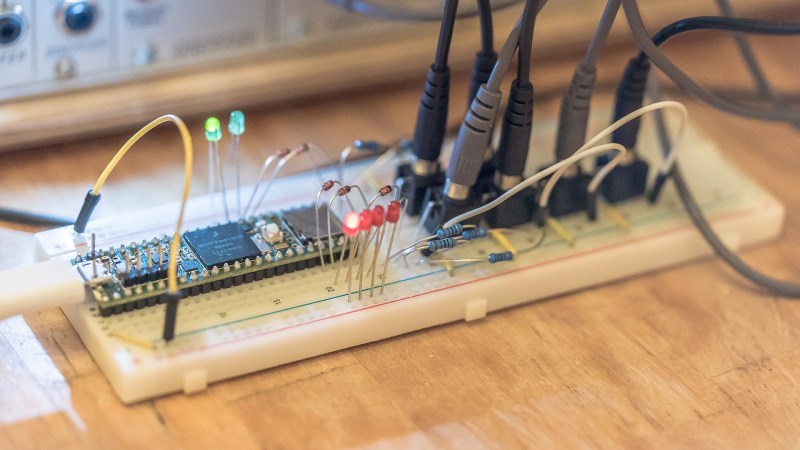
The 4chord MIDI is a small board with an old Nokia display, buttons, a single USB port, and an ATMega328 microcontroller. Using MIDI over USB, it plays the I-V-vi-IV progression in any key. It plays in chord mode, arpeggiated mode, or mixed mode at any sensible tempo.

You can check out a video of the 4chord playing several hundred songs simultaneously below.

Continue reading “Four Chords Should Be Enough For Anyone”

Designing The Atom Smasher Guitar Pedal

[Alex Lynham] has been creating digital guitar pedals for a while and after releasing the Atom Smasher, a glitchy lo-fi digital delay pedal, he had people start asking him how he designed digital effects pedals rather than analog effects. In fact, he had enough interest, that he wrote an article on it.

The article starts with some background on [Alex], the pedals he’s built and why he chose not to work on pedals full-time. Eventually, the article gets to the how [Alex] designed the Atom Smasher. He starts by describing the chip he used, the same one that many hobbyists, as well as commercial builders, use for delay based effects – the SpinSemi FV-1.

The FV-1 is a SMD chip used for digital delays and other effects that require a delay line – reverbs, choruses, flangers, etc. It’s programmed with an assembly-style language called SpinASM. [Alex] goes over some of the tools and references he used when designing for the pedal. He also has a list of tips for would-be effect pedal designers which work whether you’re designing digital or analogue effects.

[Alex] ends his article saying that, in the future, he might make the schematic and code available, but for the moment he’s not. The FV-1 is an interesting chip, and [Alex]’s article gives a nice high-level look at its features and how to develop for it. For some interesting guitar pedal related articles, check out this one using effects pedals to get better audio in your car, and here’s one about playing with DSP and designing a pedal with it.

Continue reading “Designing The Atom Smasher Guitar Pedal”

Meet The Video DJ Machine

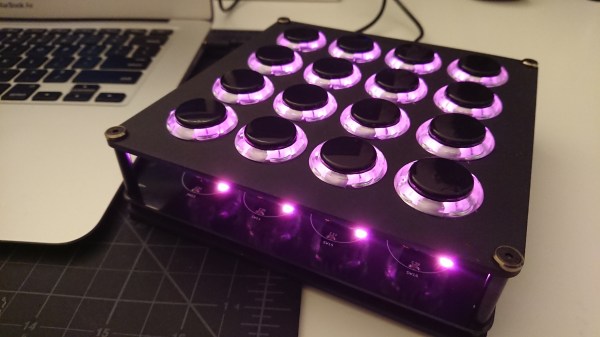
Have you ever wanted to perform as a DJ but found the equipment expensive as well as intimidating? Well, your prayers have been answered by [Dror Ayalon] who has designed Nomnom 2. It is an open source, music mixing project that uses up to 16 video clips to give you control of your next hit album.

You are given charge of a physical control panel that has 16 buttons and four knobs. Each button can be used to turn on or off a particular clip while the knobs control the repetition rate, volume, speed and playable length of each track. An Arduino sits under the buttons and is responsible for sending the information to an application that runs in your web browser. The browser app uses the NexusUI library to control playback of the audio clips and bring to life the entire experience.

[Dror Ayalon] has been busy polishing his project and there are some neat videos of him demonstrating it so check out the videos below. The code is available for down from GitHub and the BOM is available at the Hackaday.io project page. The web app can be ported to a desktop app using electron and a PCB can be designed for the controller for future versions.

For now, it is incredible to see hardware and software, come together in such a harmonious fashion. This may be the start of something wonderful but if you are just looking for a way to annoy the neighbors, check out the Midi Musical Siren instead. Continue reading “Meet The Video DJ Machine”

Play It Again, Arduino

[MrRedBeard] wanted to play a particular song from an Arduino program and got tired of trying to hand transcribe the notes. A little research turned up that there was a project to convert Music XML (MXL) files to the Arduino. However, [MrRedBeard] wasn’t a fan of the language it used, so he created his own means of doing the same thing. He learned a lot along the way and was willing to share it in a tutorial that will help you if you want to do the same thing. You can see a video of his results, below.

Continue reading “Play It Again, Arduino”

Radiohead’s Greatest Hits For The ZX Spectrum

We’ll admit that only a few of us here at Hackaday are Radiohead fans. However, we all couldn’t help but appreciate their new remastered release of OK Computer. The new release contains some bonus material. At the end of the bonus material is a strange noise that turns out to be a ZX Spectrum Basic program.[OooSLAJEREKooO] managed to find it, play it, and record it for all of us (see video below).

The two minutes of tones might sound unfamiliar to a modern computer user, but back in the day, audio tones were used to communicate over phone lines and to load and save programs via cassette tape recorders. You might be asking yourself: why the ZX Spectrum? Radiohead is from the UK, but that’s not the complete picture. Of all home computers, the ZX Spectrum had a higher effective bit rate when storing data on tape. Basically, it takes less time (and less tape) to put it on a Speccy than a C64 or Apple.

Continue reading “Radiohead’s Greatest Hits For The ZX Spectrum”