[Jeri Ellsworth] On Making Her C64 Bass Keytar

[Jeri Ellsworth] finally set aside some time to talk about the build process for her Commodore 64 bass keytar. We think what started by taking a band saw to the guitar body ended up as a fantastic new instrument.

When she was showing off the project at Maker Faire we really only got a cursory look at what it could do. Her most recent video covers all that went into pulling off the project. Once the bulk of the guitar body was gone she tore the guts out of a dead c64 in order to mate the case with the guitar neck. Always the craftsman, she altered the computer’s badge to preserve the iconic look, then went to work adding pickups to each string using piezo sensors. This was done with Maker Faire in mind because magnetic pickups would have been unreliable around all of the tesla coils one might find at the event. These were amplified and filtered before being processed via an FPGA which connects to the original c64 SID 6581 chip.

Continue reading “[Jeri Ellsworth] On Making Her C64 Bass Keytar”

Turning A Bunch Of Solenoids Into A Performance Of Stomp

Say you have a handful of solenoids, a copy of MaxMSP, an Arduino, and access to a whole bunch of parts in a textile museum. What do you do? If you’re like [Luke], you’ll probably come up with an Arduinofied performance of Stomp, played on dozens of old gears, light fixtures, and various other metal parts.

To control what noise sounds when, [Luke] used a Touch OSC interface running on an iPad to send MIDI information to Ableton. From there, MAX/MSP sends messages to an Arduino to actuate the solenoids on cue. The interface is set up so anyone can make their own compositions by reusing patterns into loops of solenoids making noise. Sure, it’s not the dulcet tones you would expect from a more traditional instrument, but [Luke] manages to put on a good show.

While [Luke]’s instrument may sound overly mechanical and dissonant, it’s entirely possible to replace the objects he’s hitting with the solenoids with something a little more melodious. Putting a few solenoids in a cave wouldn’t be a bad idea; too bad it’s already been done.

Christmas Prep Starts Early: MIDI Control For Strings Of Lights

If you’re planning to outdo yourself with this year’s Christmas decorations now’s the time to start planning. After all, what else have you got going on since the dreadful heat is making outdoor activities a sweat-soaked misery? Take some inspiration from [Tim] who just finished prototyping a wireless MIDI controller for his strings of Christmas lights. You can just see the four spools in the distance which are lighting up as he tickles the ivories.

The wireless link is provided by a WiFi access point which uses its USB port to control the external hardware. This is a USB Bit Whacker board which in turn drives a relay board that was designed to switch mains voltages. The high voltage parts of the rig are housed in a plastic food storage container which hosts two pair of outlets to drive four channels in total. [Tim] is happy with the outcome, which he shows off in the video after the break, and hopes to expand to a total of sixteen channels for this year’s festivities.

Continue reading “Christmas Prep Starts Early: MIDI Control For Strings Of Lights”

Open Source Synth Sounds Awesome

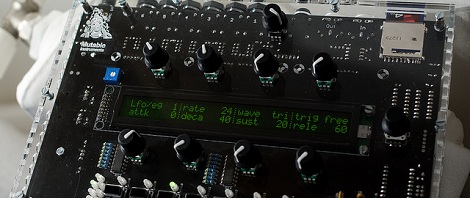
A little bird sent in a tip about a really cool MIDI synth. It’s called the Ambika, and it seems like just the thing to introduce a synth head to the world of soldering.

Compared to an entry-level synthesizer like the microKorg or its ilk, the Ambika is packed full of really cool features that just happen to sound awesome. In addition to the basic saw, square, and sine waves, there is also FM, and wavetable synthesis along with a noise generator, rudimentary voice synth, and a bitcrushed sawtooth wave voice. Really, the sound demos (available after the break) speak for themselves.

The hardware is based on the ATMega644p, a fairly high-powered 8-bit microprocessor notably used in the Sanguino. This synth supports up to 6 voices, each individual voice is contained on a separate circuit board attached to the motherboard.

Of course, the schematics/board files/firmware for the Ambika are freely available along with a pretty amazing set of technical notes. There’s no word on how much the Ambika will cost, but having it available as a kit should make it palatable if you don’t mind spending a Saturday holding an iron.

Tip ‘o the hat to an anon for sending this one in.

Continue reading “Open Source Synth Sounds Awesome”

New And Improved Potentar

We like what we’re seeing and hearing with [Dorian Damon’s] newest version of the Potentar. This is revision 2.0 of the instrument we saw in a December links post. He calls it the Potentar, since it uses a linear potentiometer in a way similar to how the frets on a guitar work (Potentiometer + Guitar = Potentar).

The first thing you should notice is the case upgrade. The original used what looked like unfinished scrap wood, but finished wood of this case really makes the thing look like a traditional instrument. With this design he loses the Arduino in favor of a standalone ATmega328 chip. You’ll notice knobs and a switch on the face of the body. This allows for selecting a couple different kinds of scales and turning the power off. The linear potentiometer and sewing machine button are the same as before. After the break you can catch his description and a quick performance thanks to the audio jack for patching it into an amp.

Continue reading “New And Improved Potentar”

Putting An Atari POKEY In Your Pocket

The Atari POKEY served as the main I/O chip on the venerable Atari 400/800 and XL/XE 8-bit computers. While a chip designed to get voltages from game paddles and scanning a matrix of keyboard switches wouldn’t normally be remembered 30 years later, the POKEY had another function: generating very, very distinctive music and sound effects for those old Atari games. [Markus Gritsch] wanted a portable version of the POKEY, so he emulated one on a modern microcontroller. Now he’s able to take those old Atari chiptunes where ever he goes.

The build uses the Another Slight Atari Player by emulating a 6502 and POKEY chip inside [Markus]’ PIC32MX-based microcontroller. There’s not much physical hardware [Markus] had to deal with – the board is built on a QFP proto board [Markus] picked up with a few buttons and a jack added for some simple I/O.

This isn’t [Markus]’s first attempt at portabalizing chiptunes – last year, we saw a truly awesome portable SID player that used the same PIC32 microcontroller and an emulated 6502. Between the Atari SAP Music Archive and the High Voltage SID Collection, [Markus] has more than enough chiptunes for days of listening pleasure.

Theremin Takes The Touch Out Of Multitouch

Multitouch builds are all the rage now, so it’s not surprising someone would come up with a multi-touchless interface sooner or later. [Hanspeter] did just that; his Multi-touchless ribbon controller, a.k.a. Polymagnetophonic Theremin is multi-touch without the touch.

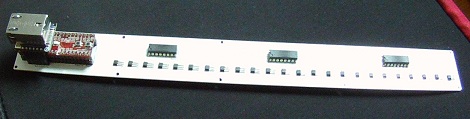
[Hanspeter]’s touchless ribbon controller uses an array of 24 Hall effect sensors that activate whenever a magnet mounted on a thimble is placed near a build. These sensors go to an ARM-equipped Maple Mini to record multitouch events and send them out over Ethernet.

Even though [Hanspeter] is only using his “multi-touchless ribbon sensor” as a theremin, there’s no reason why it couldn’t be put to other uses. It’s entirely possible to place several of these magnetic sensors in an array and build a real Minority Report interface where the user interacts with a computer without touching anything.

After the break is a video demo showing off how much control [Hanspeter] can get with the thimble/magnet setup. There’s also a few demo songs made with SuperCollider showing off a trio of sitar/Moog/harpsichord synths.

Continue reading “Theremin Takes The Touch Out Of Multitouch”