The Fart Box, A Synthesizer Not Quite Like Others

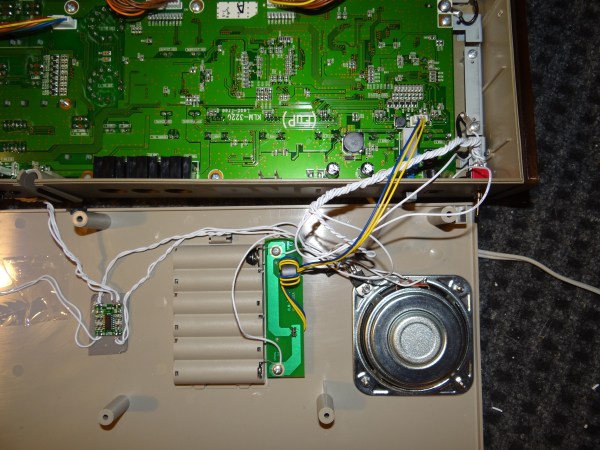
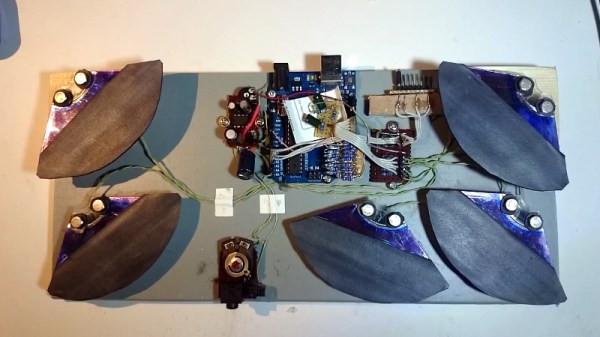
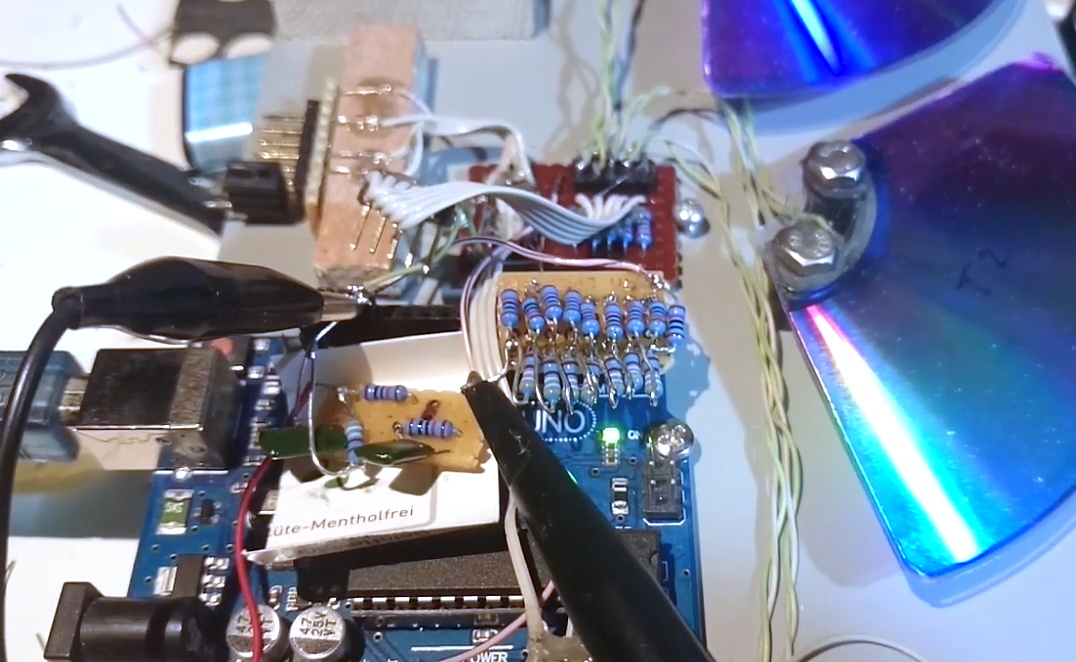
[lookmumnocomputer] enjoys creating synthesizers, and early last year he created one called The Fart Box. It is an entirely analog synthesizer with which, according to its creator, it is difficult to make anything that doesn’t sound gassy. It’s not quite like any other synthesizer, and while it is capable of acting like a regular analog synth it is never very far from cranking out farty sounds.

One may think this is just a gimmick, but it can actually be quite musical. There’s a good demonstration at the 7:09 mark in the video of what it can do. Entirely hand-made, it’s definitely a labor of love. There’s a bill of materials and a wiring diagram (of a sort) for anyone who is interested in such details, but it looks like it was a limited run only. [lookmumnocomputer]’s whole video is embedded below, and he demonstrates its ability to act more like a “normal” synthesizer around 8:30.

Continue reading “The Fart Box, A Synthesizer Not Quite Like Others”

Rubber Bands Can Secure Your Sanity

One of the greatest joys of being a child was figuring out that rubber bands make awesome sounds when they are plucked, and that the sound is easily changed by stretching the band to different lengths. For those of us who need firsthand experience to truly understand how the world works, these types of self-discovery are a pretty great way to learn about physics.

If you’re looking to build a physical music lesson or musical physics lesson into your burgeoning home school curriculum, look no further than the junk drawer, the broom closet, and the 3D printer. [Ham-made] used to stretch his bands across an empty tissue box, but came up with a much more professional implementation based on a broom handle. Check out this fat sound!

You don’t even need to find a spare broom handle, because none of this is permanent — the headstock piece with the hooks is meant to slide up and down to create cool sounds, and the tailpiece threads on in place of the broom bristles. Inside the tailpiece is a piezo disk and a 1/4″ jack so you can plug it in to your amp stack and start an impromptu jazz group. Just keep it under 10 people, okay?

You’ll need to mic your chanteuse, so keep the physics fun going with this plastic cup microphone.

Sweet Streams Are Made Of These: Creating Music On The Command Line

There are countless ways to create music. In the simplest form, it won’t even require any equipment, as evidenced by beatboxing or a capella. If we move to the computer, it’s pretty much the same situation: audio programming languages have been around for as long as general-purpose high-level languages, and sound synthesis software along with them. And just as with physical equipment, none of that is particularly necessary thanks to sed. Yes, the sed, the good old stream editor, as [laserbat] shows in her music generating script.

Providing both a minified and fully commented version of Bach’s Prelude 1 in C major as example, [laserbat] uses a string representation of the sheet music as the script’s starting point, along with a look-up table of each transformed note’s wavelength. From here, she generates fixed length PCM square wave signals of each of the notes, to be piped as-is to the sound card via ALSA’s aplay or SoX’s play. To keep things simple enough, she stays within the region of printable characters here, using space and tilde as low and high values respectively, providing highest possible volume at the same time this way.

The concept itself is of course nothing new, it’s how .au and .wav files work, as well as these little C lines. And while the fixed note duration takes away some of the smoothness in [laserbat]’s version, adding variable duration might just be a hint too much for a sed implementation, although we’ve certainly seen some more complex scripts in the past.

[via r/programming]

Patterned Plywood Makes For Attractive Speakers

In the matter of audio, we’re well past the reign of the home hi-fi and the boombox. If you’re not listening on headphones or directly on your phone, you’ve got a brick-sized Bluetooth speaker pumping out the tunes. Still a fan of the old-school, [Amanda Ghassaei] built some bookshelf speakers with a hip aesthetic.

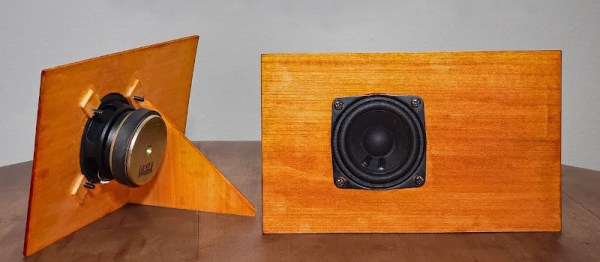
First, the speaker enclosures were designed in WinISD, a software package specifically made for the task. For given woofers and tweeters, it helps get the enclosure and port sizes in the correct range for good sound. Panels were then fabricated out of plywood to make the enclosures. The plywood was cut and reformed several times to make the panels, using the pattern from the multiple plies to create the zig-zag look. Audio wise, a class D amplifier takes in line-level signals, before pumping them out to a woofer and tweeter through a custom designed crossover network.

It’s a tidy build, and we’d love to experiment ourselves with the fancy patterned plywood technique. Getting your enclosure design right can make a big difference to sound quality, as we’ve seen before. Video after the break.

Continue reading “Patterned Plywood Makes For Attractive Speakers”

A Tin Can Phone, But With Magnets

The tin can phone is a staple of longitudinal wave demonstrations wherein a human voice vibrates the bottom of a soup can, and compression waves travel along a string to reproduce the speaker in another can at the other end. All the parts in this electrical demonstration are different, but the concept is the same.

Speakers are sound transducers that turn electrical impulses into air vibrations, but they generate electricity when their coil vibrates. Copper wires carry those impulses from one cup to another. We haven’t heard of anyone making a tin can phone amplifier, but the strictly passive route wasn’t working, so an op-amp does some messy boosting. The link and video demonstrate the parts and purposes inside these sound transducers in an approachable way. Each component is constructed in sequence so you can understand what is happening and make sense of the results.

Can someone make a tin can amplifier transformer? We’d like to see that. In another twist of dual-purpose electronics, did you know that LEDs can sense light?

Continue reading “A Tin Can Phone, But With Magnets”

Adora-BLE Synth Wails Without Wires

Isn’t this the cutest little synth you ever saw? The matching sparkly half-stack amp really makes it, visually speaking. But the most interesting part? There’s not a wire in sight, ’cause [Blitz City DIY]’s futuristic rig sends the bleep boops over Bluetooth LE.

Hardware-wise, both the synth and the amp are fairly simple. Underneath each of those cute little printed keys is one of those clicky momentaries that usually come with bright button caps in primary colors — the keys themselves just press-fit over the tops. All twelve ebonies and ivories are connected up to an Adafruit Feather, which communicates over Bluetooth LE to a CircuitPlayground Bluefruit (CPB) in the amp. Each time a note is played on the synth, its corresponding color circles comet-like around the CPB’s NeoPixels, which shine through the amp’s speaker grille.

The super interesting part is that all the hard work is happening in the code. Both boards have the same array of colors in rainbow order, and the CPB has an array of tone frequencies that match up one for one with the colors. For every note played, the CPB looks up the color, swirls it, and plays the note. If you want to build one, this project is wide open — [Blitz City DIY] even made a learn guide with all the dirty details. Be sure to check out the demo and extended walk-through after the break.

More in the market for making a computer keyboard? Just grab the nearest ESP32.

Continue reading “Adora-BLE Synth Wails Without Wires”

A 3D-Printed Bass Guitar

A visit to the hardware hacking area of the recent Hacker Hotel hacker camp in the Netherlands would bring plenty of interesting pieces of hardware to delight the eye. Among them though was one to delight the ear, and on hearing it we asked whether its creator could put it online so we could share it with you. [XDr4g0nX]’s bass guitar is 3D printed, and while it still contains some non-3D-printed parts it’s still a very effective musical instrument.

This is not the first model he’s produced, he told us, an earlier guitar was entirely 3D-printed but proved not to be rigid enough. Tuning such an instrument merely resulted in its bowing out of shape and becoming unplayable as well as out of tune. This one has hefty steel bars for rigidity, though it uses a Yamaha neck rather than 3D-printing the whole instrument.  The main body of the instrument has to be printed in multiple parts and epoxied together, which he’s done without some of the ugly seams that sometimes disfigure prints of this nature.

Having heard it, we’d be hard pressed to tell it wasn’t a more traditional guitar, but then again since people have made guitars from all kinds of scrap it’s not the first home build we’ve encountered.