Very, Very Tiny X86 Systems

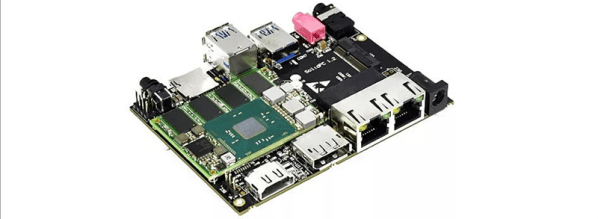
The most interesting market for Intel in recent years has been very, very small form factor PCs. ARM is eating them alive, of course, but there are still places where very small and very low power x86 boards make sense. The latest release from SolidRun is the smallest we’ve seen yet. The SolidPC Q4 is one of the smallest x86 implementation you can find. It’s based around the MicroSoM, a module even smaller than a Raspberry Pi, and built around a carrier board that has all the ports you could ever want from the tiniest PC ever.

The SolidPC Q4 is technically only a carrier board featuring a microSD slot, Displayport, HDMI 1.4B, two RJ45 ports with the option for PoE, three USB 3.0 Host ports, jacks for mic and stereo sound, and an M.2 2230 connector for a wireless module. The interesting part of this launch is the MicroSoM, a System on Module based on Intel’s Braswell architecture. Two models are offered, based on the quad-core Atom E8000 and the Pentium N3710. Both modules feature up to 8GB of DDR3L RAM and 4GB of eMMC Flash.

The interesting part of this launch is the MicroSoM, a System on Module based on Intel’s Braswell architecture. Two models are offered, based on the quad-core Atom E8000 and the Pentium N3710. Both modules feature up to 8GB of DDR3L RAM and 4GB of eMMC Flash. The size of these modules is 52.8mm by 40mm, or just a shade larger than the stick-of-gum-sized Raspberry Pi Zero.

The SolidPC isn’t intended to be a Raspberry Pi competitor. While those cheap ARM boards are finding a lot of great uses in industry, they’re no replacement for a small, x86 single board computer. The pricing for this module starts at $157 according to the product literature, with a topped out configuration running somewhere between $300 and $350, depending on options like a heatsink, enclosure, or power adapter. If you want a small single board computer with drivers for everything, there aren’t many other options: you certainly wouldn’t pick a no-name Allwinner board.

Qualcomm Looks To Gobble Up NXP

Remember when we talked about NXP merging with Freescale to move into the top ten semiconductor companies? Yeah, that was just eighteen months ago and just barely closed before the new year. Now it looks like Qualcomm wants to acquire NXP to the tune of $30 billion.

You’re most likely familiar with Qualcomm as a cellphone silicon company. The acquisition of NXP opens up a lot of additional markets with their portfolio of chips — automotive among them thanks to the Freescale merger. Now you should be asking yourself just how big Qualcomm is already. What’s perhaps most interesting is that, as mostly a wireless chip company, Qualcomm is ranked number three in worldwide semiconductor sales. Adding NXP — a behemoth now in the top ten — adds at least 30% to Qualcomm’s numbers.

And so here we are, one step close to a monolithic chip fab that produces all computing power for the human race. Yippie!

Amazon Offers $2.5M To Make Alexa Your Friend

Amazon has unveiled the Alexa Prize, a $2.5 Million purse for the first team to turn Alexa, the voice service that powers the Amazon Echo, into a ‘socialbot’ capable of, “conversing coherently and engagingly with humans on popular topics for 20 minutes”.

The Alexa Prize is only open to teams from colleges or universities, with the winning team taking home $500,000 USD, with $1M awarded to the team’s college or university in the form of a research grant. Of course, the Alexa Prize grants Amazon a perpetual, irrevocable, worldwide, royalty-free license to make use of the winning socialbot.

It may be argued the Alexa Prize is a competition to have a chat bot pass a Turning Test. This is a false equivalency; the Turing Test, as originally formulated, requires a human evaluator to judge between two conversation partners, one of which is a human, one of which is a computer. Additionally, the method of communication is text-only, whereas the Alexa Prize will make use of Alexa’s Text to Speech functionality. The Alexa Prize is not a Turing Test, but only because of semantics. If you generalize the phrase, ‘Turing Test’ to mean a test of natural language conversation, the Alexa Prize is a Turing Test.

This is not the first prize offered for a computer program that is able to communicate with a human in real time using natural language. Since 1990, the Loebner Prize, cosponsored by AI god Marvin Minsky, has offered a cash prize of $100,000 (and a gold medal) to the first computer that is indistinguishable from a human in conversation. Since 1991, yearly prizes have been awarded to the computer that is most like a human as part of the competition.

For any team attempting the enormous task of developing a theory of mind and consciousness, here are a few tips: don’t use Twitter as a dataset. Microsoft tried that, and their chatbot predictably turned racist. A better idea would be to copy Hackaday and our article-generating algorithm. Just use Markov chains and raspberry pi your way to arduino this drone.

Earliest Recorded Computer Music Restored

You want old skool electronic music? How about 1951?

Researchers at the University of Canterbury in New Zealand have just restored what is probably the oldest piece of recorded, computer-generated music. Recorded in 1951, the rendition of “God Save The King”, “Baa-Baa Black Sheep” and “In The Mood” was produced by a computer built by none other Alan Turing and other researchers at the Computing Machine Research Laboratory in Manchester.

These phat beats were captured by the BBC for broadcast on an acetate disk that the researchers found in an archive. They sampled and restored the recording, fixing the rather poor quality recording to reproduce the squawky tones that the computer played. You can hear the restored recording after the break.

It halts apparently unexpectedly in the middle of a stanza, sounds essentially horrible, and goes out of tune on the higher notes. But you gotta learn to crawl before you can walk, and these are the equivalent of the grainy 8mm films of baby’s first steps. And as such, the record is remarkable.

Via ABC News

Continue reading “Earliest Recorded Computer Music Restored”

808 Drum Machine In An ATTiny 14-Pin Chip

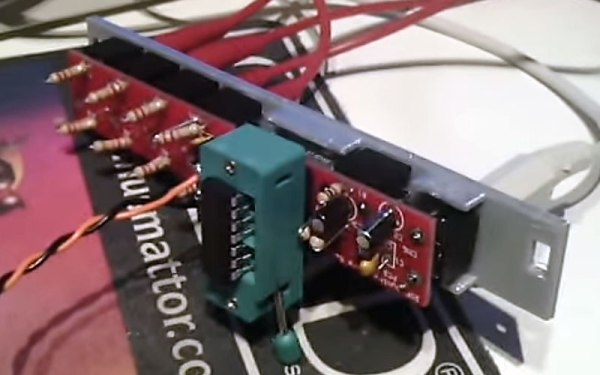
You may not know the 808 drum machine, but you have definitely heard it: the original Roland TR-808 was the first programmable drum machine and has been a mainstay of electronic music ever since. Hackers have been building their own versions of this vintage device for years, but this version from do-it-yourself synth builder [Jan Ostman] is quite remarkable.

He’s packed the entire device (called the Drum8 Vintage) into a single ATtiny84 14-pin DIP package, including the samples and eight polyphonic voices, plus old-school analog CV triggers, a global tune and an analog global accent input. That won’t mean a lot to non-musicians, but suffice to say that these are the same inputs that the original TR-808 had that allowed you to do all sorts of interesting stuff to trigger and modify the drum sounds. Plus some extras.

[Jan] is offering the chip itself for $20, and has made a limited edition version that is built into a patch bay panel for that genuine hard-wired look for $99. If you want to go the home-made route and make your own, he’s released the source code and schematics for making your own. You can check out more of [Jan’s] work in this post on making your own open-source instruments from Elliot. Thanks, Jan!

3D Printed Acoustic Holograms: Totally Cool, Not Totally Useless

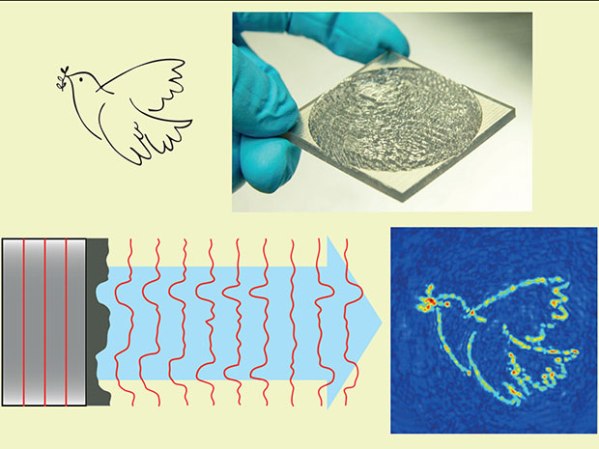
If you wave your hand under the water’s surface, you get a pattern of ripples on the surface shortly thereafter. Now imagine working that backwards: you want to produce particular ripples on the surface, so how do you wiggle around the water molecules underneath?

That’s the project that a crew from the University of Navarre in Spain Max Planck Institute for Intelligent Systems undertook. Working backwards from the desired surface waves to the excitation underwater is “just” a matter of math and physics. The question is then how to produce the right, incredibly irregular, wavefront. The researchers’ answer was 3D printing.

The idea is that, by creating the desired ripples on the water’s surface, the researchers will be able to move things around. We’ve actually seen this done before in air by [mikeselectricstuff], and a more sophisticated version from the University of Navarre in Spain uses multiple ultrasonic transducers and enables researchers to move tiny objects around in mid-air.

What’s cool about the work done underwater by the Navarre Max Planck Institute group is that all they’re doing is printing out a 3D surface and wiggling it up and down to make the waves. The resulting surface wave patterns are limited in comparison to the active systems, but the apparatus is so much simpler that it ought to be useful for hackers with 3D printers. Let the era of novelty pond hacking begin!

Don’t Like The FAA’s Drone Registration? Sue Them!

When the US Federal Aviation Administration (FAA) began requiring registration of quadcopters (“drones”) in the US, it took a number of hobbyists by surprise. After all, the FAA regulates real 747s, not model airplanes. [John Taylor], an RC hobbyist, has done what you do when faced with a law that you believe is unjust: he’s filed a lawsuit in the DC District Court, claiming that the FAA has overstepped their mandate.

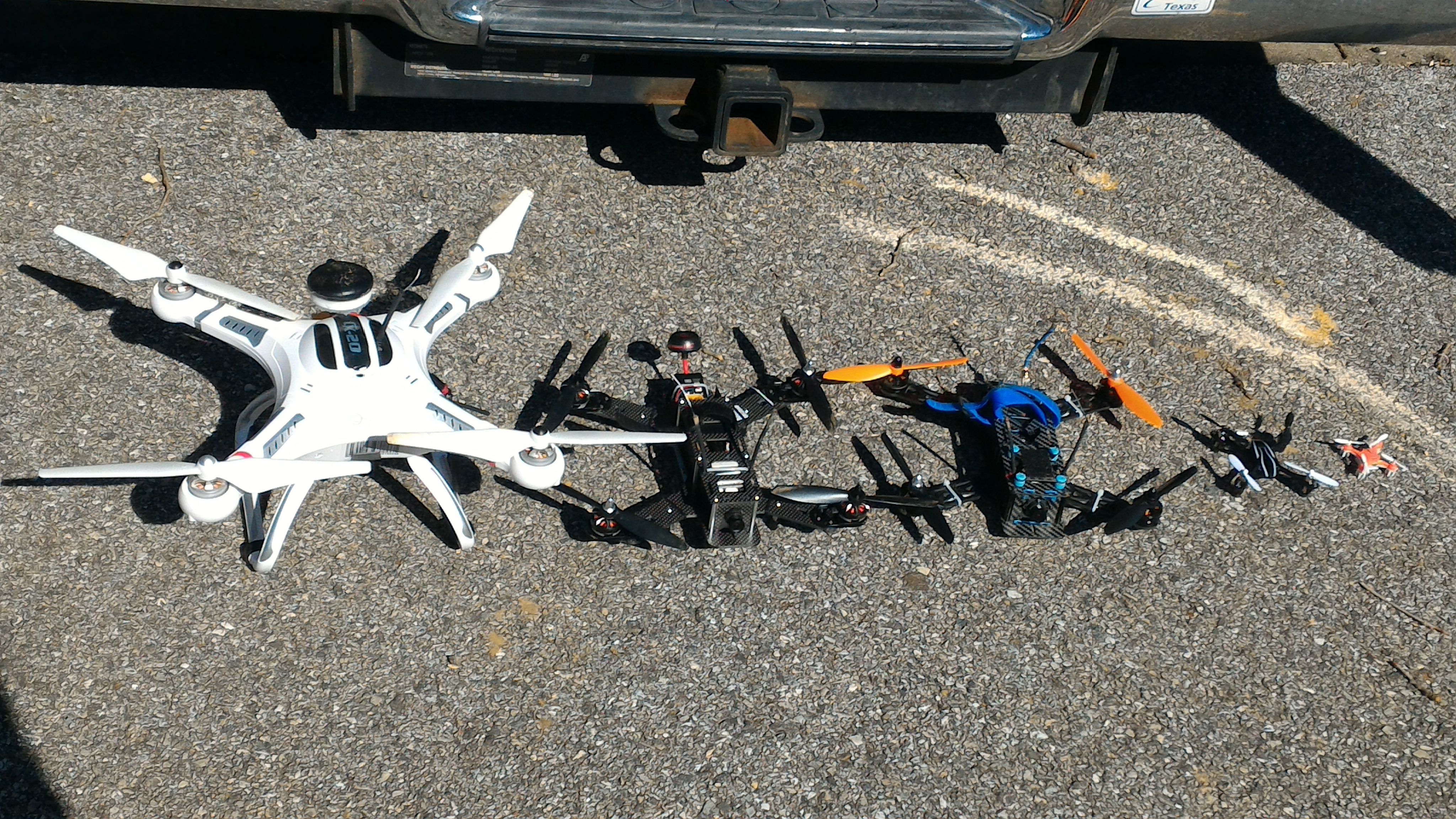
Which one is the "aircraft"?
Which one is the “aircraft”?

The lawsuit will hinge (as legal battles often do) on the interpretation of words. The FAA’s interpretation of quadcopters to be “aircraft” rather than toys is at the center of the dispute. Putting hobbyists into a catch-22, the FAA also requires recreational RC pilots to stay under a height of 400 feet, while requiring “aircraft” to stay above 500 feet except for emergencies, take-off, or landing. Which do they mean?

The editorial staff at Hackaday is divided about whether the FAA ruling makes no sense at all or is simply making hobbyists “sign their EULA“. This writer has spent enough time inside the Beltway to know an expanse of a mandate when he sees it, and no matter which body of the US government is to blame, regulating toy planes and helicopters as if they were commercial aircraft is an over-reach. Even if the intentions are benign, it’s a poorly thought-out ruling and should be revisited.

If you agree, you now have the chance to put your money where your mouth is. The DC Area Drone User Group is putting together a legal defense fund to push [Taylor]’s case. Nobody would be cynical enough to suggest that one can buy the legal system in the US, but, paraphrasing Diamond Dave, it sure as heck can buy a good enough lawyer to get the law changed.