C++ Turns 30 – Looking Forward To The Future

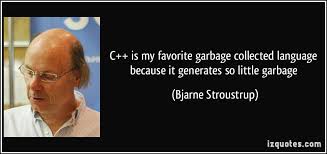
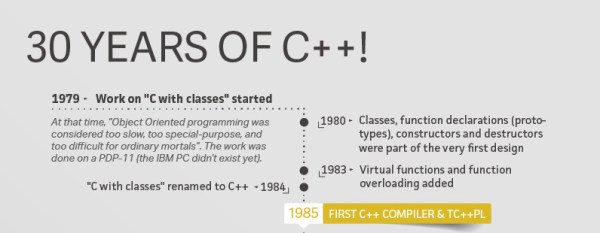
[Bjarne Stroustrup] introduced C++ to the world on Monday 14th October 1985 at the ACM annual conference on “The Range of Computing”. On its 30th anniversary [Bjarne] reviewed the history, his experience, and his thoughts on the future of the language in an interview. Also on that day the first edition of his book, “The C++ Programming Language” was released. It’s now available in a 4th edition. The title differed only in the “++” from the classic C book by [Kernighan] and [Ritchie] that graced the desktops of a multitude of C programmers.

The first versic++ bjarneons of C++ were compiled with CFront, a compiler that generated C code which was then compiled as normal. Around the 1990s, it’s unclear when, numerous native compilers became available, notably for PCs, which lead to explosive growth from 400,000 users to an estimated 4.4 million today.


One of the frustrations [Stroustrup] expresses is how C++ is viewed by developers,

… a problem that has plagued C++ forever: Poor teaching and poor understanding of C++ even among its practitioners. There has always been a tendency to describe C++ as some odd variant of something else.

Soon the standards committee is meeting to discuss C++17 in Hawaii. Fair winds and bright skies look to be in the future of C++.

You Might Want To Buy A Quadcopter Now

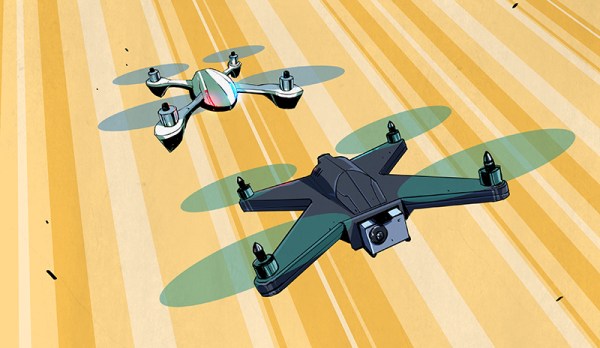
NBC News has reported the US Government may implement regulations in the coming days that would require anyone who buys an unmanned aircraft system to register that device with the US Department of Transportation.

The most simplistic interpretation of this news is that anyone with a DJI Phantom or a model aircraft made out of Dollar Tree foam board would be required to license their toys. This may not be the case; the FAA – an agency of the US DoT – differentiates between unmanned aircraft systems and model aircraft.

This will most likely be the key thing to watch out for in any coming regulation. The FAA defines model aircraft as, “an unmanned aircraft that is capable of sustained flight in the atmosphere; flown within visual line of sight of the person operating the aircraft; and flown for hobby or recreational purposes.” Additionally, the FAA may not make any regulations for model aircraft. While this means planes and quads flown without FPV equipment may be left out of this regulation, anything flown ‘through a camera’ would be subject to regulation.

Intel And Arduino Introduce Curie-Based Educational Board

This week, Intel and Arduino are releasing their first product pushed directly on the education market, the Arduino/Genuino 101 board powered by the Intel Curie module.

The Intel Curie Module
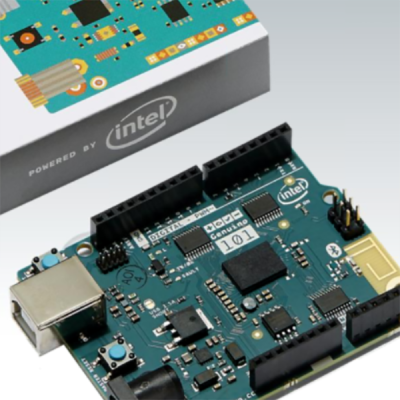
genuino101The Arduino/Genuino 101 is the first development platform for the Intel Curie modules which are a recent development from Intel’s Maker and Innovator group. The button-sized Curie is a single package encapsulating microcontroller, Bluetooth, a 6-DOF IMU, and battery charging circuitry; the requisite hardware for anything marketed as a ‘wearable’. The Curie’s brain is a 32-bit Intel Quark microcontroller with 384kB of Flash 80kB SRAM, giving it about the same storage and RAM as a low-end ARM Cortex microcontroller.

Called a module, it needs a carrier board to interface with this hardware. This is where the Arduino/Genuino 101 comes in. This board – the third such collaboration between Intel and Arduino – provides the same form factor and pinout found in the most popular Arduino offering. While the Curie-based Arduino/Genuino 101 is not replacing the extraordinarily popular Arduino Uno and Leonardo, it is going after the same market – educators and makers – at a similar price, $30 USD or €27. For the same price as an Arduino Uno, the Arduino/Genuino 101 offers Bluetooth, an IMU, and strangely the same USB standard-B receptacle.

Intel has further plans in store for the Curie module; In 2016, Intel, [Mark Burnett] of reality television fame, and United Artists Media group will produce America’s Greatest Makers, a reality show featuring makers developing wearable electronics on TV. No, it’s not Junkyard Wars, but until the MacGyver reboot airs, it’s the closest we’re going to get to people building stuff on TV.

Intel’s Prior Arduino Offerings

In 2013, Intel and Arduino introduced the Galileo board, a dev board packed with I/Os, Ethernet, PCIe, and an Intel instruction set. This was a massive move away from all ARM, AVR, or PIC dev boards made in recent years, and marked Intel’s first foray into the world of education, making, and an Internet of Things. In 2014, Intel and Arduino released the Edison, a tiny, tiny board designed for the embedded market and entrepreneurs.
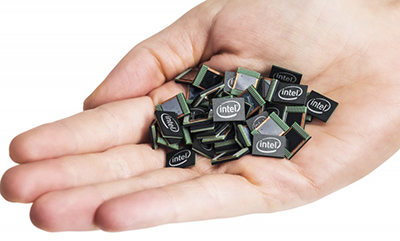
Intel CurieThe Arduino 101 and Genuino 101 – different names for the same thing and the first great expression of arduino.cc’s troubles with trademarks and the Arduino vs Arduino war – are targeted specifically at the ‘maker’ market, however ephemeral and hard to define that is. The form of the Arduino 101 follows directly in the footsteps of the Arduino Uno and Leonardo; The 101 has the same footprint, the same pinout, a single USB port as the Leonardo.

Being the ‘maker market Arduino’, this board is designed to bring technology to the classroom. In a conference earlier this week, [Massimo] framed the Arduino 101 as the educational intersection between technology, coding, art, and design. Students who would not otherwise learn microcontroller development will learn to program an Arduino for art and design projects. The Arduino/Genuino 101 is the board that puts the STEAM in STEM education.

Where the Curie is Going

Intel has big plans for the Curie module, with a few products in the works already. The Intel Edison has made its way into consumer electronics and wearables, including an electronic ski coach that will tell you when to pizza and when to french fry. The Curie will be available independently of the Arduino/Genuino 101, with both products being released in early 2016.

Flying High With Zynq

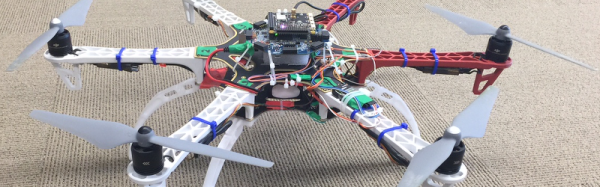
[Aerotenna] recently announced the first successful flight of an unmanned air vehicle (UAV) powered by a Xilinx Zynq processor running ArduPilot. The Zynq is a dual ARM processor with an onboard FPGA that can offload the processor or provide custom I/O devices. They plan to release their code to their OcPoC (Octagonal Pilot on a Chip) project, an open source initiative that partners with Dronecode, an open source UAV platform.

Continue reading “Flying High With Zynq”

Graphene Grown On Semiconductors Big Step Toward Manufacturability

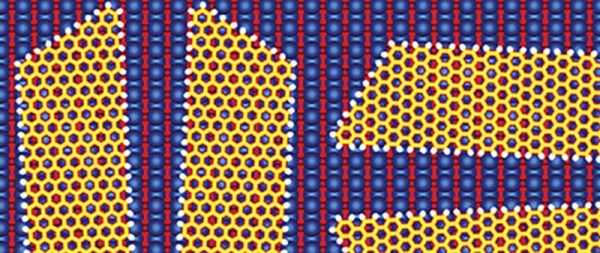
No modern technology has been met with more hype than graphene. These single-layer sheets of carbon promise everything from incredibly efficient power grids to more advanced electronics to literal elevators to space. Until now, though, researchers have yet to produce graphene sheets or ribbons in a reliable way. Researchers at the University of Wisconsin at Madison and the US Department of Energy Argonne National Laboratory have done just that, growing graphene nanoribbons on the surface of a germanium crystal.

By using a germanium crystal as a substrate, the researchers have found a directionality to the way these graphene nanoribbons form. This has been a problem for researchers experimenting with graphene microelectronics in the past; labs experimenting with making transistors out of carbon nanotubes found growth is highly unpredictable. The controlled growth of graphene nanoribbons opens the door to more precise fabrication, something that is necessary for microelectronics fabrication.

Synthesis of nanoribbons this small have not been possible before. Because germanium itself is a semiconductor – and was used for the first transistor – this discovery may pave the way for the creation of graphene-based circuits grown using the same semiconductor fabrication processes used today.

Skarp Laser Razor Kickstarter Suspended, Jumps To Indiegogo

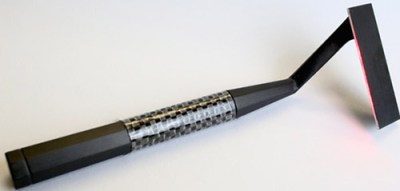
An irritation-free razor that gives a close shave has been a dream for thousands of years. [Gillette] came close, and with multiple blades came even closer, but all razors today are still just sharpened steel dragged across the skin. This is the 21st century, and of course there’s a concept for a laser razor pandering for your moola. We recently covered the Skarp laser razor and its Kickstarter campaign, and today the campaign has been shut down.

The email sent out to all contributors to the Skarp campaign follows:

Hello,

This is a message from Kickstarter’s Integrity team. We’re writing to notify you that the Skarp Laser Razor project has been suspended, and your pledge has been canceled.

After requesting and reviewing additional material from the creator of the project, we’ve concluded that it is in violation of our rule requiring working prototypes of physical products that are offered as rewards. Accordingly, all funding has been stopped and backers will not be charged for their pledges. No further action is required on your part. Suspensions cannot be undone.

We take the integrity of the Kickstarter system very seriously. We only suspend projects when we find evidence that our rules are being violated.

Regards, Kickstarter Integrity Team

It only took eight hours for the Skarp team to relaunch their crowdfunding campaign on Indiegogo. As of this writing, over 900 people (ostensibly from the 20,000 backers of the original Kickstarter campaign) have pledged to the new campaign.

Although we will never know exactly why Kickstarter suspended the original Skarp campaign, the reason given by the Kickstarter Integrity Team points to the lack of a working prototype, one of the requirements for technology campaigns on Kickstarter. Interestingly, Skarp did post a few videos of their razor working. These videos were white balanced poorly enough to look like they were filmed through green cellophane, a technique some have claimed was used to hide the actual mechanism behind the prototype’s method of cutting hair. A few commenters on the Skarp Kickstarter campaign – and here on Hackaday – have guessed the Skarp prototype does not use lasers, but instead a heated length of nichrome wire. While this would burn hair off, the color of the wire would be a dull red when filmed in any normal lighting conditions. It is assumed the poor quality of the Skarp prototype videos is an attempt to hide the fact they do not have a working prototype.

The Skarp laser razor. Source

Skarp’s move to Indiegogo has been lauded by some – mostly in the comments section of the Indiegogo campaign – and has been derided on every other forum on the Internet. Indiegogo is commonly seen as the last refuge of crowdfunding scam artist, but there are a few legitimate reasons why a campaign would choose to go to Indiegogo. Kickstarter is not available for campaign founders in all countries, and for some, debiting a card immediately, instead of after the campaign end like Kickstarter does, is a legitimate crowdfunding strategy.

But for a crowdfunding campaign to be suspended on Kickstarter and immediately move to Indiegogo? This almost never ends well. One of the most famous examples, the Anonabox, had its Kickstarter campaign suspended after it was found the creator was simply rebadging an off-the-shelf router. The Anonabox then moved over to Indiegogo where it raised over $80,000. Already the campaign for the Skarp Laser Razor has raised $135,000 USD from Indiegogo, after having its Kickstarter campaign raised over $4 Million. No, Skarp won’t be one of the most successful technology Kickstarter campaigns of all time. We can only hope it won’t be one of Indiegogo’s most successful campaigns.

Makerbot Has Now Cut 36% Of Staff In Last 6 Months

The CEO of Makerbot, [Jonathan Jaglom] announced this week a massive reorganization. Twenty percent of the staff will be laid off, management will be changed, an office will be closed, and perhaps most interestingly, the production of 4th generation of Makerbots will be outsourced to contract manufacturers.

This news comes just months after Makerbot announced its first 20% reduction in staff, and follows on the heels of a class action suit from investors. These are troubling times for Makerbot.

So Goes Makerbot, So Goes The Industry

In the last six months, Makerbot has closed all three of its retail locations in Manhattan, Boston, and Greenwich, CT. It has moved out of one of its office buildings in Industry City, Brooklyn as the company faces a class action suit from investors for possible securities violations. These are by any measure troubling times for anyone at Makerbot.

The 3D printing industry has been forced through the rollercoaster of the hype cycle in the last few years, and where Makerbot goes, media coverage and public perception of 3D printing goes with it. According to pundits, we are now deep in the doldrums of the trough of disillusionment. No one wants to make their own parts for their washing machine, it is said, and 3D printers are finicky devices with limited utility.

Despite these pundits’ projections, the 3D printing industry doubled in 2015. Multiple manufacturers of sub $5000 machines are going gangbusters, and seeing the biggest revenues in the history of their respective companies. By any measure except the one provided by Makerbot, we are still in an era of a vast proliferation of 3D printing.

Makerbot, for better or worse, is a bellweather, and public perception and media attention is highly dependant on the success of Makerbot. The Verge writes – incorrectly – “…The consumer 3D-printing market’s rise has slowed”, and Business Insider writes ‘consumers are beginning to lose interest.’ These are not statements backed up by facts or statistics or even hearsay; they are merely a reflection of the consumer’s disinterest in Makerbot and not of the 3D printing industry of the whole.

Unfortunately, we will not know the extent of how bad it is at Makerbot until Stratasys releases its 2015 financial report sometime in early March next year. Wohlers Report 2016, the definitive guide to the 3D printing industry, will be released sometime around May of next year. Keep one thing in mind: Makerbot did not build the 3D printing industry, and the public perception of Makerbot does not necessarily translate to the public perception of 3D printing.