
We’re really sorry to have missed GLOW. It was a unique all-night art and music event that took place the evening of July 19, 2008, in Santa Monica, and lasted until dawn. We were most intrigued by [Shih Chieh Huang]’s haunting robotic sculptures. They were eerily beautiful, and appeared to be alive and “breathing”. He took some unusual materials – plastic bags and bottles, computer fans and circuit boards, among others, and combined them all to give the creatures otherworldly auras. Simultaneously familiar and strange, the sculptures are designed to evoke marine life, yet they’re completely different, in both materials and structure. More coverage and pictures of the event can be found at LAist, NOTCOT, and on Flickr.
News3658 Articles
Hacking At Random 2009
Hacking At Random 2009 has recently been announced. It’s brought to you by the same people who held the outdoor hacking event What The Hack, which we covered in 2005. Date, location, and many other details are still up in the air. They’re looking to host 3000 attendees and we’re guessing it will be similar in nature to last Fall’s incredible Chaos Communication Camp near Berlin. 2009 will also feature the beta run of outdoor hacker event ToorCamp near Seattle. Two great events we’re certainly looking forward to.
[photo: mark]
Annoy Your Friends With High Pitched Noise
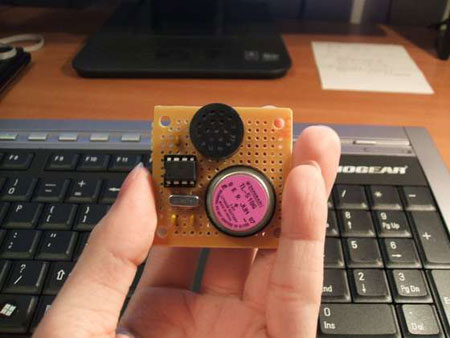
[Hungry_Myst] has put together this fantastic device to annoy your friends. It randomly emits high pitched sounds, then stops for a while to make it very hard to locate. He has added an extra level of annoyance by putting the noise in vicinity of 17KHz thus making it almost undetectable by people over the age of 30. The fact that not everyone in the room can hear it makes people go even crazier trying to find it.
The parts list is fairly short, and the directions concise. One thing that is fantastic about this article is that he encourages people to improve it. That alone is not a huge deal, but he mentions in several areas specific additions that would make it more user friendly: on/off, pitch control, and delay control.
Related: [jay]’s Picaxe based Brain Assailant
ReWalk Suit For Paraplegics
We here at Hack a Day are really interested in power suits, so the ReWalk suit for paraplegics immediately caught our attention. By using unique robotic control algorithms, the suit works with the user rather than for the user. This allows the user to experience the sensation of walking autonomously and a chance at a normal life. Argo, the design company, also claims that a suit like this will end up saving the user money considering the high price of medical and transportation equipment. The core design is not entirely new. It has a batterypack and DC motors placed at the joints. The wearer uses crutches and the sensors and software monitor upper body movement to predict when and where the user wants to move their leg.
[via Medgadget]
The Next HOPE Announced

Against all previous indications-including being called The Last HOPE-the conference will not only be returning in 2010, it will be at the Hotel Pennsylvania. We’re looking forward to The Next HOPE, which will probably followed by The Last HYPE, which in turn will be followed by: We’re Super Serious This Is The Last HOPE.
OpenMoko Usability Review
[Dave Fayram] has put out two videos covering the interface of the FreeRunner from OpenMoko. For those unfamiliar, we’ve covered it a few times before. It is an opensource mobile platform that includes a full X server. They encourage people to make their own software and even release the CAD files for chassis modification.
He points out some glaring faults and compares it to his iPhone. Some of the major faults he has listed and shown are:
- Bezel around screen makes input difficult.
- Extremely slow interface
- Can’t play mp3s.
- On screen keyboard is tiny.
It is marketed at around $400 so the comparison to an iPhone seems legitimate. We do need to keep in mind, however, that the FreeRunner is opensource. The more support we show to them, the better it will get. The thought of an opensource handheld platform, comparable to an iPhone is quite enticing. At this point though, the comparison is pretty one sided. Hopefully more software development and support from the community will make this device something to get very excited about.
[via Daring Fireball]
HOPE 2008: Wikiscanner 2.0

[Virgil] presented the next version of Wikiscanner at The Last HOPE today. To build the original Wikiscanner, he scanned the monthly database dump of anonymous edits and compared that against a purchased list of known company IP addresses. The 34.5 million edits account for nearly 21% of all edits. The idea was to unearth businesses and groups white washing critical pages. This only handles anonymous edits though. Users could log in to avoid having their IP reversed.
In the new version, [Virgil]’s team developed a Poor Man’s CheckUser. If you spend too much time editing a talk page, your session could end and when you hit save it attaches your IP. Most regular users will then log in and remove their IP. They found 13,000 username/IP address pairs by searching for IPs being removed and replaced with usernames. These are some of the most active users. Using this list, they could potentially uncover sockpuppets or potential collusion by top editors.









