We have all seen optimistic claims for electronic products that fail to match the reality, and [Electronic Wizard] is following one up in a recent video. Can a relatively small IGBT really switch 200 A as claimed by a dubious seller? Off to the datasheet to find out!
The device in question is from Toshiba, and comes in a TO-220 package. This itself makes us pause for a minute, because we suspect the pins on a TO220 would act more like fuses at a steady 200 A.
But in the datasheet, there it is: 200 A. Which would be great, but of course it turns out that this is the instantaneous maximum current for a few microsecond pulse. Even then it’s not finished, because while the continuous current is supposed to he half that, in the datasheet it specifies a junction temperature of 25 °C. The cooling rig required to maintain that with this transistor passing 200 A would we think be a sight to behold, so for all intents and purposes this can’t even switch a continuous 100 A. And the real figure is much less as you’d imagine, but it raises an important point. We blindly read datasheets and trust them, but sometimes we should engage brain before releasing the magic smoke.
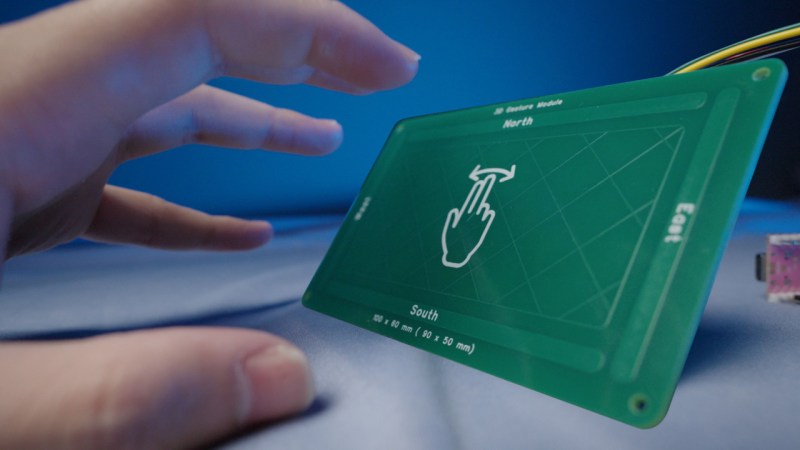
In today’s “futuristic tech you can get for $5”, [RealCorebb] shows us a gesture sensor, one of the sci-fi kind. He was doing a desktop clock build, and wanted to add gesture control to it – without any holes that a typical optical sensor needs. After some searching, he’s found Microchip’s MGC3130, a gesture sensing chip that works with “E-fields”, more precise than the usual ones, almost as cheap, and with a lovely twist.
The coolest part about this chip is that it needs no case openings. The 3130 can work even behind obstructions like a 3D-printed case. You do need a PCB the size of a laptop touchpad, however — unlike the optical sensors easy to find from the usual online marketplaces. Still, if you have a spot, this is a perfect gesture-sensing solution. [RealCorebb] shows it off to us in the demo video.
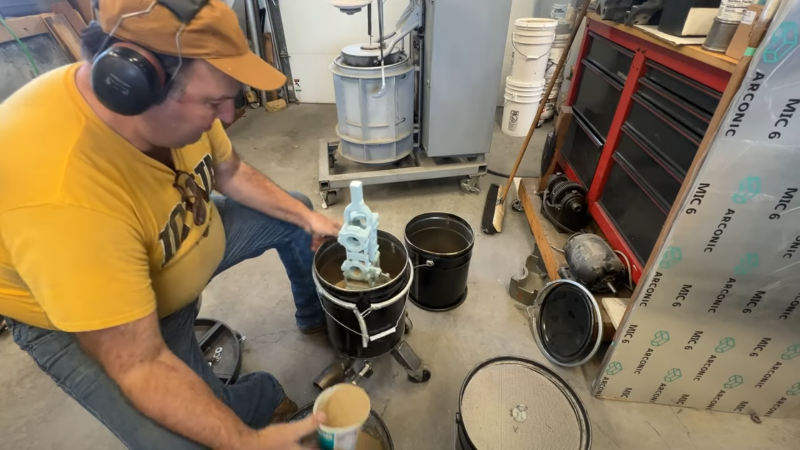
[Kelly Coffield] makes intake manifolds for old Ford throttle bodies for fun, demonstrating an excellent technique for making such things in the small shop. The mould patterns are CNC machined from a solid polystyrene block, with all the necessary gates to feed the aluminium into the mould. The principle is to introduce aluminium from a large central runner into the mould structure, which feeds the gates into the mould parts. The various foam mould components are then glued with an extra brace bar at the bottom to strengthen it.
Dip coating with a refractory slurry
The complete structure is then sprayed with surfactant (just plain old soapy water) and dip-coated in a refractory slurry. The surfactant adjusts the coating’s surface tension, preventing bubbles from forming and ruining the surface quality produced by this critical coating step.
Once a satisfactory coating has been applied and hardened, the structure is placed inside a moulding pan fitted with a pneumatic turbine vibrator, to allow sand to be introduced. The vibrations ease the flow of sand into all the nooks and crannies, fully supporting the delicate mould structure against the weight of the metal, and gases produced as the foam burns away. A neat offset pouring cup is then added to the top of the structure and packed in with more sand to stabilise it. It’s a simple setup that can easily be replicated in any hackerspace or backyard for those motivated enough. [Kelly] is using A356 aluminium alloy, but there’s no reason this technique won’t work for other metals.
It was amusing to see [Kelly] demould by just dumping out the whole stack onto the drive and throwing the extracted casting into a snow bank after quenching. We might as well use all that free Midwest winter cooling capacity! After returning to the shop, [Kelly] would typically perform any needed adjustments, such as improving flatness in the press, while the part was in the ‘as cast temper’ condition. We’ll gloss over the admission of cutting the gates off on the table saw! After these adjustments, the part is artificially aged to a T5-like specification, to give it its final strength and machinability properties. There are plenty more videos on this process on the channel, which is well worth a look.
Normally, when you want a low DC voltage from the AC line, you think about using a transformer of some kind. [RCD66] noticed that an AC monitor meter must have some sort of power supply but had no transformers in sight. That led to an exploration of how those work and how you can use them, too. You can watch the work in the video below.
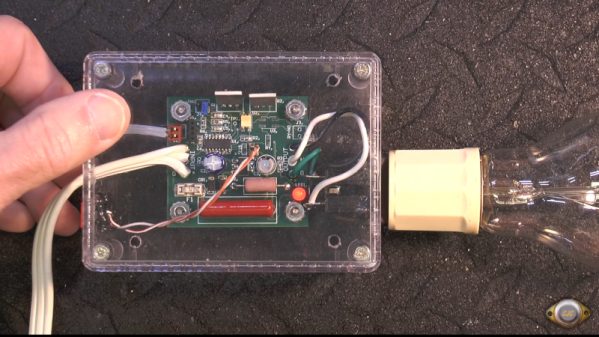
Sensibly, there is a transformer in the test setup — an isolation transformer to make it safe to probe the circuit. But there’s no transformer providing voltage changes. Isolation is important even if you are taking apart something commercial that might be trasformerless.
The circuit is simple enough: it uses a capacitor, a resistor, and a pair of diodes (one of them a zener diode). He uses this basic circuit to drive simple regulators with input and output filter capacitors. We’ve seen many variations on this design over the years.
You can’t draw a lot of power through this arrangement. But sometimes it is all you need. However, this is pretty dangerous, as we’ve discussed before. Be sure you understand exactly what the risks are before you decide to build something like this.
Fair warning: watching this hybrid manufacturing method for gear teeth may result in an uncontrollable urge to buy a fiber laser cutter. Hackaday isn’t responsible for any financial difficulties that may result.
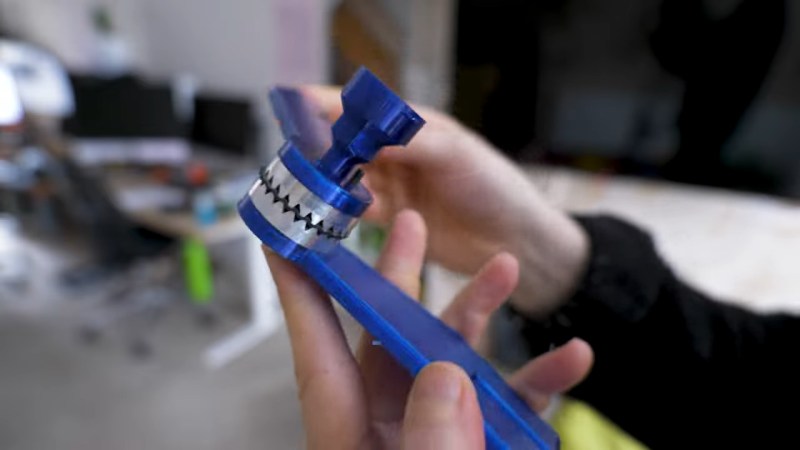
With that out of the way, this is an interesting look into how traditional machining and desktop manufacturing methods can combine to make parts easier than either method alone. The part that [Paul] is trying to make is called a Hirth coupling, a term that you might not be familiar with (we weren’t) but you’ve likely seen and used. They’re essentially flat surfaces with gear teeth cut into them allowing the two halves of the coupling to nest together and lock firmly in a variety of relative radial positions. They’re commonly used on camera gear like tripods for adjustable control handles and tilt heads, in which case they’re called rosettes.
To make his rosettes, [Paul] started with a block of aluminum on the lathe, where the basic cylindrical shape of the coupling was created. At this point, forming the teeth in the face of each coupling half with traditional machining methods would have been tricky, either using a dividing head on a milling machine or letting a CNC mill have at it. Instead, he fixtured each half of the coupling to the bed of his 100 W fiber laser cutter to cut the teeth. The resulting teeth would probably not be suitable for power transmission; the surface finish was a bit rough, and the tooth gullet was a little too rounded. But for a rosette, this was perfectly acceptable, and probably a lot faster to produce than the alternative.
In case you’re curious as to what [Paul] needs these joints for, it’s a tablet stand for his exercise machine. Sound familiar? That’s because we recently covered his attempts to beef up 3D prints with a metal endoskeleton for the same project.
The Tiny Tapeout custom ASIC project has been around for a while now, and has passed through several iterations of its production. On each Tiny Tapeout chip are multiple designs, each representing an individual project, and in use the chip is configured to present that project to its pins. Given enough Tiny Tapeout chips it was inevitable that someone whould eventually make a project using two such functions, and here’s [Sylvain Munaut] with an SDR using Tiny Tapeouts 6 and 7.
At its heart is [Carsten Wulff]’s 8 bit ADC from Tiny Tapeout 6, fed by [Kolos Koblász]’s Gilbert cell RF mixer from Tiny Tapeout 7. There’s a local oscillator provided by an RP2040, and a USB interface board which sends the data to a host computer where GNU Radio does the maths. On the bench it’s receiving an FM signal generated around 30MHz by a signal generator, followed by some slightly indistinct commercial radio stations.
It’s clear that there are many better SDRs than this one, and that (as yet) Tiny Tapeout is perhaps not the radio enthusiast’s choice. But it does demonstrate beautifully how the chips are more than just curios, and we’re definitely in the era of useful on-demand ASICs.
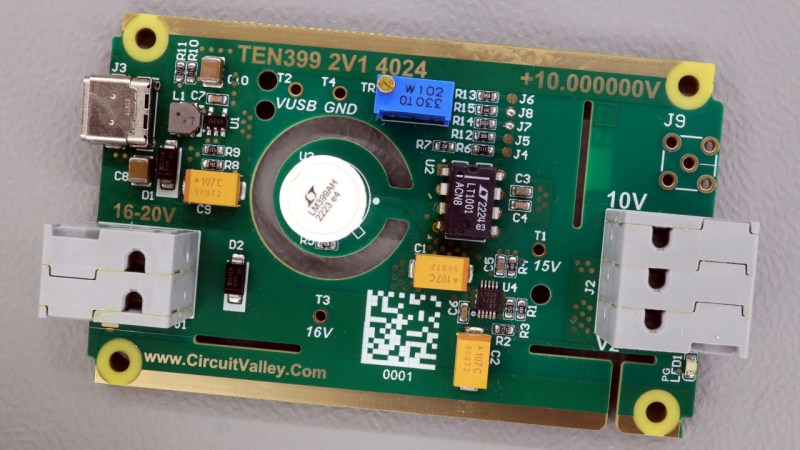
Interesting parts make for interesting projects, and this nifty precision voltage reference has some pretty cool parts, not to mention an interesting test jig.
The heart of [Gaurav Singh]’s voltage reference is an ADR1399, precision shunt reference from Analog Devices. The datasheet makes for pretty good reading and reveals that there’s a lot going on inside the TO-49 case, which looks unusually large thanks to a thick plastic coat. The insulation is needed for thermal stability for the heated Zener diode reference. The device also has a couple of op-amps built in, one that provides closed-loop voltage control and another that keeps the internal temperature at a toasty 95°C. The result is a reference that’s stable over a wide range of operating conditions.
[Gaurav]’s implementation maximizes this special part’s capabilities while making it convenient to use. The PCB has a precision linear regulator that accepts an input voltage from 16 V to 20 V, plus a boost converter that lets you power it from USB-C. The board itself is carefully designed to minimize thermal and mechanical stress, with the ADR1399 separated from the bulk of the board with wide slots. The first video below covers the design and construction of an earlier rev of the board.
One problem that [Gaurav] ran into with these boards was the need to age the reference with an extended period of operation. To aid in that, he built a modular test jig that completed PCBs can be snapped into for a few weeks of breaking in. The jigs attach to a PCB with pogo pins, which mate to test points and provide feedback on the aging process. See the second video for more details on that.