Rotary Encoding With Your Soundcard

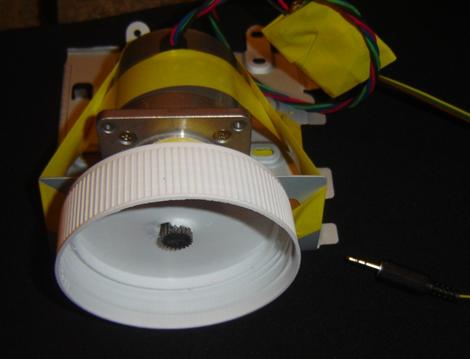
[Stefan] sent in this project writeup to show us how he used a stepper motor as a rotary encoder. Using a stepper motor as an encoder isn’t really that new, as [Stefan] points out, we’ve seen it several times before. He wanted to use this in the quickest simplest way with his computer though. Instead of doing any decoding on a separate microprocessor, he’s connected the stepper directly to his sound card and written code to do the rest. You can download that code and see a video of some practical applications on his site.

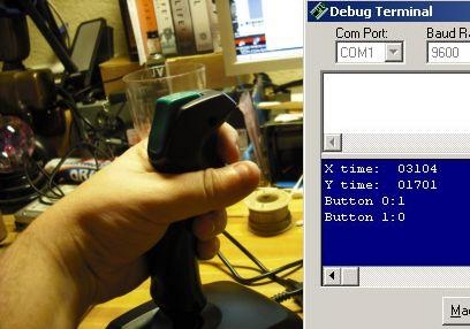
C64 Interface For Your Computer

Before we get started, lets just point out that this C64 was broken. He did not take a functional C64 out of operation for this. What he did do, was to build a hardware interface for for his VICE system. For those unfamiliar, VICE is a cross platform C64 emulator. [Simon] points out that the old games just weren’t as much fun without the original hardware. Having a broken C64 lying around, he put it to good use. It now acts as the interface for all the original fun stuff.

If you are a fan of the hardware, but just want to interface it as a normal USB keyboard, that is possible as well.

Bike Controller For Xbox 360

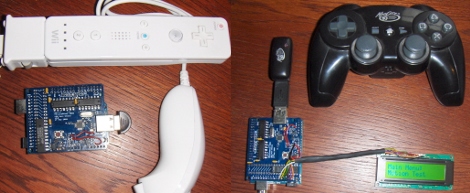
ProjectExciteBike is on its second iteration of an exercise bike controller for Xbox 360. The controller takes pedal input from the cranks of the exercise bike. The sensing is handled by a ring of five hall effect sensors that detect a passing magnet attached to the crank. The sensor data is collected and processed by an Arduino which connects to a wireless Xbox 360 controller for output.

This version of the gaming device includes a fine adjustment widget. It uses a row of LEDs to represent the speed of the pedals and has a slider to adjust how much of an effect this has on the game. This is what we envisioned for the trainer computer we saw yesterday. Take a look at some game play video after the break and dig through the code if you have an exercise bike waiting to be recommissioned.

Continue reading “Bike Controller For Xbox 360”

Reverse Engineering The Telly Terminator

[Oliver] received the Telly Terminator as a gift and decided to take a closer look at it. This key fob has two buttons; one shines an LED like a flashlight and the other turns off televisions. Sound familiar? Yeah, it made [Oliver] think of the TV-B-Gone as well.

He cracked open the case to find just a few components. The brain behind the IR signals is a Helios H5A02HP. Only a few pins are used for outputs so he connected a logic analyzer and recorded the signals. His writeup covers the process quite well. He takes a known IR transmitter protocol and compares it to the capture from the logic analyzer. It turns out that the fob generates 46 different signals and with further analysis concludes that there’s a chance the code used here is from an older version of the TV-B-Gone source.

Arduino Traffic Light

[Rockwell] sent us an update on his traffic light hacking. Dedicated readers will remember seeing this legally attained traffic signal controlled through a parallel port from back in 2005. The new update swaps the old port for USB and adds several autonomous functions which are demonstrated in the clip after the break. The update includes a nice UI and some notifications for things like email, IMs, Reddit posts, etc.

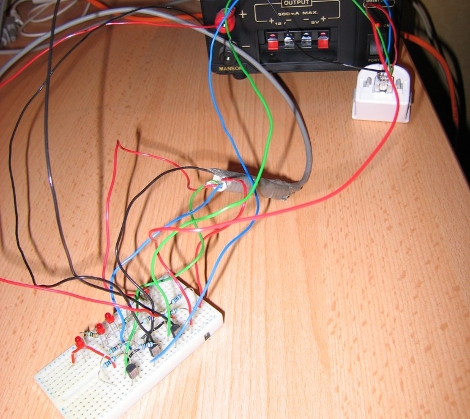
He’s given control of the hardware over to an Arduino. Instead of building the board into the project he’s included just the parts he needs; an AVR running the Arduino bootloader, a crystal and filtering caps, and an Arduino serial to USB module for connectivity. The AC load switching is handled by three relays. The relays he links to are 12VCD rated coils. We think this should have pointed to 5VDC coils as that’s the voltage that the logic circuit are running at. Be careful with switching these AC loads, this traffic light isn’t a toy.

Continue reading “Arduino Traffic Light”

Make Your Own 3d Monitor

[youtube=http://www.youtube.com/watch?v=NektsV1EOic]

Don’t let this cruddy video fool you. [Sprite_tm] has done an amazing job here. He has put together a fairly simple way of creating your own 3d monitor at home. The basic principle is easy to get. You have to supply different angles of an object, on the screen, at the same time. [Sprite_tm] has done this by using transparency sheets, printed with a pattern to only show specific pixels. As you move your head, you see a different set of pixels, and therefore a different image. It’s simple, but it works. The system isn’t really new. Traditional 3d with polarized glasses uses a very similar setup. This system however seems like it is lacking in stereoscopic view however. When you move your head, you’re looking at a different angle, but still a 2d image of it. It would be really cool if he could somehow present each eye a different view, without polarizing filters and glasses. We’ve seen others do that with multiple screens, but that gets so clunky and can give most people a headache pretty quick. We also think we are about to see a flood of face tracking perspective modification, especially with project Natal and similar technology emerging.