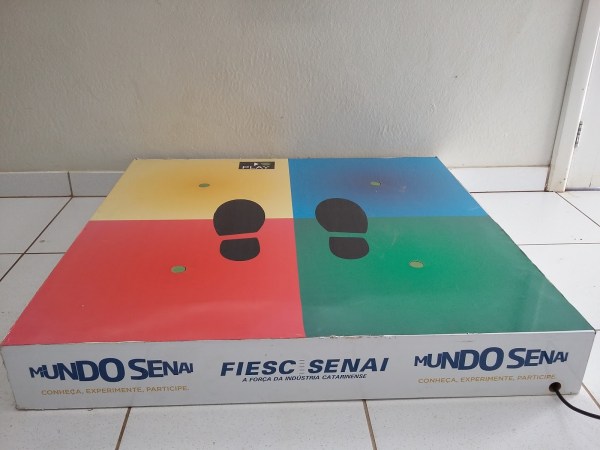
Since 1998 we’ve been privileged to partake in an arcade game known as Dance Dance Revolution, but before that, way back in the 70’s, was the Simon game. It’s essentially a memory game that asks the player to remember a series of lights and sounds. [Uberdam] decided to get the best of both worlds and mixed the two together creating this giant foot controlled Simon game. (English translation.)
The wood platform that serves as the base of the project was fitted with four capacitive sensors, each one representing a “color” on the Simon game. When a player stomps on a color, a capacitive sensor sends a signal to a relay which in turn notifies the Raspberry Pi brain of the input. The Pi also takes care of showing the player the sequence of colored squares that must be stepped on, and keeps track of a player’s progress on a projector.
This is a pretty good way of showing how a small, tiny computer like the Raspberry Pi can have applications in niche environments while also being a pretty fun game. We all remember Simon as being frustrating, and we can only imagine how jumping around on a wooden box would make it even more exciting. Now, who can build a robot that can beat this version of Simon?