Tiny Open Source Robot

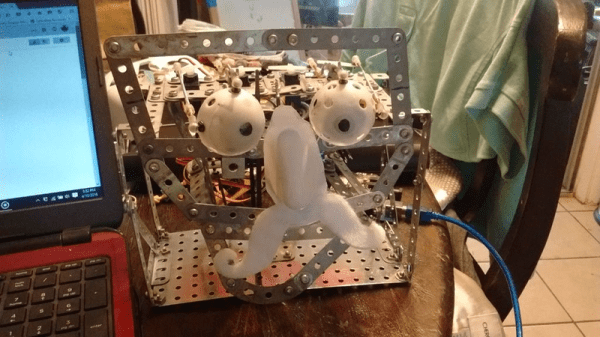
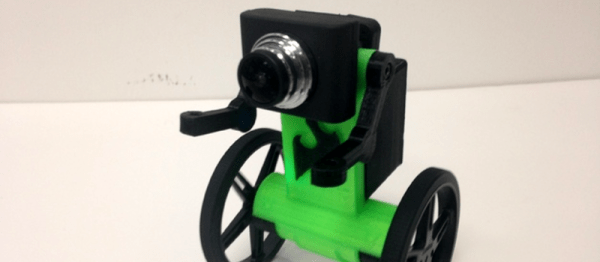
We watched the video introduction for this little open source robot, and while we’re not 100% sure we want tiny glowing eyes watching us while we sleep, it does seem to be a nice little platform for hacking. The robot is a side project of [Matthew], who’s studying for a degree in Information Science.

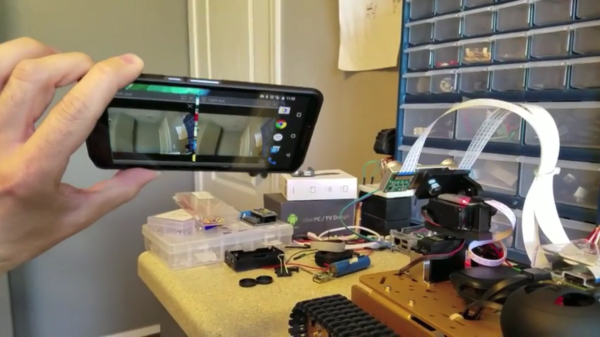
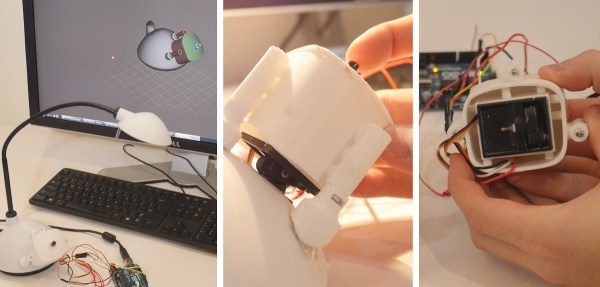
The robot has little actuated grippy arms for holding a cell phone in the front. When it’t not holding a cellphone it can use its two little ultrasonic senors to run around without bumping into things. We like the passive balancing used on the robot. Rather than having a complicated self-balancing set-up, the robot just uses little ball casters to provide the other righting points of contact.

The head of the robot has plenty of space for whatever flavor of Arduino you prefer. A few hours of 3D printing and some vitamins is all you need to have a little robot shadow lurking in your room. Video after the break.

Continue reading “Tiny Open Source Robot”

Arduino Makerbeam Live Plotter Controlled By HTML5 Canvas And Java Website

We’ve never seen someone build a plotter out of buzzwords, but [roxen] did a really good job of it. The idea is simple, place the plotter over a sheet of paper, open a website, draw, and watch the plotter go. Check out the video below the break.

The user draws in an HTML5 Canvas object which is read by a Java Web Server. From there it gets converted to serial commands for an Arduino which controls the steppers with two EasyDrivers.

The build itself is really nice. It perfectly meets the mechanical requirements of a pen plotter without a lot of fluff. The overall frame is T-shaped, for the x- and y-axis. The movements are produced by two steppers and acetal rack and pinion sets. The pen is lifted up and down by a hobby servo.

Continue reading “Arduino Makerbeam Live Plotter Controlled By HTML5 Canvas And Java Website”

Connect Four Robot Uses Raspberry Pi

Most people play games for entertainment. Hackers build robots to play games for entertainment. That’s what [piandchips] did. He used a Raspberry Pi and a MeArm kit to build a Connect 4-playing robot. The robot–named 4-Bot–has to do two things: the first is it has to be able to manipulate the pieces. Secondly, it has to be able to see the board. The MeArm imbues 4-Bot with the manipulation ability, and a clever scanning system does the trick.

Continue reading “Connect Four Robot Uses Raspberry Pi”

Paydar: What It Was Like To Battle Bots In 2002

Most people remember when Battle Bots was a big thing, but few of us got to live it as seen in this gallery. Every now and then, someone posts something more amazing than usual in the comments. When [Wolf] was studying at IUPUI they somehow convinced a professor to let them build a scary dangerous robot maiming device for their final project. It’s a cross-disciplinary project — even the medical students may get to participate.

Spike vs hours and hours of work.
Spike vs. hours and hours of work. Victory: spike.

Their bot, unfortunately, got taken out by some spikes after attempting to get a spinbot before it started spinning and got them. If you look closely at the 2002 Comedy Central Battlebot opening you can see the smoke pour from their robot as they try to escape the fatal spikes.

The robot itself is a three wheeled design. The two wheels across from each other drive the robot, and the third steers. There is a very cool encoder mechanism for the steering wheel that is worth checking out. The main drive motor is a hefty 15HP electric forklift motor current limited to 300amps. The robot never got a weapon thanks to slow mechanical engineers, but a motor like that can turn most chunks of metal into deadly weapons.

Battle Bots is making a comeback in some ways. Word’s still out if it will ever go back to it’s prime, or if something more insane will replace it.

Nessie, The Educational Robot

At the Lifelong Learning Robotics Laboratory at the Erasmo Da Rotterdam in Italy, robots are (not surprisingly) used to teach all of the fundamentals of robotics. [Alessandro Rossetti] and the students at the lab have been at it for years now, and have finally finished their fifth generation of a robot called Nessie. The big idea is to help teach fundamentals of programming and electronics by building something that actually uses these principles.

The robot is largely 3D printed and uses an FPGA to interact with the physical world through a set of motors and sensors. The robot also uses a Raspberry Pi to hold the robot’s framework. The robot manages the sensors in hardware with readers attached to the CPU AXI bus. The CPU reads their values from memory space, though, so the robot is reported to be quite quick.

The lab is hoping to take their robot to a robotics competition in Bari, Italy. We hope that they perform well there, since we are big fans of any robot that’s designed to teach anyone about robotics and programming. After all, there are robots that help teach STEM in Africa, robots that teach teen girls about robots, and robots that teach everyone.

Variable Stiffness Joints For Robots And More

The human body has many miraculous capabilities that we often take for granted. One of the more subtle ones is the variable stiffness of your joints. In technical terms, stiffness refers to the ability to resist a load. Delicately manipulating an artist’s paint brush, for example, doesn’t require much load resistance, but does require fine control. However, that same artist might pick up a bowling ball with a stiffer joint (and, usually, less fine control).

[Christopher Churchill] and some colleagues have a novel mechanical device that can rapidly change stiffness. The device could have applications in robotics and other devices. It can also transmit or attenuate vibration since non-stiff joints don’t pass vibrations as easily as stiff ones.

Continue reading “Variable Stiffness Joints For Robots And More”

Plastic Battlebots Might Bite Your Hand Off

The folks at Fetch Robotics do love a good game of combat robots. Time is tight these days, however, so putting together a good ol’ 220-pounder for Robogames is a dream few of us can realize. Instead, the Fetch team hosted their own Plastic fantastic battlebots competition to blow off some steam, and the results are in!

Battlebots enter the ring built from a frame of entirely plastic parts and weighing a humble 3lbs. Just like Battlebots and Robogames, they’ll follow a 2-minute episode of hack-and-slash after which judges determine the winner. Bots were forged from everything you might see in arms reach of your local hackerspace: pvc pipe, acrylic sheets, and a few 3D-printed components. On the menu of shredded plastic we have everything from classic wedges and spinners to a giant spinning rubber pterodactyl strapped onto the body of an RC car. (Time is tight, right?)

While 3 pound plastic fighters might not seem devastating, don’t underestimate the LiPo batteries and brushless motors that are running under the hood. These competitors can easily heave each other across the ring. We’ve definitely seen mini Battlebot tournaments before, and we’re thrilled to see them on the rise in everyday places. Better start getting your materials ready. Who knows? Mini Battlebots might be coming to an alley near you too.

Continue reading “Plastic Battlebots Might Bite Your Hand Off”