Ambrosianus L 99 sup., p. 190, ll. 14–23, UV fluorescence image by Lumière Technology. Upside-down Latin overtext in dark brown and Greek undertext in light brown.

Reading Ptolemy’s Treatise On The Meteoroscope On Palimpsests After Centuries Of Recovery Attempts

During the Middle Ages much of Ancient Greek and Roman scientific, legal and similarly significant texts written on parchment were commonly erased, mostly because of the high cost of new parchment and the little regard given to these secular texts. Although recovery attempts of the remaining faint outlines of the old text has been attempted since at least the 19th century, these often involved aggressive chemical means. Now researchers have managed to recover the text written by Ptolemy on a parchment that suffered such a previous recovery attempt.

The term for a parchment and similar on which the existing text was washed or scraped off is a palimpsest, via Latin from  Ancient Greek παλίμψηστος (palímpsēstos, from παλίν + ψαω = ‘again’ + ‘scrape’). In the case of this particular treatise, it is part of L 99 sup which is kept at the Biblioteca Ambrosiana in Milan, Italy. This collection contains fifteen palimpsest parchment leaves previously used for three Greek scientific texts: a text of unknown authorship on mathematical mechanics and catoptrics, known as the Fragmentum Mathematicum Bobiense (three leaves), Ptolemy’s Analemma (six leaves), and a so far unidentified astronomical text on six leaves.

Outermost six rings of the meteoroscope, not to scale. Nh, Sh, Eh, and Wh are cardinal points of the horizon; Ne and Se are the north and south celestial poles; Nz and Sz are the north and south poles of the ecliptic; and Z is the zenith. (Gysembergh et al., 2023)

It is this last text that has now been identified, courtesy of work by Victor Gysembergh and colleagues. Whereas 19th century palimpsest recovery attempts by Angelo Mai involved reagents, during the 20th century ultraviolet illumination became the preferred method, followed by similar non-destructive analysis methods. For this study UV fluorescence and multispectral reflectance imaging was employed, which allowed for significant more of the original Greek text to be uncovered. Most notable, this revealed Ptolemy’s treatise on the Meteoroscope, which is an instrument for measuring the position, length, and direction of the apparent path of a shooting star.

This new recovery builds upon text previously recovered by other researchers since Mai’s attempts, and fills in more details, although it must be noted that not all of the text has been recovered. It’s hoped that in future imaging sessions more can be recovered of this irreplaceable text, that like so many of its kind nearly got destroyed during Europe’s darkest era.

(Top image: Ambrosianus L 99 sup., p. 190, ll. 14–23, UV fluorescence image by Lumière Technology. Upside-down Latin overtext in dark brown and Greek undertext in light brown.)

3D Print For Extreme Temperatures (But Only If You’re NASA)

At the level pursued by many Hackaday readers, the advent of affordable 3D printing has revolutionised prototyping, as long as the resolution of a desktop printer is adequate and the part can be made in a thermoplastic or resin, it can be in your hands without too long a wait. The same has happened at a much higher level, but for those with extremely deep pockets it extends into exotic high-performance materials which owners of a desktop FDM machine can only dream of.

NASA for example are reporting their new 3D printable nickel-cobalt-chromium alloy that can produce extra-durable laser-sintered metal parts that van withstand up to 2000 Fahrenheit, or 1033 Celcius for non-Americans. This has obvious applications for an organisation producing spacecraft, so naturally they are excited about it.

The alloy receives some of its properties because of its oxide-dispersion-strengthened composition, in which grains of metal oxide are dispersed among its structure. We’re not metallurgists here at Hackaday, but we understand that the inconsistencies in the layers of metal atoms caused by the oxides in the crystal structure of the alloy leads to a higher energy required for the structure to shear.

While these particular materials might never be affordable for us mere mortals to play with, NASA’s did previously look into how it could greatly reduce the cost of high-temperature 3D printing by modifying an existing open source machine.

Testing Part Stiffness? No Need To Re-invent The Bending Rig

If one is serious about testing the stiffness of materials or parts, there’s nothing quite like doing your own tests. And thanks to [JanTec]’s 3-Point Bending Test rig, there’s no need to reinvent the wheel should one wish to do so.

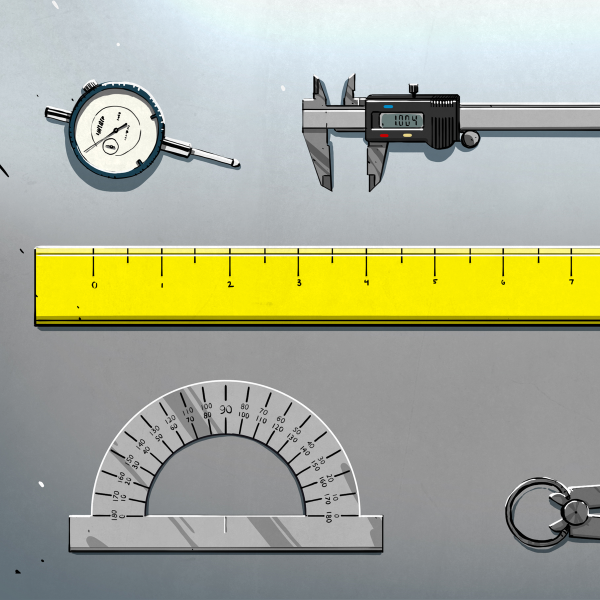
The dial caliper can be mounted to a fixed height, thanks to a section of 3030 T-slot extrusion.

Some simple hardware, a couple spare pieces of 3030 T-slot extrusion, a few 3D-printed parts, and a dial indicator all come together to create a handy rig that will let one get straight to measuring.

Here is how it works: stiffness of a material is measured by placing a sample between two points and applying a known force to the middle of the sample. This will cause the material to bend, and measuring how far a standardized sample deforms under a known amount of force (normally accomplished by a dial indicator) is how one can quantify a material’s stiffness.

When a material talks about its Young’s modulus (E) value, it’s talking about stiffness. A low Young’s modulus means a material is more elastic, a high value means the material is more stiff. (This shouldn’t be confused with strength or toughness, which are more about resistance to non-recoverable deformation, and resistance to fracture, respectively.)

Interested in results, but don’t want to get busy doing your own testing? Someone’s already been there and done that: here’s a great roundup of measurements of 3D-printed parts, using different filaments.

Warmer Ice Cream?

What if you could tweak the recipe on ice cream to keep it frozen at higher temperatures? The idea comes from massive conglomerate Unilever. Among other things, the brand owns a wide variety of ice cream brands, from Ben & Jerry’s to the Magnum and Cornetto lines. Instead of running freezers at the industry standard of -18 °C (0°F), the company is experimenting with upping the temperature to -12 °C (10 °F) instead.

First off, you’d save a lot of electricity. Thanks to the way the industry works, the company actually owns the vast majority of the three million or so display freezers that are used to sell its stock to customers. Running at a higher temperature could slash the freezer’s energy use by 20% to 30%, according to the company’s calculations. The company also estimates that the energy used by these freezers makes up around 10% of its total greenhouse gas footprint, so it’s better for the environment too.

Of course, there’s savvy commercial reasons behind the idea. Unilever had noticed its ice cream sales dropping in 2022. The company believes this was in part due to retailers unplugging their freezers earlier than usual as winter approached, due to high energy bills. If the company’s freezers aren’t humming, they’re doing less business. If shaving down the freezer’s energy use helps retailers keep them plugged in and the lights on, that’s a net bonus to the company’s bottom line. It could also make their freezers unhospitable places for rival products, giving them an edge in the marketplace.

But this is all business intrigue. Let’s instead take a deeper look at ice cream.

Continue reading “Warmer Ice Cream?”

Generating Entangled Qubits And Qudits With Fully On-Chip Photonic Quantum Source

As the world of computing and communication draws ever closer to a quantum future, researchers are faced with many of the similar challenges encountered with classical computing and the associated semiconductor hurdles. For the use of entangled photon pairs, for example, it was already possible to perform the entanglement using miniaturized photonic structures, but these still required a bulky external laser source. In a recently demonstrated first, a team of researchers have created a fully on-chip integrated laser source with photonic circuitry that can perform all of these tasks without external modules.

In their paper published in Nature Photonics, Hatam Mahmudlu and colleagues cover the process in detail. Key to this achievement was finding a way to integrate the laser and photonics side into a single, hybric chip while overcoming the (refractive) mismatch between the InP optical amplifier and Si3N4 waveguide feedback circuit. The appeal of photon-based quantum entanglement should be obvious when one considers the relatively stable nature of these pairs and their compatibility with existing optical (fiber) infrastructure. What was missing previously was an economical and compact way to create these pairs outside of a laboratory setup. Assuming that the described approach can be scaled up for mass-production, it may just make quantum communications a realistic option outside of government organizations.

MRI Resolution Progresses From Millimeters To Microns

Neuroscientists have been mapping and recreating the nervous systems and brains of various animals since the microscope was invented, and have even been able to map out entire brain structures thanks to other imaging techniques with perhaps the most famous example being the 302-neuron brain of a roundworm. Studies like these advanced neuroscience considerably but even better imaging technology is needed to study more advanced neural structures like those found in a mouse or human, and this advanced MRI machine may be just the thing to help gain better understandings of these structures.

A research team led by Duke University developed this new MRI technology using an incredibly powerful 9.4 Tesla magnet and specialized gradient coils, leading to an image resolution an impressive six orders of magnitude higher than a typical MRI. The voxels in the image measure at only 5 microns compared to the millimeter-level resolution available on modern MRI machines, which can reveal microscopic details within brain tissues that were previously unattainable. This breakthrough in MRI resolution has the potential to significantly advance understanding of the neural networks found in humans by first studying neural structures in mice at this unprecedented detail.

The researchers are hopeful that this higher-powered MRI microscope will lead to new insights and translate directly into advancements healthcare, and presuming that it can be replicated, used on humans safely, and becomes affordable, we would expect it to find its way into medical centers as soon as possible. Not only that, but research into neuroscience has plenty of applications outside of healthcare too, like the aforementioned 302-neuron brain of the Caenorhabditis elegans roundworm which has been put to work in various robotics platforms to great effect.

Continue reading “MRI Resolution Progresses From Millimeters To Microns”

A Temperature-Sensing Magnetic Stir Bar

Magnetic stirring bars are the coolest piece of equipment you’ll see in a high-school chemistry lab. They’re a great way for agitating a solution without having to stand there manually and do it yourself. [Applied Science] has now made a magnetic stir bar that features an integrated temperature sensor.

The device is essentially an RFID temperature sensor snuck inside a custom-made magnetic stir bar. The bar is paired with a smart hotplate base that displays the temperature readings. As a bonus, it can detect when the magnetic stir bar is out of place or not in sync, prompting it to slow down the spin motor until the stir bar is turning properly again.

The video also notes that the stir bar could be instrumented for even greater functionality. A Hall effect sensor could measure the magnetic slip angle of the stir bar, and provide useful readings of liquid viscosity. Alternatively, a pressure sensor in the stir bar could potentially measure liquid level based on hydrostatic pressure.

It’s a great quality-of-life improvement for regular lab work. It eliminates the need for bulky temperature probes that often get in the way. We’ve featured some interesting temperature sensors before, too.

Continue reading “A Temperature-Sensing Magnetic Stir Bar”