A Microneedle Vaccine Patch Printer For Thermostable MRNA Vaccines

What if you could get vaccinated with the ease of putting on an adhesive bandage? This is the promise of microneedle patches (MNP), which are essentially what they sound like. These would also have uses in diagnostics that might one day obliviate the need for drawing blood. The one major issue with MNPs is their manufacturing, which has been a laborious and highly manual process. In a recent paper in Nature Biotechnology researchers detail the construction and testing of a MNP printer, or microneedle vaccine printer (MVP) that can print dissolving polymers containing stabilized mRNA vaccine.

These mRNA strands are as usual encapsulated in a liquid nanoparticle container, which is mixed with the soluble and biocompatible polymer. This mixture is then added to a mold and dried, after which it retains the microneedle structure of the mold. On tests involving pig skin, the MNPs were capable of penetrating the skin and delivering the vaccine contained in the needles. Produced patches were shown to be shelf-stable for at least six months, which would make these ideal for vaccine distribution in areas where refrigeration and similar are problematic.

Using MNPs for delivering vaccines has previously been researched for e.g. delivering rotavirus and poliovirus vaccine, and a 2021 study in Nature Biomedical Engineering looked at the viability of using MNPs to rapidly sample protein biomarkers in interstitial fluid, which could make diagnostics for certain biomarkers as uncomplicated as putting on the patch, removing it and examining it, removing the need for drawing blood or sampling large amounts of interstitial fluid for external analysis.

If the concept of the MVP and similar MNP printers can be commercialized, it might make it possible to strongly shorten the supply chain for vaccines in less developed regions, while also enabling diagnostics that are very costly and cumbersome today.

A human hand holds a stack of several plexiglass sheets with needles glued into the ends. Very faint lines can be seen in the transparent stackup.

Biomimetic Building Facades To Reduce HVAC Loads

Buildings currently consume about 50% of the world’s electricity, so finding ways to reduce the loads they place on the grid can save money and reduce carbon emissions. Scientists at the University of Toronto have developed an “optofluidic” system for tuning light coming into a building.

The researchers devised a biomimetic system inspired by the multi-layered skins of squid and chameleons for active camouflage to be able to actively control light intensity, spectrum, and scattering independently. While there are plenty of technologies that can regulate these properties, doing so independently has been too complicated a task for current window shades or electrochromic devices.

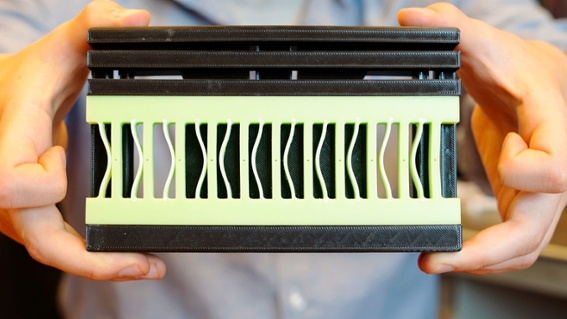
To make the prototype devices (15 × 15 × 2 cm), 3 mm PMMA sheets were stacked after millifluidic channels (1.5 mm deep and 6.35 mm wide) were CNC milled into the sheets. Fluids could be injected and removed by needles glued into the ends of the channels. By using different fluids in the channels, researchers were able to tune various aspects of the incoming light. Scaled up, one application of the system could be to keep buildings cooler on hot days without keeping out IR on colder days which is one disadvantage of static window coatings currently in use.

If you want to control some of the light going OUT of your windows, maybe you should try building this smart LED curtain instead?

Continue reading “Biomimetic Building Facades To Reduce HVAC Loads”

Transistors That Grow On Trees

Modern technology is riddled with innovations that were initially inspired by the natural world. Velcro, bullet trains, airplanes, solar panels, and many other technologies took inspiration from nature to become what they are today. While some of these examples might seem like obvious places to look, scientists are peering into more unconventional locations for this transistor design which is both inspired by and made out of wood.

The first obvious hurdle to overcome with any electronics made out of wood is that wood isn’t particularly conductive, but then again a block of silicon needs some work before it reliably conducts electricity too. First, the lignin is removed from the wood by dissolving it in acetate, leaving behind mostly the cellulose structure. Then a conductive polymer is added to create a lattice structure of sorts using the wood cellulose as the structure. Within this structure, transistors can be constructed that function mostly the same as a conventional transistor might.

It might seem counterintuitive to use wood to build electronics like transistors, but this method might offer a number of advantages including sustainability, lower cost, recyclability, and physical flexibility. Wood can be worked in a number of ways once the lignin is removed, most notably when making paper, but removing the lignin can also make the wood relatively transparent as well which has a number of other potential uses.

Thanks to [Adrian] for the tip!

El Caracol observatory at Chichen Itza.

Solving The Mystery Of The Mayan Calendar’s 819-Count Cycle

Mayan Calendar Round. (Source: Chichen Itza)

Despite the mysticism that often clouds the Mayan calendar in popular culture, fact remains that the calendar system in use by the Mayans was based on a system used throughout the pre-Columbian Mesoamerican societies, dating back to at least the 5th century BCE. Characteristic of this system is the cyclical nature, with the Mayan calendar featuring three common cycles: the Long Count, Tzolk’in (260-day) and the 365-day, solar-based Haab’. Combined, these three cycles formed what is known as the Calendar Round and which lasts for 52 haab’ (years).

What was less obvious here was the somewhat obscure 819-day count that was found in certain locations in Mayan constructions. Now researchers John H. Linden and Victoria R. Bricker figure that they have discovered how this new cycle matches up with the previously known Calendar Round. In previous reports by e.g. Barbara McLeod and Hutch Kinsman in 2012, they noted the ongoing debate on this 819-day count and its potential purpose. The new insight by Linden and Bricker is that by increasing the calendar length to 20 periods of 819 days, it matches up with all synodic periods of the visible planets, explaining it as a planetary astronomical cycle.

What is interesting here is that the Mayan counting system is base-20 (vigesimal). Whether coincidence or not when it comes to this part of the Mayan calendar, it is good to see that more secrets of the Classical Mayan society are being recovered. With modern day Maya still living where their ancestors once did, these discoveries help them to recover and reconnect to the parts of their history that were so brutally destroyed by the invading Europeans.

(Heading image: El Caracol observatory at Chichen Itza, Mexico)

Making Hydrogen With Solar Energy, With Oxygen And Heat A Bonus

Hydrogen is a useful gas. Whether you want to float an airship, fuel a truck, or heat an industrial process, hydrogen can do the job. However, producing it is currently a fraught issue. While it can be produced cleanly using renewable energy, it’s often much cheaper to split it out of hydrocarbon fuels using processes that generate significant pollution.

There are methods to generate hydrogen more efficiently, though, in a clean and sustainable process. that also produces useful heat and oxygen as byproducts. The key to the process? Concentrated sunshine.
Continue reading “Making Hydrogen With Solar Energy, With Oxygen And Heat A Bonus”

Leonardo Da Vinci’s Visualization Of Gravity As A Form Of Acceleration

Although we take a lot of scientific knowledge for granted today, each of the basics – whether it be about light, gravity, mass or the shape of the Earth – had to be theorized and experimentally verified. In the case of gravity, as far back as around 500 BCE the Ionian Greek philosopher Heraclitus theorized on the balance created by what we came to call ‘gravity’. Later, the Greek philosopher Aristotle coined his own postulations and Greek physicist Archimedes did research that led him to discover the center of mass. Centuries later, the Roman engineer and architect Vitruvius argued for the concept of specific gravity rather than mass alone.

Da Vinci’s sketch and the Caltech experiment replicating it.

Although scientific pursuits in this area ground to a halt in Europe during medieval times, the Renaissance saw a renewed interest in the topic, with newly published research performed on Leonardo da Vinci‘s notes showing that he appears to – unsurprisingly – have also created a number of experiments aimed at determining the properties of gravity. One of the major limitations of the 15th century was that many of the basic scientific tools we have come to rely on since the 19th century such as accurate clocks, along with many other products of advanced alloys and metallurgy simply did not exist. Da Vinci’s experiment in this context is nothing if not ingenious in its simplicity.

By the time of the European Renaissance, the Aristotelian concept of gravity as solely a factor of an object’s mass was dismissed by many in favor of a model that saw the motion of an object affected by its velocity and mass, also influenced by works published by Persian scholars. When Da Vinci set up his experiment, he focused specifically on the acceleration of the falling objects by pouring a large number of granules or possibly water droplets from a pitcher which was being pulled along a straight path. He theorized that if the pitcher was being accelerated at the same rate as the objects are accelerating due to gravity, it’d create a isosceles right triangle.

When the researchers ran his experiment and compared Da Vinci’s notes on the results, they realized that although he had made a mistake in his model, at the small scale this would not have affected the results, making it valid and an early precursor to what later be published by Isaac Newton in the 17th century.

Smoke Some Weeds: Lasers Could Make Herbicide Obsolete

We’ve all tangled with unwelcome plant life at one point or another. Whether crabgrass infested your lawn, or you were put on weeding duty in your grandfather’s rose patch, you’ll know they’re a pain to remove, and a pain to prevent. For farmers, just imagine the same problem, but scaled up to cover thousands of acres.

Dealing with weeds typically involves harsh chemicals or excessive manual labor. Lasers could prove to be a new tool in the fight against this scourge, however, as covered by the BBC.

Continue reading “Smoke Some Weeds: Lasers Could Make Herbicide Obsolete”