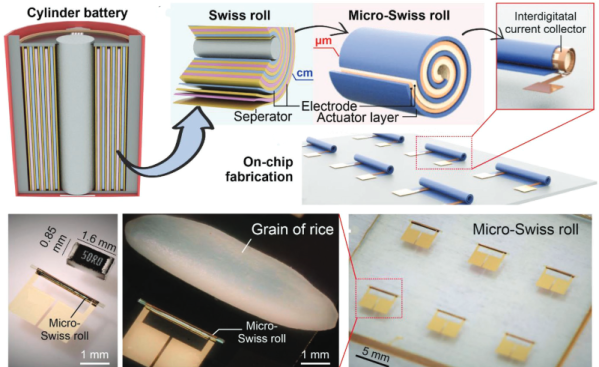
Steve Martin had a comedy routine that focused on the idea of “getting small.” That probably didn’t inspire the researchers at the Institute for Integrative Nanoscience when they set out to create a sub-square-millimeter microbattery. As you might expect, you won’t be starting your car with a battery the size of a grain of sand anytime soon, but these batteries do have a surprising capacity.
The key is creating what they call “micro-swiss rolls” where the electrodes are wrapped in a tiny cylinder. This isn’t a new idea. However, creating workable rolls at the scale where a grain of rice looks huge isn’t trivial.
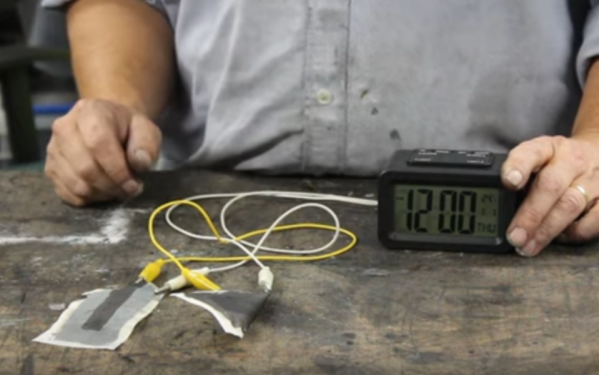
Paper is an ubiquitous part of society; so much so that the incredible engineering behind it often goes unnoticed. That isn’t the case for [Robert], though, who has a deep appreciation for the material and all its many uses far beyond recording information. In this particular video, he recreates a method found by researchers to turn a piece of paper into a battery with equivalent performance to a AA-sized alkaline battery. (Video, embedded below the break.)
The process involves the creation of a few different types of ink, each of which can be made with relatively common materials such as shellac, ethanol, polyethylene glycol, and graphite. Each of these materials are mixed in different proportions to create the inks. Once the cathode ink and anode ink are made, a third ink is needed called a current collector ink which functions essentially as a wire. The paper is dipped into a salt solution and then allowed to dry, given a partial waterproof coating, and when it is needed it can be activated by wetting it which allows the ion flow of the battery to happen.
The chemistry of this battery makes a lot of sense once you see it in action, and the battery production method also has a perk of having a long shelf life as long as the batteries stay dry. They also don’t damage the environment as much as non-rechargable alkaline cells do, at least unless you want to go to some extreme measures to reuse them.
When we talk about emissions these days, we typically talk about cutting them back for the good of the environment. However, the climate system is a complex beast, and one we’re still learning to understand.
As it turns out, cutting back on emissions may have unexpected or undesirable effects. Some scientists are concerned that cuts to human-induced sulfur emissions may actually be warming the Earth.
When we think of brain-computer interfaces (BCIs) that use electrodes, we usually think of Utah arrays that are placed directly on the brain during open brain surgery, or with thin electrodes spliced into the exposed brain as postulated by Neuralink. While Utah arrays and kin as a practical concept date back to the 1980s, a more recent concept called Stentrodes – for stent-electrode array – seeks to do away with the need for invasive brain surgery.
As the name suggests, this approach uses stents that are inserted via the blood vessels, where they are expanded and thus firmly placed inside a blood vessel inside the brain. Since each of these stents also features an electrode array, these can be used to record neural activity in nearby neural clusters, as well as induce activity through electrical stimulation.
Due to the fact that stents are already commonly used by themselves in the brain’s blood vessels, and the relatively benign nature of these electrode arrays, human trials have already been approved in 2018 by an ethics committee in Australia. Despite lingering concerns about the achievable resolution and performance of this approach, it may offer hope to millions of people suffering from paralysis and other conditions.
Hydrogen has long been touted as the solution to cleaning up road transport. When used in fuel cells, the only emissions from its use are water, and it eliminates the slow recharging problem of battery-electric vehicles. It’s also been put forth as a replacement for everything from natural gas supplies to laptop batteries.
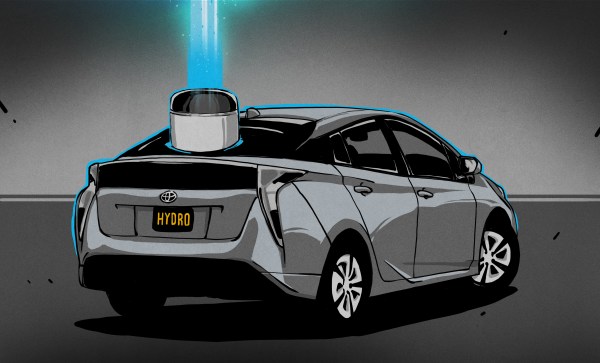
Toyota has been pushing hard for hydrogen technology, and has worked to develop vehicles and infrastructure to this end. The company’s latest efforts involve a toteable hydrogen cartridge – letting you take hydrogen power on the go!
Ever heard of Aerochrome? It’s a unique type of color infrared film, originally created for the US military and designed for surveillance planes. Photos taken with Aerochrome film show trees and other vegetation in vivid reds and pinks, creating images that aren’t quite like anything else.
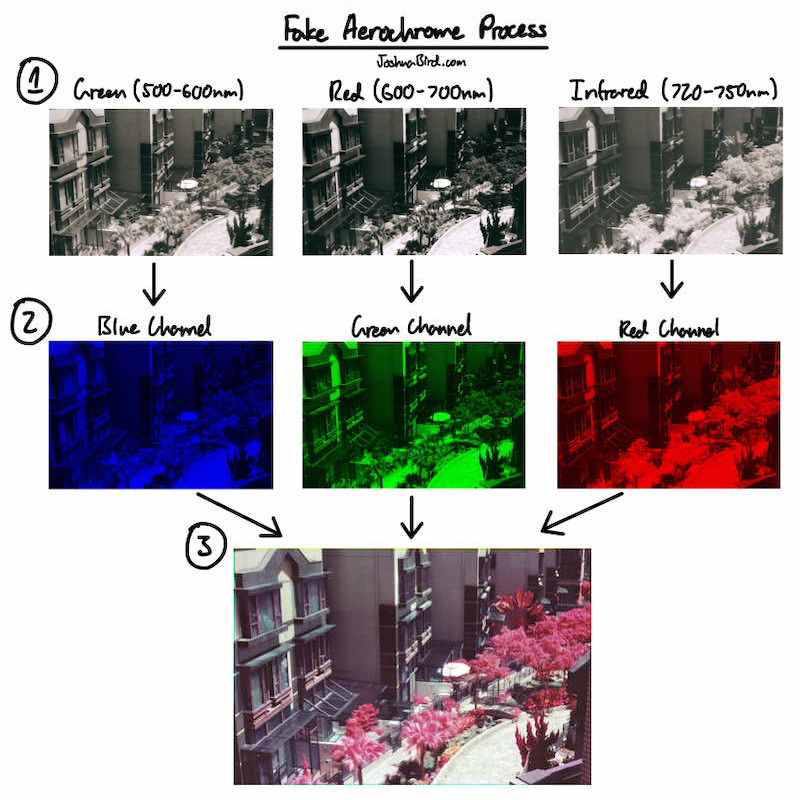
A modified method of trichrome photography is the key behind re-creating that unique Aerochrome look. Click to enlarge.
Sadly, Aerochrome hasn’t been made for over a decade. What’s an enterprising hacker with a fascination for this unobtainable film to do? [Joshua] resolved to recreate it as best he could, and the results look great!
Aerochrome isn’t quite the same as normal film. It is sensitive to infrared, and photos taken with it yield a kind of false color image that presents infrared as red, visible reds as greens, and greens are shown as blue. The result is a vaguely dreamy looking photo like the one you see in the header image, above. Healthy vegetation is vividly highlighted, and everything else? Well, it actually comes out pretty normal-looking, all things considered.
Why does this happen? It’s because healthy, leafy green plants strongly absorb visible light for photosynthesis, while also strongly reflecting near-infrared. This is the same principle behind the normalized difference vegetation index (NDVI), a method used since the 70s to measure live green vegetation, often from satellite imagery.
Aerochrome may be out of production, but black and white infrared film is still available. [Joshua] found that he could re-create the effect of Aerochrome with an adaptation of trichrome photography: the process of taking three identical black and white photos, each using a different color filter. When combined, the three photos (acting as three separate color channels) produce a color image.
To reproduce Aerochrome, [Joshua] takes three monochromatic photos with his infrared film, each with a different color filter chosen to match the spectral sensitivities of the original product. The result is a pretty striking reproduction of Aerochrome!
But this method does have some shortcomings. [Joshua] found it annoying to fiddle with filters between trying to take three identical photos, and the film and filters aren’t really an exact match for the spectral sensitivities of original Aerochrome. He also found it difficult to nail the right exposure; since most light meters are measuring visible light and not infrared, the exposure settings were way off. But the results look pretty authentic, so he’s counting it as a success.
We loved [Joshua]’s DIY wigglecam, and we’re delighted to see the work he put into re-creating an authentic Aerochrome. Fantastic work.
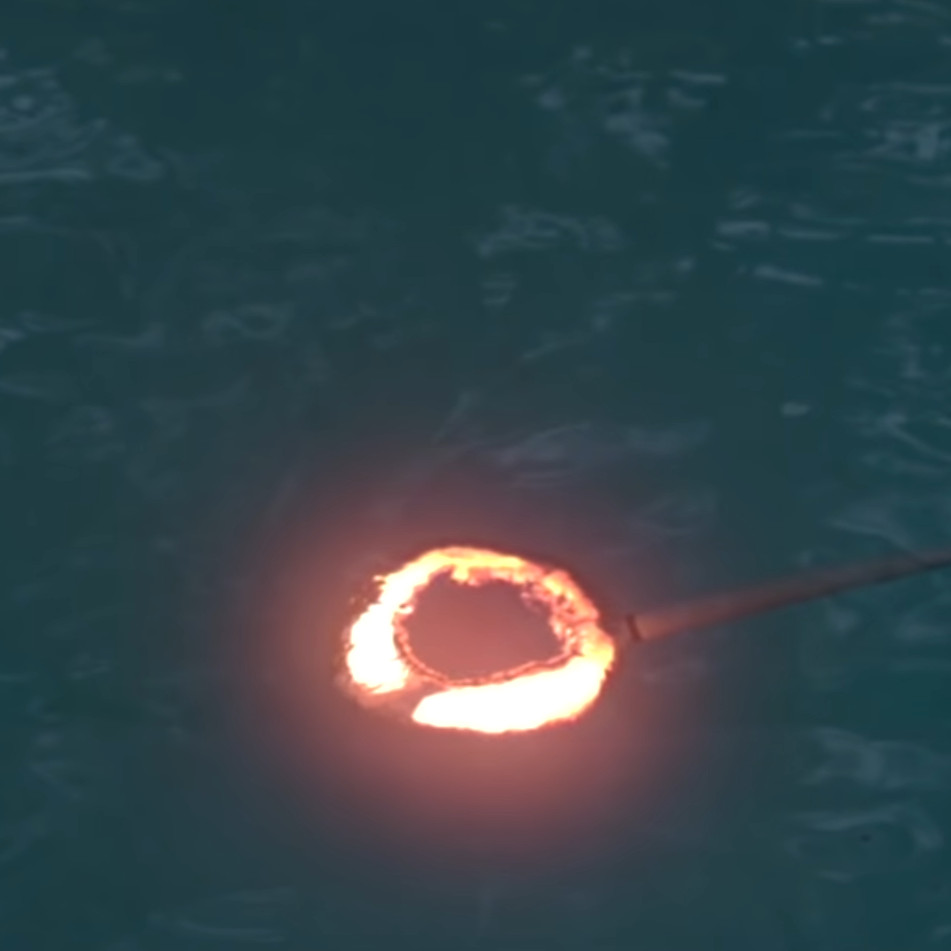
When Johnny Cash wrote “Ring of Fire”, he was talking about love. But when an unnamed follower of [TheBackyardScientist] took it literally and suggested making actual rings of fire — underwater — they rose to the challenge as you can see in the video below the break.
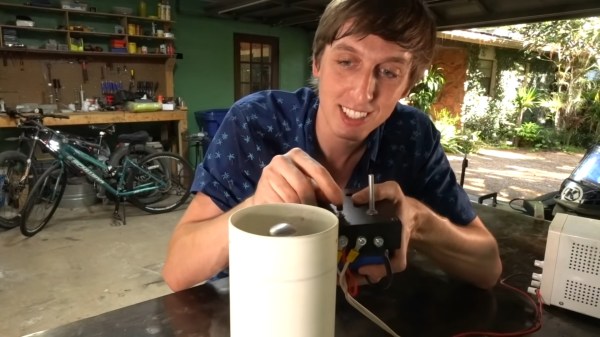
Of course there are several ingredients to underwater fire rings. First you need water, and a pool clearly does the job in this video. Second, you need flammable rings of gas. [TheBackyardScientist] decided to build a machine to create the gas rings, and it’s quite interesting to see them go through several iterations before settling on a voice coil based poppet valve design. We must say that it works absolutely swimmingly.
Lastly there needs to be fire. And for fire, you need something flammable, and something shocking. Forty thousands volts light up a spark plug, even underwater. The fuel is provided by what appears to be compressed air and acetylene but we’re not 100% sure. We are sure that it goes bang! quite sufficiently, as demonstrated by its aptitude for blowing things up.
We appreciated the engineering that went into the project but also the rapid iterations of ideas, the overcoming of serious obstacles and the actual science that went into the project. Even if it is just randomly making literal burning rings of fire.