Wacky Science: Using Mayonnaise To Study Rayleigh-Taylor Instability

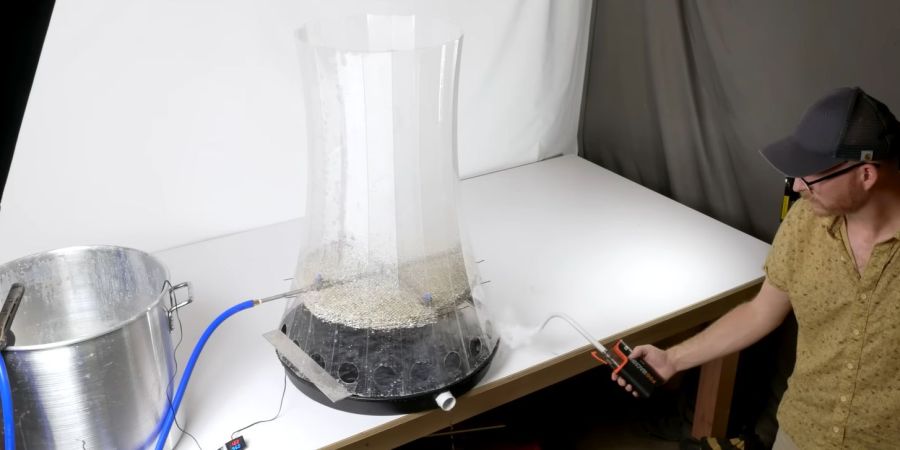
Sometimes a paper in a scientific journal pops up that makes you do a triple-take, case in point being a recent paper by [Aren Boyaci] and [Arindam Banerjee] in Physical Review E titled “Transition to plastic regime for Rayleigh-Taylor instability in soft solids”. The title doesn’t quite do their methodology justice — as the paper describes zipping a container filled with mayonnaise along a figure-eight track to look at the surface transitions. With the paper paywalled and no preprint available, we have to mostly rely the Lehigh University press releases pertaining to the original 2019 paper and this follow-up 2024 one.

Rayleigh-Taylor instability (RTI) is an instability of an interface between two fluids of different densities when the less dense fluid acts up on the more dense fluid. An example of this is water suspended above oil, as well as the expanding mushroom cloud during a explosion or eruption. It also plays a major role in plasma physics, especially as it pertains to nuclear fusion. In the case of inertial confinement fusion (ICF) the rapidly laser-heated pellet of deuterium-tritium fuel will expand, with the boundary interface with the expanding D-T fuel subject to RTI, negatively affecting the ignition efficiency and fusion rate. A simulation of this can be found in a January 2024 research paper by [Y. Y. Lei] et al.

As a fairly chaotic process, RTI is hard to simulate, making a physical model a more ideal research subject. Mayonnaise is definitely among the whackiest ideas here, with other researchers like [Samar Alqatari] et al. as published in Science Advances opting to use a Hele-Shaw cell with dyed glycerol-water mixtures for a less messy and mechanically convoluted experimental contraption.

What’s notable here is that the Lehigh University studies were funded by the Lawrence Livermore National Laboratory (LLNL), which explains the focus on ICF, as the National Ignition Facility (NIF) is based there.

This also makes the breathless hype about ‘mayo enabling fusion power’ somewhat silly, as ICF is even less likely to lead to net power production, far behind even Z-pinch fusion. That said, a better understanding of RTI is always welcome, even if one has to question the practical benefit of studying it in a container of mayonnaise.

Hydrogen Generation With Seawater, Aluminum, And… Coffee?

A team at MIT led by [Professor Douglas Hart] has discovered a new, potentially revelatory method for the generation of hydrogen. Using seawater, pure aluminum, and components from coffee grounds, the team was able to generate hydrogen at a not insignificant rate, getting the vast majority of the theoretical yield of hydrogen from the seawater/aluminum mixture. Though the process does use indium and gallium, rare and expensive materials, the process is so far able to recover 90% of the indium-gallium used which can then be recycled into the next batch. Aluminum holds twice as much energy as diesel, and 40x that of Li-Ion batteries. So finding a way to harness that energy could have a huge impact on the amount of fossil fuels burned by humans!

Pure, unoxidized aluminum reacts directly with water to create hydrogen, as well as aluminum oxyhydroxide and aluminum hydroxide. However, any aluminum that has had contact with atmospheric air immediately gets a coating of hard, unreactive aluminum oxide, which does not react in the same way. Another issue is that seawater significantly slows the reaction with pure aluminum. The researchers found that the indium-gallium mix was able to not only allow the reaction to proceed by creating an interface for the water and pure aluminum to react but also coating the aluminum pellets to prevent further oxidization. This worked well, but the resulting reaction was very slow.

Apparently “on a lark” they added coffee grounds. Caffeine had already been known to act as a chelating agent for both aluminum and gallium, and the addition of coffee grounds increased the reaction rate by a huge margin, to the point where it matched the reaction rate of pure aluminum in deionized, pure water. Even with wildly varying concentrations of caffeine, the reaction rate stayed high, and the researchers wanted to find out specifically which part of the caffeine molecule was responsible. It turned out to be imidazole, which is a readily available organic compound. The issue was balancing the amount of caffeine or imidazole added versus the gallium-indium recovery rate — too much caffeine or imidazole would drastically reduce the recoverable amount of gallium-indium.

Continue reading “Hydrogen Generation With Seawater, Aluminum, And… Coffee?”

Liquid (Reversibly) Solidifies At Room Temperature, Gets Used For 3D Prints

Researchers demonstrate sustainable 3D printing by using poly(N-isopropylacrylamide) solutions (PNIPAM), which speedily and reliably turn solid by undergoing a rapid phase change when in a salt solution.

This property has been used to 3D print objects by using a syringe tip as if it were a nozzle in a filament-based printer. As long as the liquid is being printed into contact with a salt solution, the result is a polymer that solidifies upon leaving the syringe.

What’s also interesting is that the process by which the PNIPAM-based solutions solidify is entirely reversible. Researchers demonstrate printing, breaking down, then re-printing, which is an awfully neat trick. Finally, by mixing different additives in with PNIPAM, one can obtain different properties in the final product. For example, researchers demonstrate making conductive prints by adding carbon nanotubes.

While we’ve seen the concept of printing with liquids by extruding them into a gel bath or similar approach, we haven’t seen a process that prides itself on being so reversible before. The research paper with all the details is available here, so check it out for all the details.

On Carbon Fiber Types And Their Carcinogenic Risks

Initially only seeing brief popular use as the filament in incandescent lighting, carbon fibers (CF) experienced a resurgence during the 20th century as part of composite materials that are lighter and stronger than materials like steel and aluminium, for use in aircraft, boats and countless more applications. This rising popularity has also meant that the wider population is now exposed to fragments of CF, both from using CF-based products as well as from mechanically processing CF materials during (hobby) projects.

It is this popularity that has also led to the addition of short CF sections to FDM 3D printing filaments, where they improve the mechanical properties of the printed parts. However, during subsequent mechanical actions such as sanding, grinding, and cutting, CF dust is created and some fraction of these particles are small enough to be respirable. Of these, another fraction will bypass the respiratory system’s dust clearing mechanisms, to end up deep inside the lungs. This raises the question of whether CF fragments can be carcinogenic, much like the once very popular and very infamous example of asbestos mineral fibers.

Continue reading “On Carbon Fiber Types And Their Carcinogenic Risks”

Illustrative models of collinear ferromagnetism, antiferromagnetism, and altermagnetism in crystal-structure real space and nonrelativistic electronic-structure momentum space. (Credit: Libor Šmejkal et al., Phys. Rev. X, 2022)

Altermagnetism In Manganese Telluride And Others: The Future Of Spintronics?

Magnetic materials are typically divided into ferromagnetic and antiferromagnetic types, depending on their magnetic moments (electron spins), resulting in either macroscopic (net) magnetism or not. Altermagnetism is however a recently experimentally confirmed third type that as the name suggests alternates effectively between these two states, demonstrating a splitting of the spin energy levels (spin-split band structure). Like antiferromagnets, altermagnets possess a net zero magnetic state due to alternating electron spin, but they differ in that the electronic band structure are not Kramers degenerate, which is the feature that can be tested to confirm altermagnetism. This is the crux of the February 2024 research paper in Nature by [J. Krempaský] and colleagues.

Specifically they were looking for the antiferromagnetic-like vanishing magnetization and ferromagnetic-like strong lifted Kramers spin degeneracy (LKSD) in manganese telluride (MnTe) samples, using photoemission spectroscopy in the UV and soft X-ray spectra. A similar confirmation in RuO2 samples was published in Science Advances by [Olena Fedchenko] and colleagues.

What this discovery and confirmation of altermagnetism means has been covered previously in a range of papers ever since altermagnetism was first proposed in 2019 by [Tomas Jungwirth] et al.. A 2022 paper published in Physical Review X by [Libor Šmejkal] and colleagues details a range of potential applications (section IV), which includes spintronics. Specific applications here include things like memory storage (e.g. GMR), where both ferromagnetic and antiferromagnetics have limitations that altermagnetism could overcome.

Naturally, as a fairly new discovery there is a lot of fundamental research and development left to be done, but there is a good chance that within the near future we will see altermagnetism begin to make a difference in daily life, simply due to how much of a fundamental shift this entails within our fundamental understanding of magnetics.

Heading image: Illustrative models of collinear ferromagnetism, antiferromagnetism, and altermagnetism in crystal-structure real space and nonrelativistic electronic-structure momentum space. (Credit: Libor Šmejkal et al., Phys. Rev. X, 2022)

A finger points at a diagram of a battery with two green bars. Above it is another battery with four smaller green bars with a similar area to the first battery's two. The bottom batter is next to a blue box with a blue wave emanating from it and the top battery has a red box with a red wave emanating from it. Below the red wave is written "2x wavelength" and below the top battery is "1/2 energy in a photon."

What Are Photons, Anyway?

Photons are particles of light, or waves, or something like that, right? [Mithuna Yoganathan] explains this conundrum in more detail than you probably got in your high school physics class.

While quantum physics has been around for over a century, it can still be a bit tricky to wrap one’s head around since some of the behaviors of energy and matter at such a small scale aren’t what we’d expect based on our day-to-day experiences. In classical optics, for instance, a brighter light has more energy, and a greater amplitude of its electromagnetic wave. But, when it comes to ejecting an electron from a material via the photoelectric effect, if your wavelength of light is above a certain threshold (bigger wavelengths are less energetic), then nothing happens no matter how bright the light is.

Scientists pondered this for some time until the early 20th Century when Max Planck and Albert Einstein theorized that electromagnetic waves could only release energy in packets of energy, or photons. These quanta can be approximated as particles, but as [Yoganathan] explains, that’s not exactly what’s happening. Despite taking a few classes in quantum mechanics, I still learned something from this video myself. I definitely appreciate her including a failed experiment as anyone who has worked in a lab knows happens all the time. Science is never as tidy as it’s portrayed on TV.

If you want to do some quantum mechanics experiments at home (hopefully with more luck than [Yoganathan]), then how about trying to measure Planck’s Constant with a multimeter or LEGO? If you’re wondering how you might better explain electromagnetism to others, maybe this museum exhibit will be inspiring.

Continue reading “What Are Photons, Anyway?”

Secret Messages On Plastic, Just Add Tesla Coil

Here’s a short research paper from 2013 that explains how to create “hydroglyphics”, or writing with selecting surface wetting. In it, an apparently normal-looking petri dish is treated so as to reveal a message when wetted with water vapor. The contrast between hydrophobic and hydrophilic surfaces, which is not visible to the naked eye, becomes visible when misted with water. All it took was a mask, and a little treatment with a modified Tesla coil.

Plastics tend to be hydrophobic, meaning their surface repels water. These plastics also tend to be non-receptive to things like inks and adhesives. However, there is an industrial process called corona treatment (invented by Verner Eisby in 1951) that changes the surface energy of materials like plastics, rendering them more receptive to inks, coatings, and adhesives. Eisby’s company Vetaphone still exists today, and has a page describing the process.

What’s this got to do with the petri dishes and their secret messages? The process is essentially the same. By using a Tesla coil modified with a metal wire mesh, the surface of the petri dish is exposed to the coil’s discharge, altering its surface energy and rendering it hydrophilic. By selectively blocking the discharge with a nonconductive mask made from a foam sticker, the masked area remains hydrophobic. Mist the surface with water, and the design becomes visible.

The effects of corona treatment decay over time, but we think this is exactly the sort of thing that is worth keeping in mind just in case it ever comes in useful. Compact Tesla coils are fairly easy to get a hold of nowadays, but it’s also possible to make your own.