The Ultimate Workstation That Folds Up

ultimate maker station

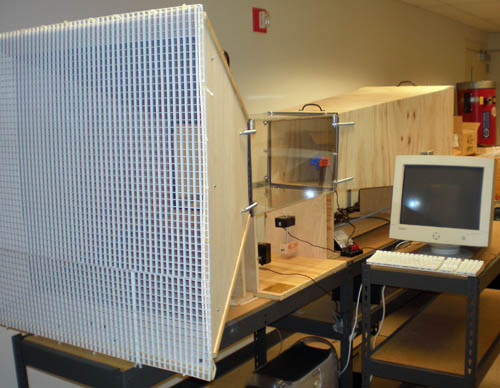
Looking for an easy way to keep on making stuff even though you’re living in a tiny dorm room? [Matt Silver] was tired of not having a dedicated work-space, so he spent some serious time designing this modular, re-configurable and collapsible portable workstation ready for almost anything.

He started out by sketching ideas, playing around with 3D models in SketchUp, and eventually building a few prototypes using trial and error — and what he’s come up with is pretty darn impressive. It folds down to just under a foot by three feet squared and has casters to roll it around. Once unfolded, you stabilize it by placing your chair on one of the walls that folds down, and the desk itself is also re-configurable for different work surfaces. He’s included a power bar, an LED work-light, and it even has storage racks for tools on the side.

It’s a very thorough Instructable, and definitely worth a look through — especially to see how it magically unfolds! And if you’re wondering about how much it would cost to build, you’re probably looking at around $200 depending on what you already have on hand. What we really like is how it’s almost entirely made out of a single 4’x8′ panel of plywood — it’s like this guy works for IKEA or something!

Turn Your Drill Press Into A Bobbin/Spindle Sander

drill press ander

Drill presses are a staple tool of the typical garage — they aren’t too expensive and are indispensably useful — but have you ever thought of turning it into a spindle sander?

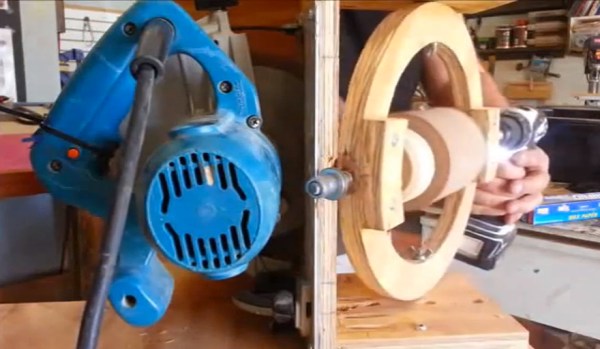
You can buy drum sander kits fairly cheap, but the problem is they’re really difficult to use and really messy too — you’ll have sawdust everywhere in no time. What [Carl’s] done here is created a wood box for his drill press with different size holes for each drum sander bit. By attaching a vacuum cleaner to the box, you can clean up your mess while you’re still doing the work.

Just a note — drill presses aren’t designed to take radial loads like a mill is. If you’re planning on doing some really heavy sanding, adding a bolt through the entire drum sander bit and then coupling it with a fixed bearing inside of your box might be a good idea.

It’s a pretty simple hack, but could save you an additional power tool, and space on your work bench! Have a drill but no drill press? No problem.


3D Printed Cyclone Dust Separator

DSCN7011

[Nicholas] has been reading Hackaday for a few months now, and after seeing several people’s dust extractor setups, he decided to make his own 3D printed version. And he’s sharing the files with everyone!

He has a small Lobo mill which produces a lot of dust and to clean up he’s been using a small “Shark” brand vacuum cleaner. It’s a powerful little thing, but has little to no capacity which makes it rather frustrating to use. This makes it a perfect candidate for a cyclone upgrade! If you’re not familiar with cyclonic separator it’s a way of removing dust from air using vortex separation — between rotational forces and gravity, this keeps the dust out of your vacuum cleaner and means you never need to change another filter!

Using Autodesk inventor he designed this 4-stage cyclone separator. It’s made for a 1.75″ OD vacuum hose (the Shark standard) but could be easily modified for different vacuums. We’ve seen lots of cyclone separators before, but this 3D printed one certainly makes it easier to fabricate to exacting standards!

Recovering Nichrome Wire From Unexpected Sources

115b-guitar-hero

Don’t you hate it when you’re in a pinch and all your favorite surplus or electronic stores are closed? You’ve gotta finish this project, but how? He’s a nice real hack for you guys.  How to recover nichrome wire from a ceramic heater!

Necessity spawned this idea, as [Armilar] needed to make 45 cuts in two pieces of foam in order to ship some long circuit boards. Not wanting to make the 90 cuts individually, he improvised this nichrome slicing jig. Not having a spool of nichrome handy, he decided to use a less conventional method. He pulled out a sledgehammer and smashed open a ceramic wirewound resistor.

According to him, nice big ceramic resistors like this 10W one have about a meter of nichrome wire inside!  After breaking the ceramic, it’s quite easy to remove. He made up a jig using nylon spacers and rivets, and then wrapped his wire back and forth across the whole length. It worked perfectly — though he was using 240VDC @ about 1.2A…

If you don’t need such a complex setup, there’s always the bare bones wire foam cutters we’ve featured many times before.

Turning An Analog Scope Into A Logic Analyzer

scope

When [Marco] was planning on a storage oscilloscope build, he realized having a small device to display eight digital signals on an analog scope would be extremely useful. This just happens to be the exact description of a simple logic analyzer and managed to turn his idea into a neat little project (German, Google translation).

The theory of operation for this surprisingly simple, and something that could be completed in a few hours with a reasonably well stocked hackerspace or parts drawer in a few hours. A clock generator and binary counter are fed into the lower three bits of a simple R2R DAC, while the 8 inputs are fed into an 8-input multiplexer and sent to the last bit of the DAC. With nothing connected to the logic analyzer inputs, the output to the scope would just be an 8-step ramp that would appear as eight horizontal lines on the screen. With something connected to the logic analyzer input, an extremely primitive but still very useful logic analyzer appears on the screen.

While it’s not the greatest analyzer, it is something that can be cobbled together in an hour or two, and the capabilities are more than sufficient to debug a few simple circuits or figure out some timings in a project.

Creative Continuity Tester Made For A Few Bucks

13595431395_4be0feaf4f_b

No multi-meter? For troubleshooting most household things, a continuity tester is extremely handy. And as it turns out, you can make your own from the dollar store for next to nothing.

[Carlyn] shows us how to make two different styles of continuity testers — a light up version using a bicycle light, or a buzzer version using one of those cheap window alarms. The leads are made of 1/8″ audio cables — and everything for both these testers cost less than $5 from their local dollar store. It’s a very simple build process that you can probably figure out just from this one photo, but [Carlyn] has also taken pictures of every step along the way.

Compared to building one of these out of components from Radio Shack, this method is much more MacGyver, and cheap! Hooray for taking advantage of mass produced consumer products!

Not functional enough? How about building a talking multimeter instead? No? Have you ever wanted two multi-meters in one? Say hello to the Mooshimeter!

Arduino Controlled Dahlander Motor Switch


Dahlander Switch

[Jean-Noel] is fixing a broken Lurem woodworking machine. This machine uses a three-phase Dahlander motor, which has three operation modes: stop, half speed, and full speed. The motor uses a special mechanical switch to select the operating mode. Unfortunately, the mechanical bits inside the switch were broken, and the motor couldn’t be turned on.

To solve the problem without sourcing a new switch, [Jean-Noel] built his own Arduino based Dahlander switch. This consists of three relays that select the wiring configuration for each speed mode. There’s also a button to toggle settings, and two lamps to show what mode the motor is currently in.

The Arduino runs a finite-state machine (FSM), ensuring that the device transitions through the modes in the correct order. This is quite important, since the motor could be damaged if certain restrictions aren’t followed. The state machine graph was generated using Fizzim, a free tool that generates not only FSM graphs, but also Verilog and VHDL code for the machines.

The final product is housed in a DIN rail case, which allows it to be securely mounted along with the rest of the wiring. The detailed write-up on this project explains all the details of the motor, and the challenges of building this replacement switch.