Arduino Thermo-cam

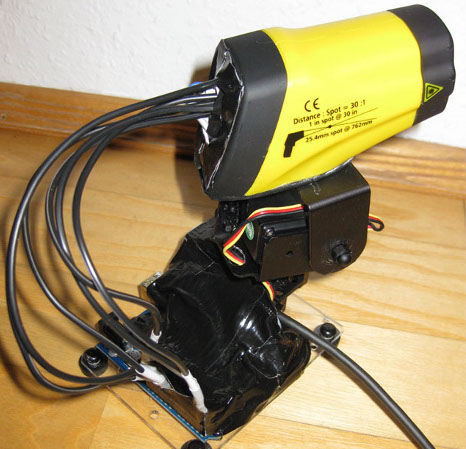
[Maxbot] wanted a inferared themo-cam that he could use to scan an area and display the results on his computer, the result is this Cheap-Thermocam. This little device is a inexpensive thermal sensor mounted on a pair of servo’s for XY scanning, custom java software and an Arudino to mate the two.

The sanner does a limited but still useful resolution of 42×32 pixels. To help out with smoothness of the colors, every other line of the finished product is interpolated against its neighbors. It takes the device about two minutes to measure each of the 1344 points, but what it lacks in speed it more than makes up for in cost, boasting around 100$ build cost, and ease of construction.

While exact details of what parts you need and how to hook everything up is lacking at this moment, there is a page in the works that will let you know all the good details “soon”, though if you are inspired to replicate one of these nifty devices it seems the most difficult part would be tapping into the sensor’s electronics and the custom software.

Cheap, hacky, and even comes with its own roll of duct tape. We have a short video for you after the break.
Continue reading “Arduino Thermo-cam”

Hacking Strippers To Do Your Bidding

wire_strippers

[Alex] knows his strippers.

By his estimation, he has stripped millions of wires over the years, and he has seen his fair share of wire strippers come and go. That cheap set of wire strippers you have with the graduated holes, or that adjustable stripper you squeeze as you pull the wire through? They just stress the insulation as well as the wires you are trying to strip – he says you might as well just use them in your tackle box.

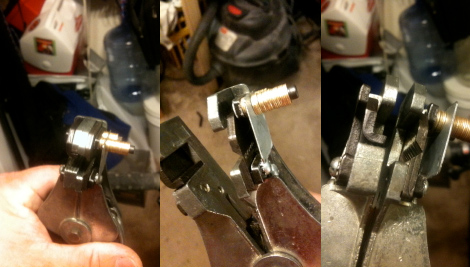
His favorite style of wire stripper is the automatic kind that grip the wire, then cut and remove the insulation just by squeezing the handles. His issue with this particular tool is that it’s difficult to get a uniform length of stripped wire when working in volume.

Since [Alex] needs uniformity in his line of work, he modified a set of automatic wire strippers to include an adjustable wire stop. He determines the length of wire he needs, adds or removes some washers from his wire stop, and off he goes. It’s a very simple yet very useful hack, depending on your application. We bet it is probably one of the most accurate ways to get uniform length, this side of a fully automatic wire stripper.

Simple PCB Etchant Made From Chemicals You Can Put In Your Mouth

etching_test

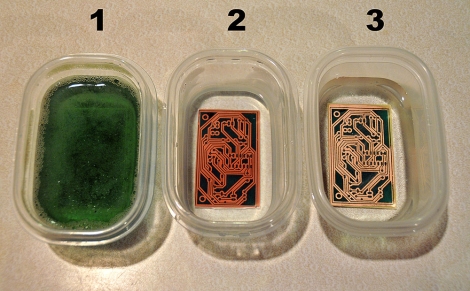
[Stephen] often finds the need to make his own PCBs at home, and when he got the urge to do some etching recently, he realized that he was fresh out of “Ferret Chloride and Bureaucratic Acid*.” Undeterred by his empty chemical cabinet, he poked around in his kitchen mixing together anything and everything that might have the ability to strip copper from a PCB.

Now, we don’t necessarily recommend this course of action, but it seems that he finally hit upon a winner. He discovered a formula that can be made at home from simple and safe household ingredients which does the job quite nicely. A fair warning however, standard ferric chloride disposal procedures need to be followed when using this solution.

If you want to know what he concocted in his kitchen as well as the chemistry behind it, you will have to visit his site, we won’t ruin it for you. You can however, see the solution at work in the video we have posted below.

*His joke, not ours

Continue reading “Simple PCB Etchant Made From Chemicals You Can Put In Your Mouth”

Open Source Laser Cutter (v2)

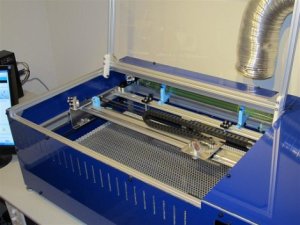
The Buildlog.net 2.x Laser is a second generation open source laser cutter that definitely improves the design of the first model. The 2 axis machine (optional vertical axis is manual or an upgrade is available) boasts a large 12” x 20” x 4” workspace while being smaller than its predecessor, fitting a table top design.

The older model had a goal of being self replicating, which limited the types of materials used, the new 2.x model drops that goal and uses stronger metal parts. Electronics are now modularized that allow easier and cleaner wiring, though you will still need a controller board.

There is an XMOS based controller provided on the main page of BuildLog.net, along with mechanical drawings, schematics, gerbers, instructions for both machines, and kit parts (for the first model) along with resources for the heavy items like laser tubes and power supplies.

Super Winch Makes Sledding 100% More Fun

sledding_winch

As every kid quickly finds out, sledding in the winter is awesome until you have to trudge back up to the top of the hill. If your sledding run is reasonably short, this isn’t a problem, but if you sled on huge hills like [Josh], you need to figure something out.

He had a go kart motor sitting around, so he figured he might as well put it to good use as a sledding winch. The winch runs a continual loop of over 1000 feet of rope, and is able to pull 3 adults up a 30 degree incline fairly easily. They say that necessity is the mother of innovation, but at some point you have to ask, “Does sledding really require an 8 HP motor and a continuously variable transmission?” The answer, of course is a resounding “Yes!”

Not only does this winch allow [Josh] and his friends to get back to real business of sledding in a hurry, it actually makes sledding fun in both directions.

Keep reading to see a video of the winch in action, and be sure to check out some other fun uses for winches we have featured in the past.

[via Neatorama]

Continue reading “Super Winch Makes Sledding 100% More Fun”

Easy To Build Rig Prevents Reflow Soldering Mishaps

reflow_soldering_rig

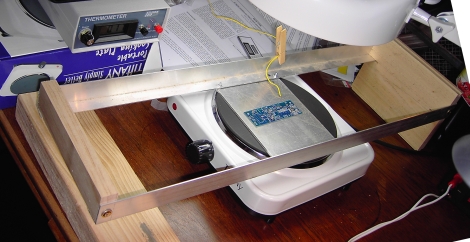
[Erich aka VK5HSE] performs quite a bit of solder reflow work, but has always been concerned about bumping his circuit boards once the solder has liquified and is ready to be removed from the heat source. He says that removing workpieces from toaster ovens often results in the unintentional jarring of a circuit board full of components sitting on molten solder, and he wanted to find a solution.

Using some off-the shelf components from a local hardware store, he built a rig that fits on top of a hot plate, allowing him to move hot circuit boards away from the heat source in a smooth controlled motion. The rig is pretty simple, not only preventing unwanted workpiece movement, but also making it easy to regulate the amount of time a circuit board is allowed to heat.

He suggests that his design is not absolutely ideal, and that it can easily be improved upon in several ways without adding significant cost to the project.

555 Inductance Meter

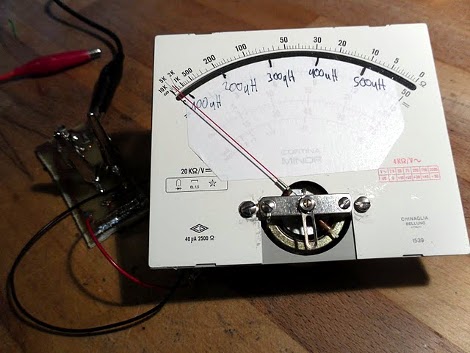
[Apexys] is performing some experiments with switched-mode power supplies and needed to compare the inductance of the coils he was using. His multimeter doesn’t have an inductance testing function, but he does have a 555 timer on hand. He put the 555 and some other parts together to create his own L meter. The writeup includes the theory behind this meter, with an incoming AC source converted to a voltage by an RC network.

Once he’d worked out the design it was time to build the circuit. Instead of printing a circuit board he created what he calls a DCB; Drawn Circuit Board. We’ve got to admit that this was way faster than using toner transfer or soldering point-to-point. We also like his use of an Erlenmeyer flask and a torch to heat the etchant. We don’t make PCBs in the winter because our Cupric Chloride is too cold to use outside but that may change now. The final piece in the puzzle is an analog meter which he pulled from an extra microamp meter he had on hand. Check out the demo after the break.

Continue reading “555 Inductance Meter”