Pong, For Real

[youtube=http://www.youtube.com/watch?v=Z5mjx1iYt5g]

Over at EvilMadScientistLaboratories.com they’ve asked a question that many of us have never thought to ask. What exactly is Pong supposed to be? Instead of assuming it was ping pong like the rest of us, they decided to build a literal physical  interpretation. They may have taken some liberty, using solenoids as the paddles, but the end effect is quite nice. Watching them play actually looks both challenging and fun. There’s a great writeup about the construction, so be sure to check out the project page.

Missile Hack Taunts Your Cat

[youtube=http://www.youtube.com/watch?v=3K7rTWnuQ6Y]

[Atlantageek] sent in a missile launcher project that he threw together. For Christmas he received a Chumby One and a ThinkGeek USB Rocket Launcher as gifts (lucky dog). Neither of these toys are “played with” in the traditional sense as much as they become centerpieces of your next hack. In that spirit, [Atlantageek] immediately wrote a widget to control the launcher via the Chumby. The side effect of driving his cat bonkers was an unexpected bonus.

Step-a-sketch

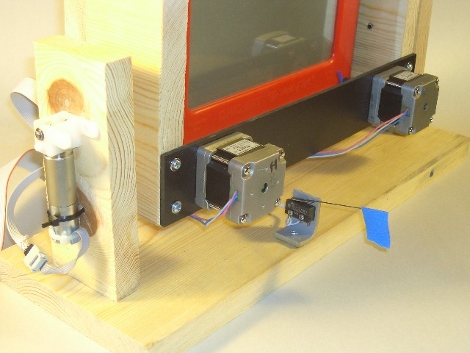
[Chris] is getting his feet wet with Computer Numerical Control starting with an Etch-a-Sketch interface. This is a great way to start out because the really tough parts of the project are already inside of the toy. He’s replaced the two white knobs with stepper motors and connected them through a mosfet network to a PIC 16f84a. The PIC then gets its commands from a computer via the parallel port.

A video of the CNC machine can be seen after the break. He needs to add a frame to increase the precision of the images drawn but this first attempt is pretty good. We prefer to have the computer in charge of the design because controlling an Etch-a-Sketch with a mouse doesn’t make our drawings any better. Continue reading “Step-a-sketch”

Star Trek Submarine

[youtube=http://www.youtube.com/watch?v=zQEsG4eKIXs]

You can try to be unimpressed. You can attempt to feign disinterest. But even the most casual Star Trek fan will get giddy watching this model submarine in action.  Apparently there is a group that builds under water R/C vehicles from static models. It’s not Star Trek exclusively either, we saw some anime vehicles as well as a modern-day shuttle replica.

[via Makezine]

Open Source Artillery

[youtube=http://www.youtube.com/watch?v=zPm84nxa2dk]

Thanks to [Josh, Kyle, and Mike], it is now possible to wage (Nerf) war with an Arduino. The turret designed around it is capable of shooting 6 foam projectiles in close succession, between reloads. The faux weapon interfaces with a computer through the Arduino’s onboard serial link (via USB). Software on the PC sends commands to the Arduino, which then executes functions, such as panning, tilting, firing, and rotating the cylinder. The power for the firing itself comes from a 5 gal, 80 psi air compressor. The Java software on the host PC also does smarter things, like show streaming video from the turret’s webcam and even performs basic object tracking (with mixed success). All the code for building the brute is available on [Josh’s] website.

Cheap Toy Yields Good Parts

We’ve spent some serious time building robot chassis and motor controllers. [Whamodyne] does the smart thing and scavenges what he needs form cheap sources. He picked up an RC car from the local pharmacy for just $10, tore the body off and behold, a bounty of robot-friendly parts.

We’re not talking precision parts here, but we don’t scoff at two geared motors, four wheels, a driver board, and steering. There’s no great way to attach your own stuff but that’s half the fun of hacking. [Whamodyne] used the 9v battery that came with the toy to power his boarduino and quickly patched in to produce a miracle of automated locomotion.

BrickAVR: The Proto-brick

Sometimes, prototyping systems need to be robust, full-featured, and powerful. Other times, nostalgia and simplicity are much more appealing. Rather than buying a pre-made prototyping board, one of our readers grabbed some parts lying around, including an Atmega8, a SMD 16Mhz oscillator, and a 6 pin ISP header, and performed some circuit origami free-form soldering (thanks [Gilberti]!). After it was assembled, he realized that it fit in a hollowed out 2×6 Lego brick rather easily. After adding female headers to the pins, as well as a label and some hot glue to seal it up, he was left with a fully functional, and most likely very durable centerpiece to a project. We would love to see this worked into a Lego Mindstorm robot, just for the sake of fitting in.