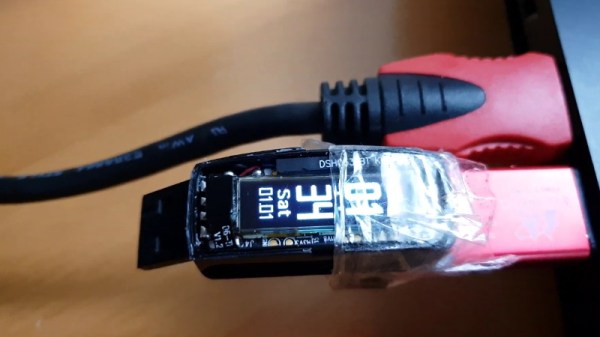
[Aaron Christophel] writes in with yet another clever hack for his D6 Fitness Tracker. Using OpenOCD and Pygame, he shows how you can pull data right off the tracker’s screen and sent it to the computer.
This one appealed to us for its brevity. First [Aaron] launches the OpenOCD server which connects to the D6. Then, a short Python script connects to the server through telnet, reads the screen data, and uses a look-up table to turn the data into a duplicate display on the PC screen. If you’re more of a visual learner, there’s a demonstration video after the break.
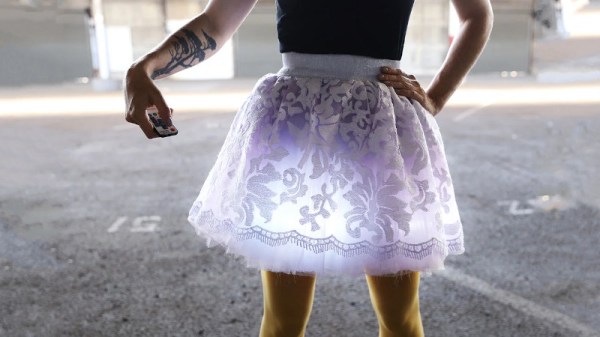
Versatility is always a boon in any outfit. [Mikaela Holmes] wanted to create a skirt that could be unassuming by day, but be the life of the party when the lights go down. Her Day-To-Night Light Skirt achieves just that!
The build is one that should be achievable by anyone with basic dressmaking skills. White and lavender tutus are combined to form the base of the skirt, with a lace outer layer sewn on to create an attractive silhouette for the lights. A USB battery pack is hidden in a pocket in the back to power the show. A WS2812B LED strip is then attached to the skirt, and hidden behind an additional layer of white faux-fur to help diffuse the light.
A pre-programmed LED controller from Cool Neon is used to run the strip, meaning no microcontroller code is required. It also allows the skirt’s lighting effects to be controlled by remote. Such controllers can make getting a glowable project up and running more quickly, particularly for those with less experience in the microcontroller space. Plus, the project can always be upgraded with a fancier controller later. For the most part, the vast majority of glowable projects use similar flashing and fading animations anyway; there’s really no need to reinvent the wheel every time.
[Mikaela] does a great job of showing the necessary steps to produce a skirt that is both attractive and functional. We’ve seen other great projects in this space before, too – like this awesome fibre optic piece. If you’re sewing up your own impressive glowable fashions, be sure to let us know! Video after the break.
Whether it was rays from the Sun that made a 150 million kilometer trip just to ruin your day or somebody’s unreasonably bright aftermarket headlights, at some point or another we’ve all experienced the discomfort of bright spots in our eyes. But short of wearing welder’s goggles all the time, what can we do? Luckily for us, [Nick Bild] has come up with a solution. Sort of.
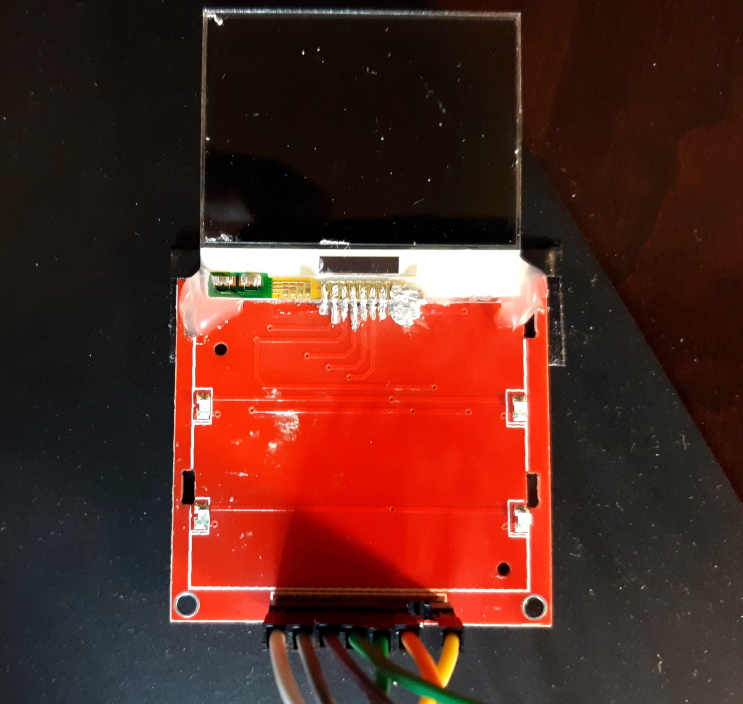
Modifying the LCD so it can be seen through.
By adding LCDs to a pair of standard sunglasses, [Nick] has created something he’s calling “Light Brakes”. The idea is that the LCDs, having their backings removed, can essentially be used as programmable shutters to block out a specific part of the image that’s passing through them. With the addition of a Raspberry Pi and a camera, the Light Brakes can identify an unusually bright source of light and block it from the wearer’s vision by drawing a sufficiently large blob on the LCDs.
At least, that’s the idea. As you can see in the video after the break, the LCDs ability to block out a moving source of light is somewhat debatable. It’s also unclear what, if any, effect the “blocking” would have on UV, so you definitely shouldn’t try looking at the sun with a pair of these.
That said, a refined version of the concept could have some very interesting applications. For instance, imagine a pair of glasses that could actively block out advertisements or other unpleasant images from your field of vision. If this all sounds a bit like something out of an episode of Black Mirror, that’s because it is.
Humans didn’t come with wings from the factory, and most efforts to fit them after the fact have been at least as far as flight is concerned, largely fruitless. That doesn’t mean you can’t cut a devastatingly sharp aesthetic though, and [Natalina’s] fiber optic wings are a great way to do just that.
The wings are a leathercraft project, consisting of a harness worn around the torso. This serves as the mounting point for the fiber optics, as well as the RGB Critter flashlight used to drive the lightshow. Leather parts are lasercut to the right shape, making it easy to create the delicate feather shapes in the design. The pieces are then dyed appropriately and sewn together into the final shape. Bundles of optical fibers are then wound through the harness, sprouting from either shoulder of the wearer. EVA foam is used to help create the right shape for the wings, allowing the different layers to remain separated to create more visual depth.
It’s a build that looks absolutely striking at night, and unlike some other wing-based cosplays, doesn’t have as many drawbacks as far as crowds and transportation. It would make a killer look if you’re going as a Hacker Angel for Halloween this.
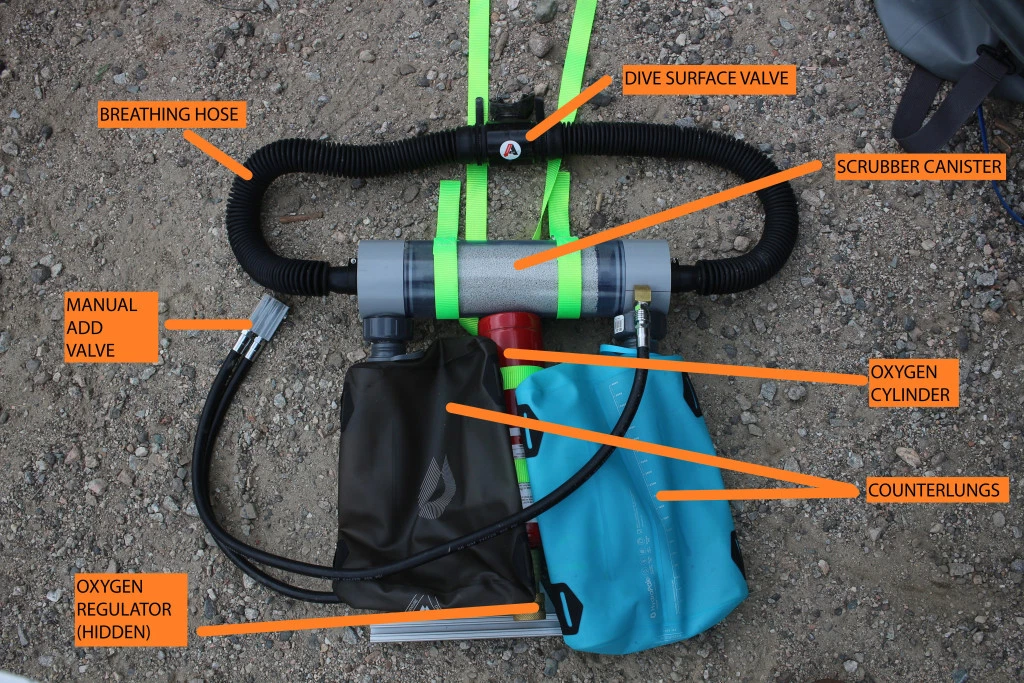
While the homebrew rebreather the [AyLo] describes on his blog looks exceptionally well engineered and is documented to a level we don’t often see, he still makes it very clear that he’s not suggesting you actually build one yourself. He’s very upfront about the fact that he has no formal training, and notes that he’s already identified several critical mistakes. That being said, he’s taken his rebreather out for a few dives and has (quite literally) lived to tell the tale, so he figured others might be interested in reading about his experiments.
For the landlubbers in the audience, a rebreather removes the CO2 from exhaled air and recirculates the remaining O2 for another pass through the lungs. Compared to open circuit systems, a rebreather can substantially increase the amount of time a diver can remain submerged for a given volume of gas. Rebreathers aren’t just for diving either, the same basic concept was used in the Apollo PLSS to increase the amount of time the astronauts could spend on the surface of the Moon.
The science behind it seemed simple enough, so [AyLo] did his research and starting designing a bare-minimum rebreather system in CAD. Rather than completely hack something together with zip ties, he wanted to take the time to make sure that he could at least mate his hardware with legitimate commercial scuba components wherever possible to minimize his points of failure. It meant more time designing and machining his parts, but the higher safety factor seems well worth the effort.
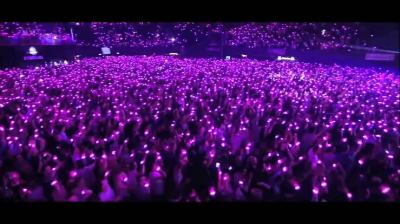
The Pixmob band is an LED wrist strap, of the type often used at big concerts or other public events. Many have tinkered with the device, but as of yet, nobody was running custom code. It wouldn’t be easy, but [JinGen Lim] got down to work.
The wristbands are given out to concertgoers to create synchronized light shows in the crowd.
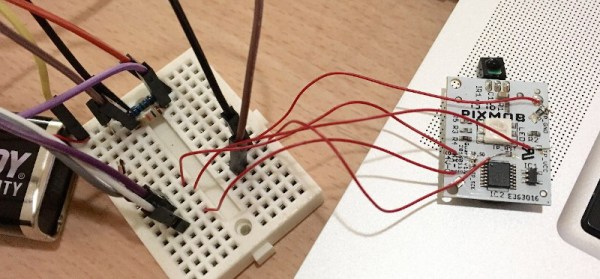
A teardown of a 2016 device revealed it consisted of an RGB LED, an IR sensor, a small EEPROM and a coin cell, which were all common parts. Unfortunately, the ABOV MC81F4204 microcontroller was a little more obscure. It’s a part that’s quite hard to find, and uses a proprietary programmer and an ancient IDE.
Searches online proved fruitless, and a working programmer remained outside [JinGen]’s grasp. Undeterred, he decided to simply walk into the company’s Korean headquarters and ask for help. As the part was end-of-life, they were unable to supply a programming device, but happily provided documentation for the chip that wasn’t publicly available. With this in hand, it was possible for [JinGen] to build his own programmer instead.
Booting up a copy of the ABOV IDE, with his newly-built programmer in hand, it was relatively easy to get the chip running custom code. Going the extra mile, [JinGen] even hacked the Arduino IDE to be partially compatible with the platform! A silicon error in the MC81F4204 design bricks the chips after only a few flash rewrites, so its never going to be the most useful platform, but it works nonetheless.
The Pixmob hardware has continued to evolve, and it’s unlikely modern units still use the same chip. Despite this, it’s a great example of what can be achieved by a little sleuthing and asking the right people the right questions. Others have attempted to hack similar products before, found at Disneyland and Coldplay concerts. You won’t catch this author at either, but if you’ve hacked something similar, be sure to reach out on the tip line!
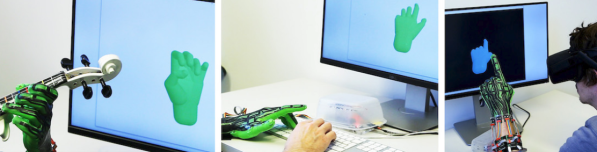
Like many hand-recognition gloves, this “stretch-sensing soft glove” mounts the sensors directly into the glove such that movements can be captured while hands are out of plain sight. However, unlike other gloves, sensors are custom-made from two stretchable conductive layers sandwiched between a plain layer of silicone. The result is a grid of 44 capacitive stretch sensors. The team feeds this datastream into a neural network for gesture processing, and the result is a system capable of reconstructing hand poses at 60Hz refresh rates.
In their paper [PDF], the research team details a process of making the glove with a conventional CO2 laser cutter. They first cast a conductive silicone layer onto a conventional sheet of silicone. Then, with two samples, they selectively etch away the conductive layer with the unique capacitive grid images. Finally, they sandwich these layers together with an additional insulating and glue it into a hand-shaped textile pattern. The resulting process is a classy use of the laser cutter for the design of flexible capacitive circuits without any further specialized hardware processes.
While we’re no stranger to retrofitting gloves with sensors or etching unconventional materials, the fidelity of this research project is in a class of its own. We can’t wait to see folks extend this technique into other wearable stretch sensors. For a deeper dive into the glove’s capabilities, have a look at the video after the break.

 The build is one that should be achievable by anyone with basic dressmaking skills. White and lavender tutus are combined to form the base of the skirt, with a lace outer layer sewn on to create an attractive silhouette for the lights. A USB battery pack is hidden in a pocket in the back to power the show. A WS2812B LED strip is then attached to the skirt, and hidden behind an additional layer of white faux-fur to help diffuse the light.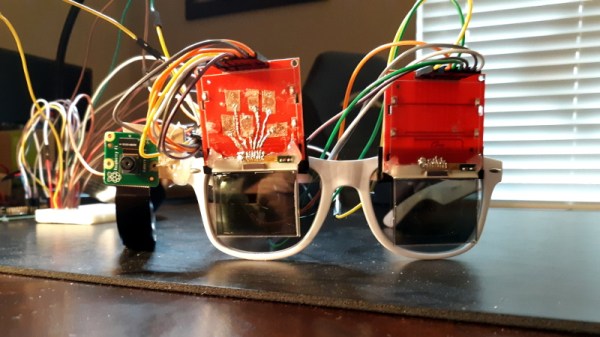
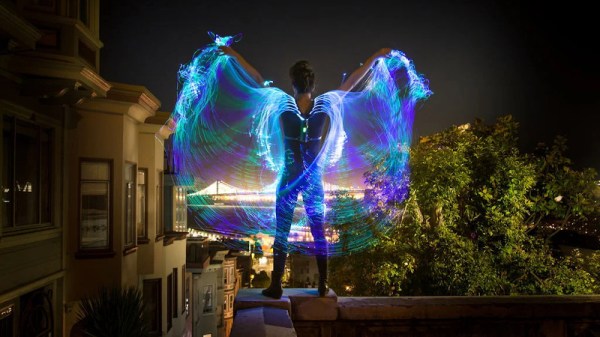
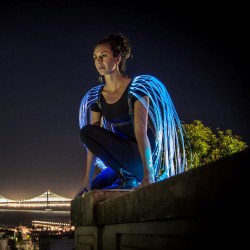 The wings are a leathercraft project, consisting of a harness worn around the torso. This serves as the mounting point for the fiber optics, as well as the RGB Critter flashlight used to drive the lightshow. Leather parts are lasercut to the right shape, making it easy to create the delicate feather shapes in the design. The pieces are then dyed appropriately and sewn together into the final shape. Bundles of optical fibers are then wound through the harness, sprouting from either shoulder of the wearer. EVA foam is used to help create the right shape for the wings, allowing the different layers to remain separated to create more visual depth.