Converting A Weather Station Kit For Wireless Data Harvesting

converting-weather-station-for-wireless-data-collection

Everyone loves getting something you can play with as a Christmas gift. [Thomas] was the lucky recipient of an Elektor USB weather station kit. But the fun didn’t end once he had assembled everything. He went on to hack the device for wireless data collection.

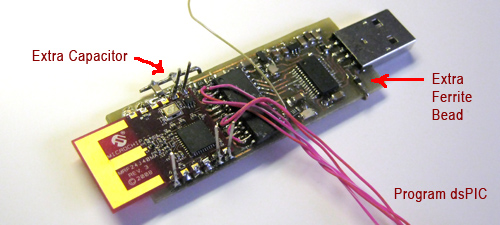
Shown above is the weather station board connected to the transmitter. The red board with a tiny antenna to the right is a Rovio RN-VX module. It is capable of transmitting serial data to its twin on the receiving end of the setup. The weather station is pretty easy to connect to the transmitter since it feeds serial data to an FTDI USB chip. [Thomas] simply connected power and ground, then added a jumper from the board’s TX pin to the Rovio’s RX pin. The receiving end uses a serial-to-USB converter — getting a signal for its RX pin from the TX pin on the Rovio receiver board.

We know from other projects that these radio modules can connect to a WiFi AP. Perhaps a future revision of [Thomas’] hack will allow the weather station to communicate with his server over the network, doing away with the need for a standalone receiver.

A Pirate Box For Sharing Files

This is [illwill]’s Pirate Box, the newest addition to the network over at NESIT, the Meriden, CT hackerspace.

A pirate box is a completely anonymous wireless file server, kind of like a wireless version of a dead drop. It’s the perfect device for transferring files at a LAN party or hackerspace. The guts of [illwill]’s portable server comes from an old Fonera router NESIT had lying around. After installing OpenWRT, connecting a few batteries, and finding a wonderful lunch box / treasure chest enclosure on ebay, [illwill] had a portable file server perfect for sharing files.

The pirate box isn’t connected to the Internet. Instead, users can connect to each other and the 16GB USB drive by simply connecting to the router’s WiFi and opening up a browser. All web page requests are redirected to the Pirate Box page, where users can chat and share files. The folks at NESIT uploaded a few public domain files to their pirate box, but they’re anxiously waiting to see what files other users will upload.XVID.AC3.HQ.Hive-CM8.

Finally, TI Is Producing Simple, Cheap WiFi Modules

Ever responsive to the hobbyist market, Texas Instruments is releasing a very inexpensive, very simple WiFi module specifically designed for that Internet of Things.

The TI SimpleLink TI CC3000 WiFi module is a single-chip solution to putting 802.11b/g WiFi in just about every project you can dream up. Just about everything needed to put the Internet in a microcontroller is included in this chip – there’s a TCP/IP stack included on the chip, along with all the security stuff needed to actually connect to a network.

The inexpensive micocontroller WiFi solutions we’ve seen – including the very cool Electric Imp – had difficult, or at least odd, means of putting WiFi credentials such as the SSID and password onto the device. TI is simplifying this with SmartConfig, an app running on a phone, tablet, or PC that automagically takes care of setting up a link in a wireless network.

Best of all, the CC3000 only costs $10 in quantities of 1000. Compare that to other Internet of Things WiFi solutions, and it looks like we might be seeing and easy and cheap way to connect a project to the internet this year.

Bluetooth Hack For Serioux Panda Speakers

bluetooth-powered-panda-speakers

[Bogdan] received this set of Serioux Panda speakers as a gift. I turns out that they sound very good and he decided to make them more useful to him by converting them to work as Bluetooth speakers.

To begin with he bought the cheapest A2DP device he could find. This is the protocol that identifies a Bluetooth audio device. The unit is designed to provide a Bluetooth connection for a set of headphones. He patched into the headphone port on that board, but also wanted to keep the option of using the Panda speakers’ line-in. To do this he added a 1k resistor to each of the audio channels. A connection was made from the 5V rail of the speakers to power the Bluetooth module rather than leaving it with its own battery.

Speaking of batteries, the Panda speakers can run from three AAA cells. This battery compartment was a perfect place to mount the add-on hardware. But the speaker can still be powered from a USB connector. Above [Bogdan] is using a portable USB power supply.

Watermelon Air Boat

watermelon-air-boat

We think you’ll turn a few heads in Central Park if you’re driving a water melon around when everyone else is piloting sailboats. This watermelon is both sea worthy and radio controlled thanks to the work which [Starting Electronics] put into it.

We used this image because it shows you what’s inside of the hull, but you don’t want to miss the thing motoring around an above-ground swimming pool in the clip after the break. The hollowed out shell is quite buoyant and has no problem staying afloat and upright with the addition of a propeller. The parts from a remote control airplane kit have been mounted on a wooden scaffold. This provides plenty of thrust with a servo motor moving turning the prop for directional control. There is no dagger board so the craft is a bit slow to respond to turns. But how responsive do you expect a floating melon to be?

Continue reading “Watermelon Air Boat”

Cheap Biquad Antenna Extends LAN Between Apartments

[Danilo Larizza] is sharing a network connection between a couple of apartments. They are not far apart, but they are also not right next to each other so a set of external antennas is necessary. He built this 2.4 GHz biquad antenna on the cheap (translated) just to test if it improved the signal before he tried to buy a proper antenna. It turns out to work well enough that this is all that he needs.

The antenna itself is about one meter of thick wire bent into two squares which are 31mm on each side. The coaxial cable going to the router connects to the center portion of this antenna. For a bit better directional reception he added some tin foil as a reflector. Since this is outdoors he used a food storage container for protection (the antenna is mounted to the lid, the body has been removed for this picture). The whole things is perched on a stake in a flower pot with proper line of sight to the other antenna.

We’ve seen a very similar design used for an NRF 24L01+ radio. If you need more details that [Danilo] posted that would be a good project to study.

Wireless Speaker Made Using Arduinos And 2.4 GHz Tranceivers

[Texane] picked up a 2.4 GHz transmitter/receiver pair for transmitting sensor data wirelessly. After using them in a project he wanted to try pushing them a bit to see what the limits are when it comes to higher bandwidths. He ended up building a wireless speaker that transmits audio at about 90 KB/s. That link leads to a subfolder of his git repository. The code for this project is in the RX and TX folders, with images and video in the DOC folder.

The radio hardware that he’s using is a Nordic nRF24L01P chip which is available on a breakout board from Sparkfun. [Texane] mentioned to us that the chip includes error checking, packet ACK, and automatic retransmission. But these add overhead that can slow things down. The chip does offer the option to disable these features to get lower level access to the hardware. That’s exactly what he did and he mentions that the example code he wrote for the transmitter and receiver make every cycle count. This makes us wonder if it’s the speed of the ATmega328 chip that is the bottleneck, or the transceivers themselves?