Arduino (PCI) Express

It is almost impossible these days to find a PC with old ISA card slots. Full size PCI card slots are in danger of going the same way. Many PCs today feature PCI Express connectors. PCI Express offers a lot of advantages including a small size, lower pin count, and a point-to-point serial bus topology that allows multiple simultaneous transfers between different pairs of end points. You’ll find PC Express connectors in things other than PCs too, including a lot of larger embedded systems.

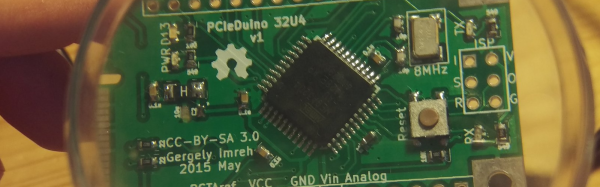
If you ever wanted to prototype something on PCI Express, you’d usually turn to an FPGA. However, [moonpunchorg] posted a workable design for an Arduino on a mini PCI Express board. (As [imroy264] points out in the comments, the board is using the USB port present on the PCI-E connector.) The design files use KiCAD so it should be fairly easy to replicate or change. Naturally, there are pins on the edges to access I/O ports and power. You do need to use ISP to program the Arduino bootloader on the chip.

The board appears to a host computer as a SparkFun as a Pro Micro 3.3V board, and from there you could easily add function to a computer with a PCI Express slot using nothing more than the Arduino IDE. The board is known to work with the VIA VAB-600 Springboard and VIA VAB-820 boards, although it is likely to work with other PCI Express hosts, too.

[Federico Musto] Of Arduino SRL Discusses Arduino Legal Situation

Recently we had the opportunity to sit down and interview Arduino SRL’s CEO, [Federico Musto], over a nice dinner. His company is one half of the Arduino vs Arduino debacle which has pitted Arduino.cc against Arduino.org in a battle over the trademark on “Arduino”.

Given the tremendous amount of press coverage of [Massimo Banzi] and the Arduino LLC side of the story (Arduino.cc), we were very interested in hearing how the whole situation looks where [Frederico Musto] sit (Arduino.org). In the end, we came away with what we feel is a more balanced and complete picture of the situation, as well as interesting news about future products from the Arduino SRL camp. [Musto’s] take on the legal proceedings, both past and present, is nothing short of fascinating.

Continue reading “[Federico Musto] Of Arduino SRL Discusses Arduino Legal Situation”

Hardware Store CNC Machine Is Remarkably Precise

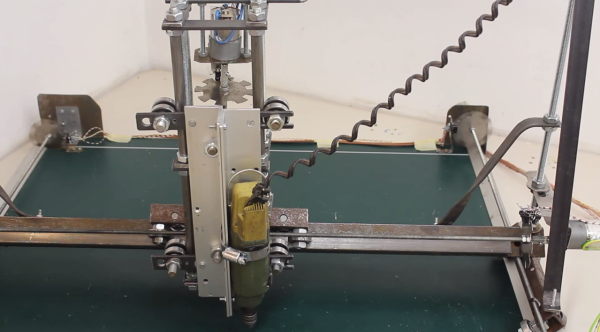
A vise, a hacksaw and file, some wrenches – the fanciest tools [HomoFaciens] uses while building his DIY hardware store CNC machine (YouTube link) are a drill press and some taps. And the bill of materials for this surprisingly precise build is similarly modest: the X- and Y-axes ride on cheap bearings that roll on steel tube stock and aluminum angles; drives are threaded rods with homemade encoders and powered by small brushed DC gear motors; and the base plate appears to be a scrap of ping-pong table. The whole thing is controlled by an Arduino and four H-bridges.

The first accuracy tests using a ball point pen for tooling are quite impressive. [HomoFaciens] was able to draw concentric circles eyeball-accurate to within a few tenths of a millimeter, and was able to show good repeatability in returning to a point from both directions on both the X- and Y-axis. After the pen tests, he shows off a couple of other hardware store tooling options for the Z-axis – a Proxxon rotary tool with a burr for engraving glass; a soldering iron for cutting styrofoam; and a mini-router that works well enough to cut some acrylic gears.

We’re impressed by this build, which demonstrates that you don’t need a fancy shop to build a CNC machine. If you’re getting the itch to jump into the shallow end of the CNC pool, check out some of the builds we’ve featured before, like this PVC CNC machine, or this $250 build.

[Thanks, ThunderSqueak]

Desktop CNC From Hardware Parts Really Makes The Cut

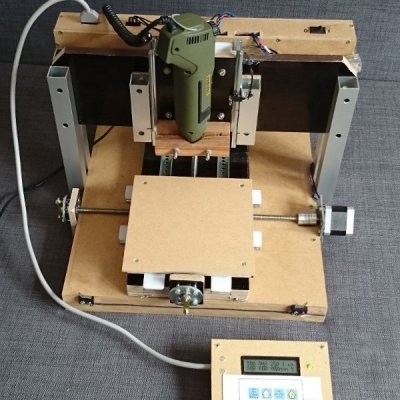
We love shop made CNC mills, so when [joekutz] tipped us off about the desktop sized CNC he just completed, we had to take a look. Each axis slides around on ball bearing drawer slides, and the machine itself is constructed with MDF and aluminum. And the results it produces are fantastic.

4950561437395360713thumbThe machine’s work area weighs in at 160*160mm with a height of 25mm. Its the table is moved around with a pair of NEMA17 motors and M8 stainless steel threaded rods. Motor control is done with a pair of Arduino’s but they also do double duty with one processing G-code while the other handles the keypad and LCD interface.


The business end is a Proxxon rotary tool whizzing up to 2000RPM, and while [joekutz] hasn’t tried it on soft metals like brass or aluminum, he has successfully cut and engraved wood, plastics and copper clad PCB material.

Be sure to join us after the break for some YouTube videos. [joe] has posted three of a planned five-part-series which aren’t linked to in the project page shown above. to see this machine in action and get a rundown how it all works

Continue reading “Desktop CNC From Hardware Parts Really Makes The Cut”

Hackaday Prize Entry: An Arduino Alarm System

The last few years have seen an incredible increase in the marketing for home automation devices. Why this tech is just picking up now is something we’ll never understand – home automation systems have been around for decades, mostly in the form of security systems. For his Hackaday Prize entry, [IngGaro] is building an Arduino-based security system that does everything you would expect from a home automation system, from closing the shutters to temperature monitoring.

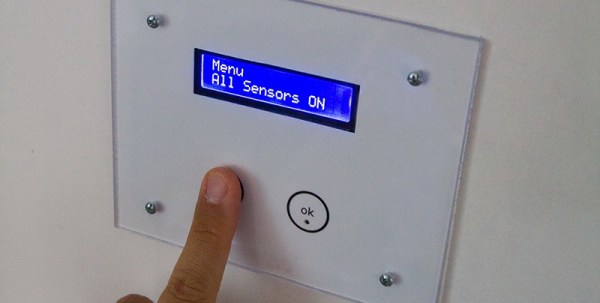
[IngGaro]’s system is built around a shield for an Arduino Mega. This shield includes connections to an alarm system, a GSM modem, temperature and humidity sensors, an Ethernet module, and IR movement sensors. This Arduino Mega attaches to a control box mounted near the front door that’s loaded up with an LCD, an NFC and RFID reader, and a few buttons to arm and disarm the system.

This project has come a long way since it was featured in last year’s Hackaday Prize. Since then [IngGaro] finally completed the project thanks to a change in the Ethernet library. It’s much more stable now, and has the ability to completely control everything in a house that should be automated. Now all [IngGaro] needs to do is create a cool PCB for the project, but in our opinion you can’t do much better than the mastery of perfboard this project already has.

The 2015 Hackaday Prize is sponsored by:

Hackaday Links Column Banner

Hackaday Links: July 19, 2015

Everybody needs an external USB drive at some time or another. If you’re looking for something with the nerd cred you so desperately need, build a 5 1/4″ half height external drive. That’s a mod to an old Quantum Bigfoot drive, and also serves as a pretty good teardown video for this piece of old tech.

The Woxun KG-UV2D and KG-UV3D are pretty good radios, but a lot of amateur radio operators have found these little handheld radios eventually wear out. The faulty part is always a 24C64 Flash chip, and [Shane] is here to show you the repair.

Last year there was a hackathon to build a breast pump that doesn’t suck in both the literal and figurative sense. The winner of the hackathon created a compression-based pump that is completely different from the traditional suction-based mechanism. Now they’re ready for clinical trials, and that means money. A lot of money. For that, they’re turning to Kickstarter.

What you really need is head mounted controls for Battlefield 4. According to [outgoingbot] it’s a hacked Dualshock 4 controller taped to a bike helmet. The helmet-mounted controller has a few leads going to another Dualshock 4 controller with analog sticks. This video starts off by showing the setup.

[Jan] built a modeling MIDI synth around a tiny 8-pin ARM microcontroller.  Despite the low part count, it sounds pretty good. Now he’s turned his attention to the Arduino. This is a much harder programming problem, but it’s still possible to build a good synth with no DAC or PWM.

Talk To The (Robotic) Hand

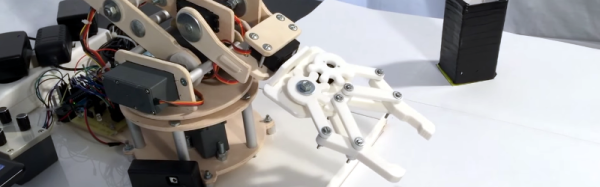
Robotic hacker [Andrea Trufini] apparently likes choices. Not only does his robotic arm have six degrees of freedom, but it has a variety of ways he can control it. The arm’s software can accept commands through a programming language, via potentiometers, an infrared remote, or–the really interesting part–through spoken commands.

The videos don’t show too much of the build detail, but the arm is mainly constructed of laser cut plywood and uses an Arduino. Hopefully, we’ll see more particulars about the build soon but for now have a look at a similar project.

The software (myrobotlab) is on github and looks very impressive. The Java-based framework has a service-oriented architecture, with modules that support common processors (like the Arduino, Raspberry Pi, and Beagle Board) along with I/O devices (like motors, sound devices, and that Leap Motion controller you just had to buy). As you might expect from the demonstration found below, there are speech to text and text to speech services, too. Like a lot of open source projects, some of these services are more ready for prime time than others but that just means you can contribute your hacks back to the project.

Continue reading “Talk To The (Robotic) Hand”