A Simple, Self-contained 7-segment Display

self-contained-7-seg

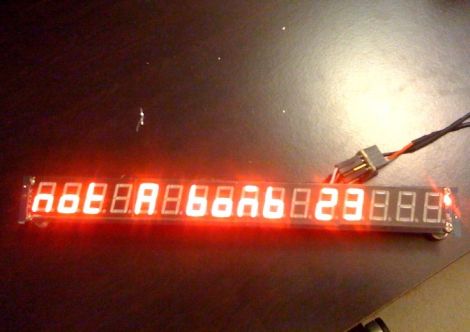
It’s no secret that seven-segment displays are an easy and useful way to relay data, so [Kelvyn Panici] decided to put together a minimalst, self-contained display for use around the house.

The display itself is a 16-digit model he picked up from DealExtreme for under $10. He wanted to find a microcontroller small enough to fit behind the display’s footprint, so he chose an ATtiny85 to control it. After mounting the mcu on a small piece of perfboard, he burned the Arduino bootloader and uploaded a small sketch to drive the display.

Things worked out quite well as you can see by the video below where he shows off a pre-perfboard prototype. [Kelvyn] currently does not have any immediate projects in the works that will utilize the display, though there are a plethora of possibilities. We think it would work great anywhere if it were fitted with a battery and some sort of wireless radio in order to make it completely self-contained.

Continue reading “A Simple, Self-contained 7-segment Display”

Controlling An LED Matrix With An Android Phone

Even though everyone with a smart phone has a small, powerful computer in their pocket, we haven’t seen many applications of this portable processing power that use the built-in camera. [Michael] decided to change this and built an LED matrix that displays the data coming from the phone’s camera.

For the build, [Michael] used two 32×32 LED panels from Adafruit along with an IOIO and an Arduino. To build the Android app, [Michael] used the Android OpenCV computer vision library that grabs an image from the Android camera and downsamples it to 64×32 pixels. This data is transferred over a serial connection from the phone to the IOIO and again from the IOIO to the Arduino. Even though each frame is 1024 bytes, [Michael] still gets around four frames per second on his LED matrix display.

After the break you can check out the results of [Michael]’s build. The video is a little choppy because of the frame rate issue, but it’s still an interesting build in the Android software development category.

Continue reading “Controlling An LED Matrix With An Android Phone”

FLORA: A Better Arduino LilyPad

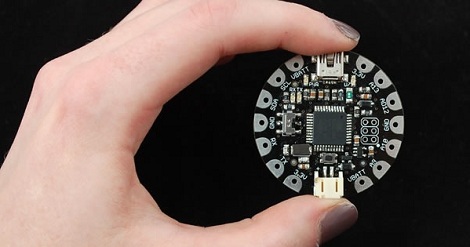
[Ladyada] has been working on FLORA, her wearable electronics platform, for a few months now. Even though it has just been announced the specs look much better than the previous queen of the hill, the Arduino LilyPad.

Going down the spec sheet for both the FLORA and the LilyPad, we see that FLORA has twice as much flash and SRAM as the LilyPad. The LilyPad has more options for I/O, but [Ladyada]’s FLORA has the benefit of not using an ISP header for programming; FLORA is completely USB-compatable. FLORA is also about a quarter-inch in diameter smaller than the LilyPad, something to take into account when you’re going for a wearable project.

On top of Bluetooth, GPS, accelerometer, compass and other modules planned for FLORA ( it doesn’t look like they’re available yet, though), FLORA has USB HID support so it can operate as a USB keyboard, mouse, MIDI device, or connect to a cell phone. If you’ve ever wanted a keytar cardigan, this is the board for you.

Check out [Ladyada]’s video demo of a LED-equipped fabric after the break.

Continue reading “FLORA: A Better Arduino LilyPad”

NES Controller Uses Capacitive Touch Instead Of Buttons

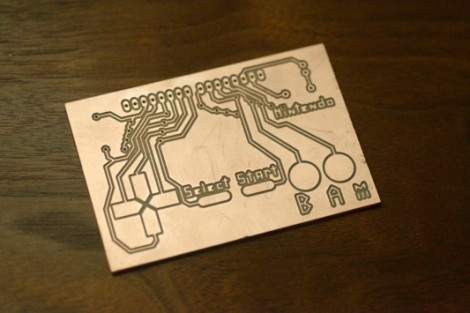
Here’s one way to really keep the component count low. [David] developed an NES controller that doesn’t use any buttons. The copper clad has been milled to provide a pad which registers a button push based on capacitance. The board has a SIL header at the top, making it easy to plug into the Arduino board that reads the inputs.

[David] had trouble getting the Arduino pin read functions to respond fast enough for he NES console’s expectations. He ended up using commands to access the ATmega’s peripherals directly in order to achieve the target timing. Speaking of, he did his own sniffing of the communication scheme using a logic analyzer. The results of that work, as well as the board files and code are available at the site linked above. And there’s a demo of the controller used to play Super Mario Bros. in the clip after the break.

This is actually a tangential project using a PCB mill which he’s developing through Kickstarter. This certainly shows that the mills works as designed.  Continue reading “NES Controller Uses Capacitive Touch Instead Of Buttons”

Automating The Shutdown Of APC UPS Devices

ups-shutdown-device

[Ishan Karve] works in some bizarro world where the building management demands that all servers and Uninterruptible Power Supplies be shut down at the end of each evening. While inconceivable to most systems admins, he has no recourse but to comply. This means that his employees need to turn things off before they leave for the day, and since they often work up to 15 hours a day, waiting for Windows server to shut down seems like an eternity.

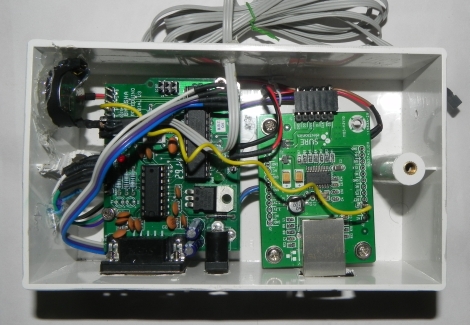
Being the good manager he is, [Ishan] decided to build a device that handles the clean shutdown of their servers and UPS for them. An Arduino board serves as the brains of the device, communicating with and issuing shutdown commands to the UPS over a serial port. The Arduino is also connected to the office network, enabling it to send ARP requests to the servers in order to determine when they have completely shut down for the day. In order to protect against an accidental shutdown due to network connectivity issues, [Ishan] added an RTC module to the mix so that the Arduino does not issue shutdown commands until at least 8 pm.

Instead of waiting around for Windows to do its thing, [Ishan’s] employees can take off once they start the server shutdown process, knowing that they are totally compliant with their landlord’s crazy requests.

Hellduino: Hellschreiber Radio Transmissions From An Arduino Board

[Mark VandeWettering] was experimenting with a simple transmitting circuit and an Arduino. The circuit in the project was designed by [Steve Weber] to broadcast temperature and telemetry data using Morse Code. But [Mark] wanted to step beyond that protocol and set out to write a sketch that broadcasts using the Hellschreiber protocol.

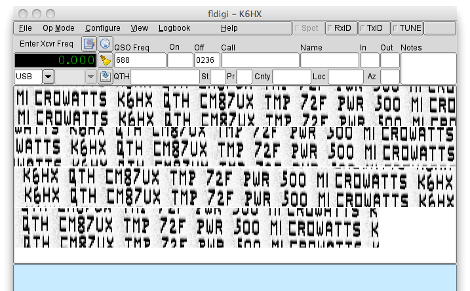
This protocol transmits glyph images, which are decoded as you see above. For some reason we can’t help but think this is like Captcha for radio enthusiasts. We have seen Hellschreiber used with AVR microcontrollers before, but this is the first Arduino implementation that we’ve come across. [Mark] does a great job of demonstrating his project in the video after the break. He mentions that the transmitter has no antenna, but is still being picked up by his receiving antenna mounted behind his house.

Since [Mark] doesn’t really cover the hardware he used, you will need to look back at [Steve’s] original design schematics for more information.

Continue reading “Hellduino: Hellschreiber Radio Transmissions From An Arduino Board”

Matchbox Launcher Reacts To Emergency Band Radio Dispatcher

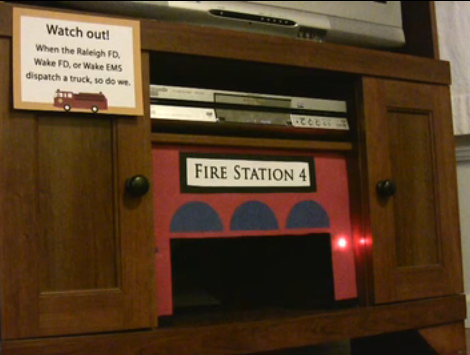
[Jeff] and his wife put together a firefighter themed birthday celebration for their son. As he’s not entirely handy in the kitchen, [Jeff] decided not to lend a hand with the baking or cake decorating. But he didn’t forego the opportunity to combine a couple of different projects to make a Matchbox car launcher that responds to emergency band radio.

Since he’s an amateur radio enthusiast he already had a scanner to monitor the air waves. Apparently there’s a band just for relaying dispatch messages to emergency vehicles. He set the radio equipment to only monitor that channel. An Arduino was added to the mix, taking measurements of the voltage level on the scanner’s audio output. When it’s driven high enough the Arduino trips the toy car launcher.

The car launcher itself is a pretty nifty setup. There are five chutes at the top of a ramp that each fit a car. A sliding gate holds them in place, but can be removed one slot at a time by a geared motor. The addition of a poster board facade and two flashing red LEDs makes the setup look right at home with the other party decorations.

See a call come into the station in the clip after the break. We don’t have a category called “fun parenting” so “toy hacks” will have to do.

Continue reading “Matchbox Launcher Reacts To Emergency Band Radio Dispatcher”