Matchbox Launcher Reacts To Emergency Band Radio Dispatcher

[Jeff] and his wife put together a firefighter themed birthday celebration for their son. As he’s not entirely handy in the kitchen, [Jeff] decided not to lend a hand with the baking or cake decorating. But he didn’t forego the opportunity to combine a couple of different projects to make a Matchbox car launcher that responds to emergency band radio.

Since he’s an amateur radio enthusiast he already had a scanner to monitor the air waves. Apparently there’s a band just for relaying dispatch messages to emergency vehicles. He set the radio equipment to only monitor that channel. An Arduino was added to the mix, taking measurements of the voltage level on the scanner’s audio output. When it’s driven high enough the Arduino trips the toy car launcher.

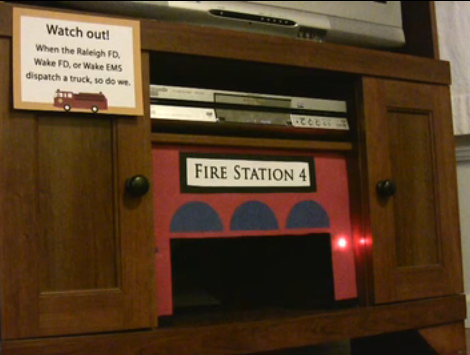
The car launcher itself is a pretty nifty setup. There are five chutes at the top of a ramp that each fit a car. A sliding gate holds them in place, but can be removed one slot at a time by a geared motor. The addition of a poster board facade and two flashing red LEDs makes the setup look right at home with the other party decorations.

See a call come into the station in the clip after the break. We don’t have a category called “fun parenting” so “toy hacks” will have to do.

Continue reading “Matchbox Launcher Reacts To Emergency Band Radio Dispatcher”

Rainbow Machine Livens Up Any Photograph

rainbow-machine

[Shameel Arafin, Sean McIntyre, and Reid Bingham] really dig rainbows. Going by the moniker the “RainBroz”, the trio built a portable display that can be used to add cool light painting effects to pictures.

The group brings their Rainbow Machine all over the place, including parties, gatherings, and random spots on the street. Anyone is welcome to have their picture taken with the Rainbow machine, and each subject is given a card with a URL on it, so that they can check out their picture whenever they please.

The display consists of addressable RGB LED strips and an Arduino from Adafruit, along with the associated support mechanisms for moving the LEDs. The real magic is carried out by the LPD8806 light painting library, also from Adafruit, which enables the RainBroz to create all sorts of images with little fuss.

As you can see in the video below, the Rainbow Machine seems to get a pretty warm reception from just about everyone, even people grabbed right off the street. It looks simple enough to build, so why not put one together for your next gathering?

Continue reading “Rainbow Machine Livens Up Any Photograph”

[Alex] Shows Us What Happens When Dance Dance Revolution Meets Simon

ddr-simon

[Alex] was digging through his closet and came upon an old PS2 game pad for Dance Dance Revolution. He hated the idea of throwing it out just slightly more than the idea of playing DDR again, so he decided to find a way to reuse it.

He was a big fan of the game Simon (aka Genius) as a kid and thought that the DDR pad would make a novel interface for the classic game. Using the PS2XLib by [Bill Porter], which allows an Arduino to easily communicate with a PS2 controller, [Alex] put his Simon replica together in no time flat.

He painted an empty ice cream container with the classic Simon colors, installing a small LED under each quadrant, then wrote the game’s code.

As you can see in the video below, his version of the game works nicely, and forces you to actually get up and move a bit, which we like.

Continue reading “[Alex] Shows Us What Happens When Dance Dance Revolution Meets Simon”

Rainbow Board Of Many Ping-pong Balls

[George] just finished his first project: an 8×8 matrix “Board of Many Ping-Pong Balls” with 64 RGB LEDs. He started this project when he was 14 years old and finished the build over this last Christmas break. We won’t make any presumptions about [George]’s age, but we couldn’t think of a better project to start out on.

For the build, [George] used a Colorduino LED driver shield for his Arduino. This made the wiring simple, but the finished product is where this project really shines. For the base, [George] got a board laser cut at his school and used ping-pong balls to diffuse the LEDs. We’ve seen this many times but with this build there’s a neat way to drill a hole in a ping-pong ball; simply put the drill into reverse. The friction is enough to open the ball up, and the chips of plastic come outside instead of remaining in.

We’re really impressed with [George] and his winter break project. He’s lucky enough to have access to a laser cutter at school, and from a look at his monitor, he’s reading the right websites. You can check out his demo rainbow pattern after the break.

Continue reading “Rainbow Board Of Many Ping-pong Balls”

Minimalist RGB LED Cube Has A Very Short BoM

charlieplexed-led-cube

[Asher Glick] wrote in to share a project he has been working on with his friend [Kevin Baker], a 4x4x4 RGB LED cube. The pair are students at Rensselaer Polytechnic Institute and also members of the newly-formed Embedded Hardware Club on campus. As their first collaborative project, they decided to take on the ubiquitous LED cube, trimming down the component count to nothing more than 64 LEDs, a protoboard, some wire, and a single Arduino.

Many cubes we have seen use shift registers or decade counters to account for all the I/O required to drive so many LEDs. Their version of the cube has none of these extra components, solely relying on 16 of the Arduino’s I/O pins for control instead. You might notice something a bit different about the structure of their cube as well. Rather than using a grid of LEDs like we see in most Charlieplexed cubes, they constructed theirs using 16 LED “spires”, tucking the additional wiring underneath the board.

The result looks great, as you can see in the videos below. The cube looks pretty easy to build, and with a cost around $60 it is a reasonably cheap project as well.

Nice job, we look forward to seeing all sorts of fun projects from the Embedded Hardware Club in the future!

Continue reading “Minimalist RGB LED Cube Has A Very Short BoM”

GSM Remote Control With The TiDiGino

tidigino-gsm-remote

If you’re looking to remotely control things around the house, but can’t do it over the Internet or via WiFi, the TiDiGino just might have what you’re looking for. [Boris Landoni] from Open Electronics sent some information on the TiDiGino our way, and it certainly looks like a useful device if you’re in need of a solid GSM remote control module.

At the heart of the TiDiGino lies an ATmega2560, which is normally used in the Arduino Mega, so there’s plenty of processing power to go around. While the form factor differs just a wee bit from what you would expect from an Arduino, the TiDiGino sports all the proper connectivity to support any standard Arduino shield along with the requisite libraries required for use.

Through a contest/community effort, the TiDiGino supports remote alarm, gate control, remote thermostat control, and DTMF remote control functionality right out of the box. We imagine that our readers can dream up a litany of other uses as well, since GSM remote control tends to be pretty popular around here.

Be sure to check out the Open Electronics site if you’re interested in learning more about the TiDiGino – you’ll find a complete BoM along with code and schematics, making it easy to build your own.

OsPID: The Open Source PID Controller

Need PID control in your next project? Perhaps this little beauty can help. It’s an Open Source PID controller that also follows the Open Hardware guidelines. [Brett Beauregard] based the project on the newly minted Arduino PID library which he wrote. In the video after the break [Brett] takes apart the device, walking through some of the ways this might be hacked. If you want an overview of every part of this project to-date the best resource is probably his personal blog post.
The front circuit board is the meat and potatoes of the device. It hosts the user interface in the form of buttons, LEDs, and a graphic LCD screen. You can also see the USB mini-b connector which gives you access to the Arduino compatible ATmega328 microcontroller on the back. There is also a piezo buzzer for your alarm needs.
The prototype that [Brett] shows off uses pin connectors to join the main board to the two daughter boards. Unfortunately, the production model moved to dual-sided edge connectors. That’s fine if you you’re using it in its stock condition, but it makes it a bit harder to replace those boards with your own hardware. None-the-less, we love to see great Open Hardware projects brought to market! Continue reading “OsPID: The Open Source PID Controller”