Arduino The Documentary

We finally got around to watching “Arduino The Documentary” and it’s a two-thumbs-up kind of film. What did we like? It’s a documentary about open source hardware so what’s not to like? You’ll hear the story of how the Arduino team was formed and the path they took from design to production. There are also interviews with early adopters and we even find out that Sparkfun passed on their chance to sell the original through-hole kit version of the board. It’s well made, and thanks to the Creative Commons license you can download it for free, or watch the embedded version here after the break. It’s only 28 action-packed minutes so finish up that special clock and watch it during lunch today.

Continue reading “Arduino The Documentary”

Attitude Control For A Really Big Rocket

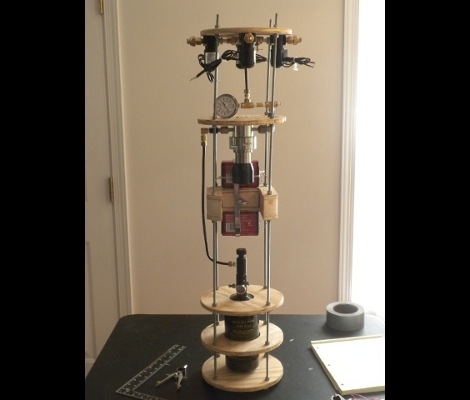
If this is meant for a model rocket it must be the biggest we’ve ever seen. [Scott] and [Trevor] took on the task of building a rocket attitude control system after reading about some research on the topic. But that researcher only tested the theories using simulations so they set out to build their own. The prototype above has a tank of compressed Nitrogen which can hold up to 3000 PSI. You can begin to understand why this needs to be used with a big rocket. The pressurized gas is connected through a regulator to four valves which feed nozzles around the circumference of the fuselage. An Arduino takes readings from a gyroscope and actuates the gas valves via a relay board.

You can check out the test rig in the video after the break. The prototype is suspended horizontally from a wire and its orientation held at one position by the system. There’s also a paper (PDF) if you’re interested in the equations that went into the stabilization control. This system would have been right at home on that huge sugar rocket we saw back in October.

Continue reading “Attitude Control For A Really Big Rocket”

New Year’s Eve Ball Drop In Your Kitchen

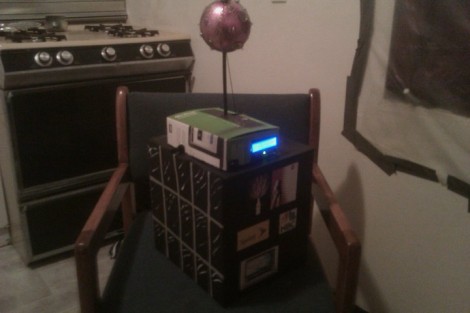
[Tech B.] hacked together a Ball Drop for New Year’s Eve using stuff he had lying around. The ball itself is an old Christmas ornament that he cut in half and filled with 14 LEDs and a 9V battery. He finished up that portion of the project by gluing the halves back together and adding a hole for the guide rod. The base is made of some cardboard boxes and hides an Arduino, a servo motor, an LCD screen, and the base for the vertical rod. When the last ten seconds of the year are counted down, a servo lowers the ball by unspooling some yarn that loops over the top of the rod. As the yarn is slowly dished out gravity pulls the ball toward its goal. We’ve embedded [Tech B.’s] demonstration video after the break.

Continue reading “New Year’s Eve Ball Drop In Your Kitchen”

Electronic Dice Has Option For 20 Or 100 Sides

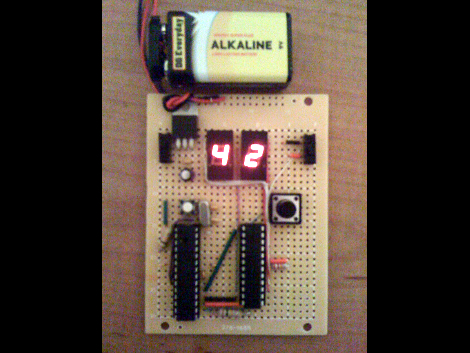
[Bluewraith] built himself an electronic dice using a 555 timer and 4017 counter. This is a classic project and he enjoyed doing it but wondered about making a 20-sided dice. So he grabbed his Arduino and got to work. A switch on the final project selects between 20 or 100 sides. He used a MAX7219 to control the 7-segment displays, and a standalone AVR chip for the rest of it.

If you missed it back in October you should also look in on this 6-sided dice. It also uses an AVR running the Arduino bootloader but a mercury switch allows the player to shake the box in order to start a roll.

One last note, we made a conscious decision to use the word ‘Dice’ instead of the grammatically correct ‘Die’ which is its singular version. We think ‘Die’ can be a bit too confusing and we’re not the only ones.

ArduSpider Entertains Children And Exercises Pets

There are so many good things about [Jose Julio’s] robotic spider. It’s design is dainty yet robust, and the behaviors encoded in the firmware are nothing short of spectacular.

The body is built from a piece of balsa wood in between sheets of carbon fiber. The legs are carbon rods, using two servo motors for left and right leg movement, and a third servo which can move the intermediary legs like the roll axis of a plane. An IR sensor rides on the front for obstacle avoidance, with system control courtesy of an Arduino. For more hardware info check out his build log.

Don’t miss the video after the break. You’ll see that the little bot can be manually controlled, or allowed to roam free. As we said before, the behavior is fantastic. Not only has [Jose] programmed interesting characteristics like the spider getting tired and sitting down for a while, but when it is awakened it leaps into the air. The movements are fun to watch for human and feline alike; if only your house cat could be so lucky.

Continue reading “ArduSpider Entertains Children And Exercises Pets”

Atomic Pinball Clock

[Mark Gibson] sent us a load of details on his build, a WWVB atomic clock using a pinball machine marquee (PDF). This is the upright portion of an old machine that used electromechanical displays instead of digital electronics. It’s big, noisy, and seeing it running might make you a bit giddy. Luckily he included video that shows it working on both the outside and the inside.

It took a bit of probing to discover the connections for relays that control the display. From there he used optoisolation to drive them with an Arduino. With this hurdle behind him, [Mark] set out to add atomic clock accuracy. He picked up a WWVB module and added it to the mix.

Check out his build log in PDF form linked above. He went out of his way to explain how the original parts work, and the processes he used during prototyping. For more of those juicy details we’ve added a photo gallery and his video after the break.

Didn’t get enough pinball goodness from this project? Check out the this digital gas plasma display pulled and reused from a much more modern pinball machine. Oh, and there’s always Bill Paxton Pinball.

Continue reading “Atomic Pinball Clock”

Turning A One-armed-bandit Into Web Slots

[Kyle Kroskey] just finished his first Arduino project, adding web control to a slot machine. He started with an IGT S+ model which were extremely popular in Vegas and Atlantic City casinos for years, but are now being replaced with more modern versions. His grand idea was to modify the machine so that it can be controlled from a PC, then unleash a live stream so that the Internets can play.

This turned out not to be too hard, there’s just a few controls he patched the Arduino into; the button for maxing out the wager amount, and sensors that measure coin inserts and payouts. In order to keep the peace he disconnected the speaker but rerouted the audio into a PC so that it can be played over the streaming feed. This make sure it’s quiet in the room without sacrificing the online fun. The PC is running Ubuntu and controls the video feed, a screen detailing jackpot data above the machine, and facilitates passing webpage player requests to the Arduino for machine control.

For another fun slot machine hack, check out this gaming device turned bartender.