Plan To Jam Mobile Phones In Schools Is Madness

Mobile phones in schools. If you’re a teacher, school staffer, or a parent, you’ve likely got six hundred opinions about this very topic, and you will have had six hundred arguments about it this week. In Australia, push has come to shove, and several states have banned the use of mobile phones during school hours entirely. Others are contemplating doing the same.

In the state of New South Wales, the current opposition party has made it clear it will implement a ban if elected. Wildly, the party wants to use mobile phone jamming technology to enforce this ban whether students intend to comply or not. Let’s take a look at how jammers work in theory, and explore why using them in schools would be madness in practice.

Continue reading “Plan To Jam Mobile Phones In Schools Is Madness”

The Tasmanian Tiger’s Comeback Tour, Powered By Science

Scientists estimate that approximately 900 species have gone extinct in the last five centuries alone, to say nothing of the thousands or millions that vanished from life in the billions of years before that.

Conventional wisdom states that once an animal has gone extinct, it’s gone forever. However, a team from the University of Melbourne hopes to change all that, with their new project aiming to bring the Tasmanian Tiger back to life.
Continue reading “The Tasmanian Tiger’s Comeback Tour, Powered By Science”

A Coolant Leak The Likely Culprit For Aussie Tesla Battery Bank Fire

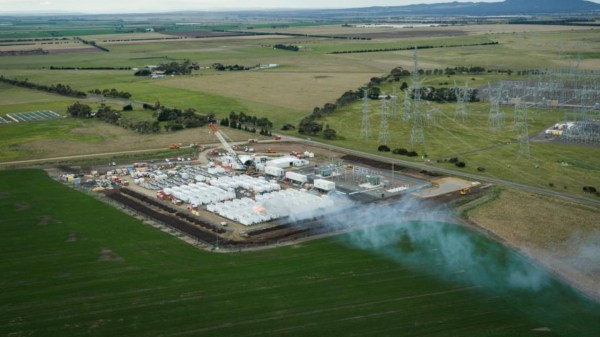
Followers of alternative energy technology will remember how earlier in the year a battery container at Tesla’s Megapack Australian battery grid storage plant caught fire. Lithium ion batteries are not the easiest to extinguish once aflame, but fortunately the fire was contained to only two of the many battery containers on the site.

The regulator Energy Safe Victoria have completed their investigation into the incident, and concluded that it was caused by a coolant leak in a container which caused an electrical component failure that led to the fire. It seems that the container was in a service mode at the time so its protection systems weren’t active, and that also its alarm system was not being monitored. They have required that cooling systems should henceforth be pressure tested and inspected for leaks, and that alarm procedures should be changed for the site.

When a new technology such as large-scale battery storage is brought on-line, it is inevitable that their teething troubles will include catastrophic failures such as this one. The key comes in how those involved handle them, and for that we must give Tesla and the site’s operators credit for their co-operation with the regulators. The site’s modular design and the work of the firefighters in cooling the surrounding packs ensured that a far worse outcome was averted. Given these new procedures, it’s hoped that future installations will be safer still.

You can read our original coverage of the fire here, if you’re interested in more information.

[Main image source: CFA]

SpaceAusScope Team Listens To The Galaxy

Australia has always had a reputation for astronomy. It is a great site low in the Southern hemisphere and there are lots of sparsely inhabited areas free from light and radio interference. Some of the first video from the Apollo 11 landing, for example, came in from “the dish” — a very large radio telescope down under. Australian hobbyists have formed a group, SpaceAusScope, where teams across Australia are building radio telescopes with the plan — which has been delayed by the pandemic — of collecting data and providing it for public analysis.

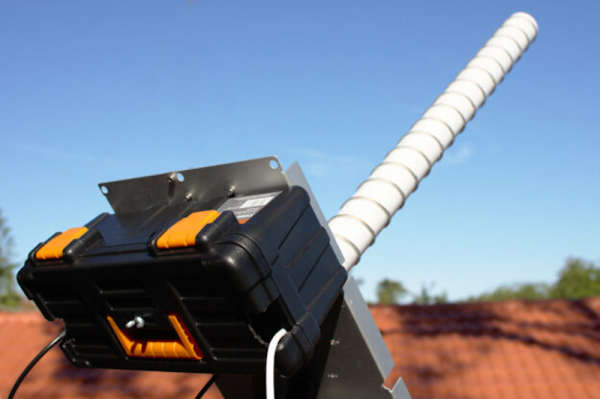
A secondary goal of the group is to provide better documentation for amateur radio telescope builders. So even if you don’t live in Australia, you might want to check out their website. It looks as thoughthe documentation will arrive in the future, but there is a very informative blog post from one team member about the helical antenna design most of the teams are using to eavesdrop on the hydrogen line.

Continue reading “SpaceAusScope Team Listens To The Galaxy”

Right To Repair: Tractor Manufacturers Might Have Met Their Match In Australia

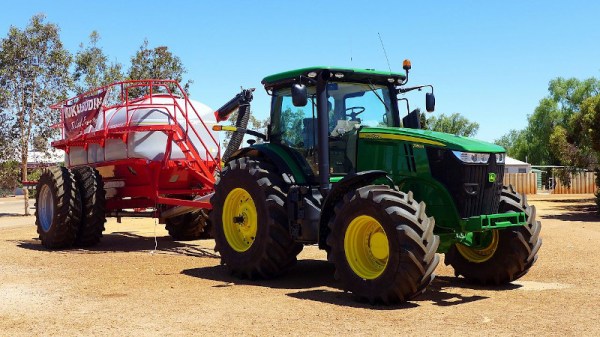
The simmering duel between farmers and agricultural machinery manufacturers over access to the software to unlock the DRM which excludes all but the manufacturer’s agents from performing repairs goes on. How this plays out will have implications for the right to repair for everyone on many more devices than simply tractors. Events so far have centred on the American Midwest, but there is an interesting new front opening up in Australia. The Aussie government consumer watchdog, the ACCC, is looking into the matter, and examining whether the tractor manufacturers are in breach of the country’s Competition and Consumer Act. As ABC News reports there is a dual focus, both of the DRM aspect and on the manufacturer’s harvesting and lock-in of customer farm data.

This is an exciting turn of events for anyone with an interest in the right to repair, because it takes the manufacturers out of the comfort zone of their home legal environment into one that may be less accommodating to their needs. If Aussie farmers force them to open up their platforms then it will benefit all of us, but even if it fails, the fact that the issue has received more publicity in a different part of the world can only be a good thing. There are still tractor manufacturers that do not load their machines with DRM, how long will it be we ask before the easy repairability of their products becomes a selling point?

There are many stories relating to this issue on these pages, our most recent followed the skirmishes in Nebraska.

Thanks Stuart Longland for the tip.

Header image, John Deere under Australian skies: Bahnfrend (CC BY-SA 4.0).

Help Save Some Of Australia’s Computer History From The Bulldozers

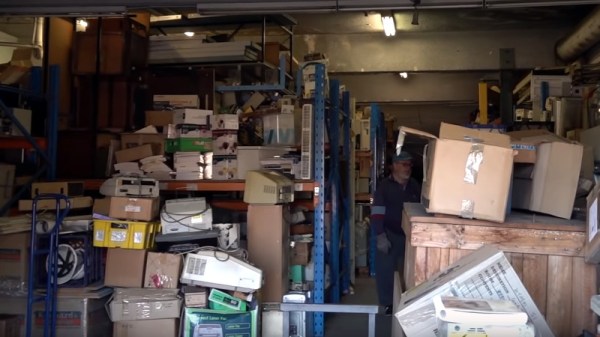
When multiple tipsters write in to tell us about a story, we can tell it’s an important one. This morning we’ve received word that the holding warehouse of the Australian Computer Museum Society in the Sydney suburb of Villawood is to be imminently demolished, and they urgently need to save the artifacts contained within it. They need Aussies with spare storage capacity of decent size to help them keep and store the collection, and they only have a few days during which to do so.

The ever-effusive Dave from EEVblog has posted a video in which he takes a tour, and like us he’s continually exclaiming over the items he finds. An EAI analog computer, a full set of DEC PDP-11 technical documentation, a huge Intel development system, Tektronix printers, huge DEC racks, memory cards for VAXen, piles and piles of boxes of documentation, and much, much more.

So, if you are an Aussie within reach of Sydney who happens to have a currently-unused warehouse, barn, or industrial unit that could house some of this stuff, get in touch with them quickly. Some of it may well be junk, but within that treasure trove undoubtedly lies a lot of things that need to be saved. We’d be down there ourselves, but are sadly on the other side of the world.

Continue reading “Help Save Some Of Australia’s Computer History From The Bulldozers”

Aussies Propose Crackdown On Insecure IoT Devices

We’ve all seen the stories about IoT devices with laughably poor security. Both within our community as fresh vulnerabilities are exposed and ridiculed, and more recently in the wider world as stories of easily compromised baby monitors have surfaced in mass media outlets. It’s a problem with its roots in IoT device manufacturers treating their products as appliances rather than software, and in a drive to produce them at the lowest possible price.

The Australian government have announced that IoT security is now firmly in their sights, announcing a possible certification scheme with a logo that manufacturers would be able to use if their products meet a set of requirements. Such basic security features as changeable, non-guessable, and non-default passwords are being mentioned, though we’re guessing that would also include a requirement not to expose ports to the wider Internet. Most importantly it is said to include a requirement for software updates to fix known vulnerabilities. It is reported that they are also in talks with other countries to harmonize some of these standards internationally.

It is difficult to see how any government could enforce such a scheme by technical means such as disallowing Internet connection to non-compliant devices, and if that was what was being proposed it would certainly cause us some significant worry. Therefore it’s likely that this will be a consumer certification scheme similar to for example the safety standards for toys, administered as devices are imported and through enforcement of trading standards legislation. The tone in which it’s being sold to the public is one of “Think of the children” in terms of compromised baby monitors, but as long-time followers of Hackaday will know, that’s only a small part of the wider problem.

Thanks [Bill Smith] for the tip.

Baby monitor picture: Binatoneglobal [CC BY-SA 3.0].