Hackaday Links Column Banner

Hackaday Links: July 12, 2026

Although we’d rather bring you news of clever modifications and repairs down on the farm, more often than not, the name “John Deere” has appeared on the pages of Hackaday because of their opposition to farmers actually being able to work on the machines their livelihoods depend on. But thanks to a settlement reached between the company and the Federal Trade Commission this week, farmers seem to have been handed a much-needed win in the Right to Repair battle.

When a lawsuit against a company ends in a settlement, it usually means spending money they would rather pay than go to court. Indeed, earlier cases against John Deere have resulted in plenty of checks being written. But this time around, the FTC agreement requires Deere to make its diagnostic and repair software available to owners and independent shops. It also has a clause that prevents them from retaliating against owners who want to handle their own repairs rather than going through the company’s official service channels — hard to believe that’s something that actually needs to be specified, but it does give you a hint as to just how bad the situation has been. We’ll definitely be keeping an eye on this story.

Sounds like the Feds were busy this week, as the Federal Communications Commission also gave the green light to Reflect Orbital to launch a prototype satellite for their controversial “sunlight as a service” concept. The company plans to put the spacecraft into a roughly 600 km orbit around the planet, where it will deploy its 324-square-meter reflector and angle itself to illuminate a spot on the ground. It might sound like something a Bond villain would come up with, but Reflect Orbital says the capability will be used to beam sunlight directly onto solar panels at night and to provide light for search-and-rescue operations.

As you might expect, providing such a service on a global scale would require many such reflectors, which is where the concern really comes in. Critics note that a sky full of literal mirrors can cause all sorts of issues, ranging from the scientific to the scenic. The American Astronomical Society points out that each satellite in the constellation could appear to be four times as bright as the full Moon, and that it’s possible an amateur sky watcher could get an eyeball full of redirected sunlight should one of them unexpectedly zip past the aperture of their backyard telescope.

Continue reading “Hackaday Links: July 12, 2026”

A Tractor From A Small Town Might Just Be The Catalyst For Ousting Machinery DRM

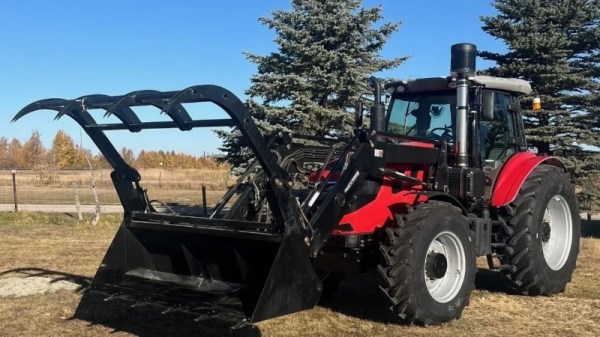
Odd things sometimes pop up in the feed of a Hackaday scribe, not hacks as such, but stories with a meaning in our community. One such that’s come our way from a variety of sources over the last week features Ursa Ag, a small machinery manufacturer based in Alberta, Canada. The reason they’re in the news is because they have gained bulging order books by taking on the likes of John Deere with a tractor more like the one their customers’ parents bought back in the ’80s or ’90s. It’s a basic machine without much in the way of electronics, and certainly without all the DRM lockdown that has made those big manufacturers so unpopular.

It’s clear that Hackaday isn’t in the business of shilling Canadian tractors, but it should be of interest to readers because it represents an alternative route to challenge the DRM lockdowns than the legal and consumer routes we’ve previously reported on. The Ursa Ag tractor may be as niche Albertan as a Corb Lund CD, but it’s not the tractor itself but the idea which matters. We doubt much sweat will be shed by John Deere execs over a tiny company out on the prairies making a basic spec tractor, but given that Ursa Ag customers are reported as buying them because they have no DRM, the prospect of larger upstart competitors taking note and offering machines without it may cause them some sleep loss. The free market is held up to outsiders as perhaps the most American of ideals, and for it to eventually prove to be the means by which something intended to limit it might be defeated, is sweet justice indeed.

We’ve reported extensively on the Deere tractor saga over the years, but perhaps the best illustration of the self-inflicted damage the brand has suffered through DRM comes in their older products being worth considerably more than their newer ones.

The FTC Take Action, Is Time Finally Up For John Deere On Right To Repair?

Over the last decade we have brought you frequent reports not from the coolest of hackerspaces or the most bleeding edge of engineering in California or China, but from the rolling prairies of the American Midwest. Those endless fields of cropland waving in the breeze have been the theatre for an unlikely battle over right to repair, the result of which should affect us all. The case of FEDERAL TRADE COMMISSION, STATE OF ILLINOIS, and STATE OF MINNESOTA, v. DEERE & COMPANY  relates to the machinery manufacturer’s use of DRM to restrict the repair of its products, and holds the promise to end the practice once and for all.

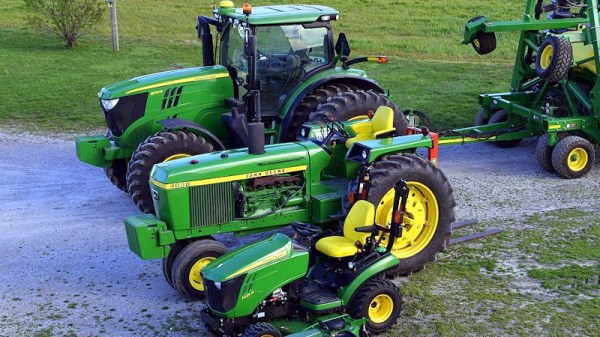
This is being written in Europe, where were an average person asked to name a brand that says “America”, they might reach for the familiar; perhaps Disney, McDonalds, or Coca-Cola. These are the flag-bearers of American culture for outsiders, but it’s fair to say that none of them can claim to have built the country. The green and yellow Deere tractors on the other hand represent the current face of a company with nearly two hundred years of farming history, which by virtue of producing some of the first mass-produced plows, had perhaps the greatest individual role in shaping modern American agriculture and thus indirectly the country itself. To say that Deere is woven into the culture of rural America is something of an understatement, agricultural brands like Deere have an enviable customer base, the most loyal of any industry.

Thus while those green and yellow tractors are far from the only case of DRM protected repairability, they have become the symbolic poster child for the issue as a whole. It’s important to understand then how far-reaching it is beyond the concerns of us technology and open-source enthusiasts, and into something much more fundamental. Continue reading “The FTC Take Action, Is Time Finally Up For John Deere On Right To Repair?”

The Latest John Deere Repair Lawsuit Now Has The Go-Ahead

Long time readers will have followed the twists and turns of the John Deere repair saga, in which the agricultural machinery manufacturer has used DRM to restrict the repair of its tractors. It may be hot stuff on the prairies, but it matters to everyone because it’s a key right-to-repair battleground. Now the company’s attempt to throw out the latest class-action lawsuit, this time in Illinois. has failed, paving the way for a meaningful challenge.

This lawsuit is special because has the aim of determining whether or not Deere conspired to drive up the cost of repair and edge out independent mechanics. It comes against a backdrop in which their promised access to repair software which we reported on back in January has failed to materialize, and this is likely to figure as an act of bad faith.

A failing of corporate culture is that the organisation can in its own eyes, never be wrong. In Deere’s case they have accrued plenty of bad publicity in the years they’ve pursued this ill-advised business model, and in case that weren’t enough they’ve alienated their core customers out on the farms to the extent that a second-hand Deere from before the DRM era has more value than its newer counterparts. Deere genuinely do make very good tractors, so for farmers loyal for generations to turn their backs on them is a very significant story indeed. One has to ask, how much bad publicity and how many lawsuits do they have to have before someone at head office in Moline figures out that DRM in tractors (or anything else for that matter) isn’t the great idea they once thought it was? Maybe this one will finally herald the moment when that happens.

Header image: Nheyob / CC BY-SA 4.0

The World’s First Agricultural Right To Repair Law

Long time readers will know that occasionally we mix up our usual subject matter with a dash of farm equipment. Usually the yellow and green variants that come from John Deere, as the agricultural manufacturer has become the poster child for all that is wrong in the fight for the right to repair. An old Deere is worth more than a nearly new one in many places, because for several years now their models have had all their parts locked down by DRM technologies such that only their own fitters can replace them. Now after a long legal fight involving many parties, the repair and parts company iFixit sound justifiably pleased as they announce the world’s first agricultural right to repair law being passed in the US state of Colorado. (Nitter)

This may sound like a small victory, and it will no doubt be followed by further rearguard actions from the industry as similar laws are tabled in other states. But in fact as we read it, with this law in place the game is de facto up for the tractor makers. Once they are required to release any access codes for the Coloradans those same codes will by extension be available to any other farmers, and though we’re guessing they won’t do this, they would be best advised to give up on the whole DRM idea and concentrate instead on making better tractors to fix their by-now-damaged brands.

It’s exciting news for everybody as it proves that right-to-repair legislation is possible, however since this applies only to agricultural machinery the battle is by no means over. Only when all machines and devices have the same protection can we truly be said to have achieved the right to repair.

We’ve reported on this story for a long time, here’s a previous piece of legislation tried in another state.

You Can Now Fix Your Deere

Over the last few years we have brought you many stories about John Deere tractors, and how their repair has been locked down such that only manufacturer-authorised technicians can work on them. They’ve become a poster child in the battle for the right to repair, a symbol of the worst practices. Finally now we can bring you some good news of sorts, as the agricultural giant has signed a memorandum of understanding with the American Farm Bureau Federation to ensure that their products will henceforth be repairable by people without Deere approval.

We can’t imagine that Deere will have taken this step willingly, and while we’d like to imagine that consumer protests in favour of right-to-repair have hit their mark, we’re guessing that it’s more of an economic pressure at work alongside the threat of legislation outside their native America. If farmers getting caught out waiting for a Deere van to arrive while their crop withers in the field wasn’t enough, when the price of a second-hand tractor without the DRM outstrips that of a newer one with it, eventually the sales of new tractors will also suffer.

So this is good news, and we’re guessing that other agricultural manufacturers doing the same DMCA practices will now follow suit. But it’s not a complete victory. The problem starts not with the DMCA restriction itself, but with the extension of the machine’s computer system into every part, including those many parts which simply don’t need it. It’s not a complete victory if anyone can now use the software to register a new hydraulic valve with the system; instead that hydraulic valve should not have to be authorised in the first place. It’s this creeping unnecessary complexity which is the true enemy of right-to-repair, and we shouldn’t forget that.

Header image: Dwight Sipler, CC BY 2.0.

Finally We Can Watch The Deere Cracking Def Con Talk

A few weeks ago, some tantalizing social media posts emerged from a Def Con talk, in which [Sick Codes] broke into the screen control unit for a John Deere tractor live on stage, and proceeded to play a special Deere-themed DOOM level upon it. At the time there was nothing more to go on, but we’re pleased to find out that the whole talk has been put online.

The talk starts with an introduction to the topic, to the basics of the control units within the machine and to the various different ages of Deere screen unit. We find that the earlier machines, which are still at work on farms worldwide, rely on outdated Windows CE versions, though the very latest screens run a Linux variant.

It’s one of these last screens to which he turns his attention, and we’re treated to an in-depth look at some of its secrets. After a lot of dead ends and learning exercises the final result is distilled into a pogo pin adapter for the hardware part, and a simple enough cron job to bypass one of Deere’s defenses by keeping the filesystem writable so a file can be updated. There’s a bit more detail about the special DOOM level too, as a special bonus.

You can see our original mention of this talk, or read some of our past Deere coverage.

Continue reading “Finally We Can Watch The Deere Cracking Def Con Talk”