Nissan Leaf Batteries Upgrade Old Truck Conversion

[Jay]’s Chevy S-10 electric conversion needed new batteries. The conversion was originally done with a bank of lead acids underneath the truck bed. With lithium battery factories so large they can boost an entire state’s economy being built, [Jay] safely assumed that it just wasn’t worth it to spend the money to replace it with a new set of the same.

Just like unwrapping a present, from around a tree.
One brand new battery pack!

You should remember the beginnings of this story from our coverage nearly a year ago. Being the kind of clever you’d expect from someone who did their own EV conversion, he purchased a totaled (yet nearly new) Nissan Leaf with its batteries intact. It took a little extra work, but after parting out the car and salvaging the battery packs for himself he came out ahead of both a new set of replacement lead acids and an equivalent set of lithium cells.

He has just completed the first test drives with the conversion, having built 48 Leaf cells into blocks resembling the volumes the old batteries occupied. He had to add some additional battery management, but right-off-the-bat, the conversion netted him more amps and 650lbs (295kg) less weight for the same power.  Nice!

We linked to all the posts tagged leaf on [Jay]’s blog. There’s a lot going on, and the articles aren’t all linked to each other. It’s a really cool build and there are definitely tricks to learn throughout the whole process. If you have an hour to kill, [Jay] recorded the entire 26-hour process in a 66-minute video that is embedded below. It’s fun to watch him build up and mount the different modules and gives you a deep appreciation for his devotion to the project.

Continue reading “Nissan Leaf Batteries Upgrade Old Truck Conversion”

Modifications to a Razor E300 motor controller to remove limits

Converting An Electric Scooter To Lithium Batteries And Disabling The Safeties

There’s a bunch of different electric scooters available nowadays, including those hoverboards that keep catching fire. [TK] had an older Razor E300 that uses lead acid batteries. After getting tired of the low speeds and 12 hour charge times, [TK] decided it was time to swap for lithium batteries.

The new batteries were sourced from a Ryobi drill. Each provides 18 V, giving 36 V in series. The original batteries only ran at 24 V, which caused some issues with the motor controller. It refused to start up with the higher voltage. The solution: disable the safety shutdown relay on the motor controller by bridging it with a wire.

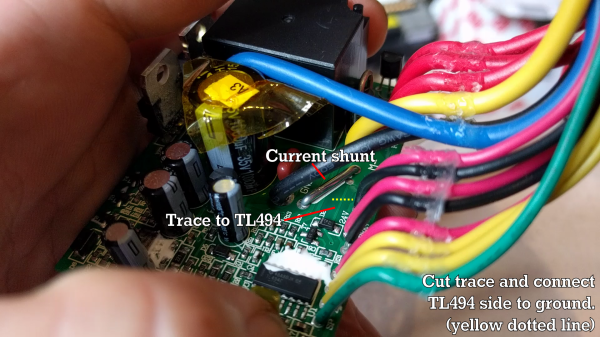
With the voltage issue sorted out, it was time for the current limit to be modified. This motor controller uses a TI TL494 to generate the PWM waveforms that drive a MOSFET to provide variable power to the motor. Cutting the trace to the TL494’s current sense pin removed the current limit all together.

We’re not saying it’s advisable to disable all current and voltage limits on your scooter, but it seems to be working out for [TK]. The $200 scooter now does 28 km/h, up from 22 km/h and charges much faster. With gearing mods, he’s hoping to eke out some more performance.

After the break, the full conversion video.

Continue reading “Converting An Electric Scooter To Lithium Batteries And Disabling The Safeties”

Unlocking Thinkpad Batteries

A few months ago, [Matt] realized he needed another battery for his Thinkpad X230T. The original battery would barely last 10 minutes, and he wanted a battery that would last an entire plane flight. When his new battery arrived, he installed it only to find a disturbing message displayed during startup: “The system does not support batteries that are not genuine Lenovo-made or authorized.” The battery was chipped, and now [Matt] had to figure out a way around this.

Most recent laptop batteries have an integrated controller that implements the Smart Battery Specification (SBS) over the SMBus, an I2C-like protocol with data and clock pins right on the battery connector. After connecting a USBee logic analyser to the relevant pins, [Matt] found the battery didn’t report itself correctly to the Thinkpad’s battery controller.

With the problem clearly defined, [Matt] had a few options open to him. The first was opening both batteries, and replacing the cells in the old (genuine) battery with the cells in the newer (not genuine) battery. If you’ve ever taken apart a laptop battery, you’ll know this is the worst choice. There are fiddly bits of plastic and glue, and if you’re lucky enough to get the battery apart in a reasonably clean matter, you’re not going to get it back together again. The second option was modifying the firmware on the non-genuine battery. [Charlie Miller] has done a bit of research on this, but none of the standard SBS commands would work on the non-genuine battery, meaning [Matt] would need to take the battery apart to see what’s inside. The third option is an embedded controller that taps into the SMBus on the charger connector, but according to [Matt], adding extra electronics to a laptop isn’t ideal. The last option is modifying the Thinkpad’s embedded controller firmware. This last option is the one he went with.

There’s an exceptionally large community dedicated to Thinkpad firmware hacks, reverse engineering, and generally turning Thinkpads into the best machines they can be. With the schematics for his laptop in hand, [Matt] found the embedded controller responsible for battery charging, and after taking a few educated guesses had some success. He ran into problems, though, when he discovered some strangely encrypted code in the software image. A few Russian developers had run into the same problem, and by wiring up a JTAG to the embedded controller chip, this dev had a fully decrypted Flash image of whatever was on this chip.

[Matt]’s next steps are taking the encrypted image and building new firmware for the embedded controller that will allow him to charge is off-brand, and probably every other battery on the planet. As far as interesting mods go, this is right at the top, soon to be overshadowed by a few dozen comments complaining about DRM in batteries.

Graphene Batteries Appear, Results Questionable

If you listen to the zeitgeist, graphene is the next big thing. It’s the end of the oil industry, the solution to global warming, will feed and clothe millions, cure disease, is the foundation of a space elevator that will allow humanity to venture forth into the galaxy. Graphene makes you more attractive, feel younger, and allows you to win friends and influence people. Needless to say, there’s a little bit of hype surrounding graphene.

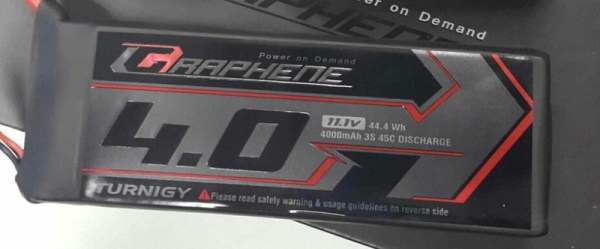
With hype comes marketing, and with marketing comes products making dubious claims. The latest of which is graphene batteries from HobbyKing. According to the literature, these lithium polymer battery packs for RC planes and quadcopters, ‘utilize carbon in the battery structure to form a single layer of graphene… The graphene particles for a highly dense compound allowing electrons to flow with less resistance compared to traditional Lipoly battery technologies” These batteries also come packaged in black shrink tubing and have a black battery connector, making them look much cooler than their non-graphene equivalent. That alone will add at least 5mph to the top speed of any RC airplane.

For the last several years, one of the most interesting potential applications for graphene is energy storage. Graphene ultracapacitors are on the horizon, promising incredible charge densities and fast recharge times. Hopefully, in a decade or two, we might see electric cars powered not by traditional lithium batteries, but graphene supercapacitors. They’ll be able to recharge in minutes and drive further, allowing the world to transition away from a fossil fuel-based economy. World peace commences about two weeks after that happens.

No one expected graphene batteries to show up now, though, and especially not from a company whose biggest market is selling parts to people who build their own quadcopters. How do these batteries hold up? According to the first independent review, it’s a good battery, but the graphene is mostly on the label.

[rampman] on the RCgroups forums did a few tests on the first production runs of the battery, and they’re actually quite good. You can pull a lot of amps out of them, they last through a lot of charging cycles, and the packaging – important for something that will be in a crash – is very good. Are these batteries actually using graphene in their chemistry? That’s the unanswered question, isn’t it?

To be fair, the graphene batteries shipped out to reviewers before HobbyKing’s official launch do perform remarkably well. In the interest of fairness, though, these are most certainly not stock ‘graphene’ battery packs. The reviewers probably aren’t shills, but these battery packs are the best HobbyKing can produce, and not necessarily representative of what we can buy.

It’s also doubtful these batteries use a significant amount of graphene in their construction. According to the available research, graphene increases the power and energy density of batteries. The new graphene batteries store about as much energy as the nano-tech batteries that have been around for years, but weigh significantly more. This might be due to the different construction of the battery pack itself, but the graphene battery should be lighter and smaller, not 20 grams heavier and 5 mm thicker.

In the RC world, HobbyKing is known as being ‘good enough’. It’s not the best stuff you can get, but it is cheap. It’s the Wal-Mart of the RC world, and Wal-Mart isn’t introducing bleeding edge technologies that will purportedly save the planet. Is there real graphene in these batteries? We await an in-depth teardown, preferably with an electron microscope, with baited breath.

Very, Very Low Power Consumption

We’re pretty far away from a world full of wall-warts at this point, and the default power supply for your consumer electronics is either a microUSB cable or lithium batteries. USB ports are ubiquitous enough, and lithium cells hold enough power that these devices can work for a very long time.

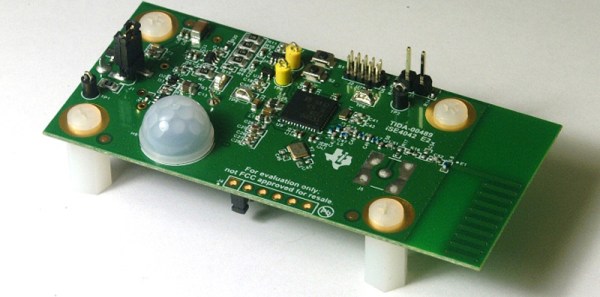
USB devices are common, and batteries are good enough for most devices, not all of them. There is still a niche where& extremely long battery lifetimes are needed and tapping into mains power is impractical. Think smoke detectors and security systems here. How do power supplies work for these devices? In one of the most recent TI application notes, TI showed off their extremely low power microcontrollers with a motion detector that runs for ten years with a standard coin cell battery. This is one of those small engineering marvels that comes by every few years, astonishing us for a few minutes, and then becomes par for the course a few years down the road.

The first thing anyone should think about when designing a battery-powered device that lasts for years is battery self-discharge. You’re not going to run a battery-powered device for ten years with a AA cell; the shelf life for an Energizer AA cell is just 10 years. Add in a few nanoAmps of drain, and you’ll be lucky to make it to 2020. The difference here is a CR2032 lithium-ion coin cell. Look at the datasheet for one of these cells, and they can easily sit on a shelf for 10 years, with 90% of the rated capacity remaining.

With the correct battery in the device, you’ll need a microcontroller that runs at a sufficiently low power for it to be useful in the mid-2020s. The product for this is the CC1310, a very, very low power ARM Cortex-M3 and sub 1GHz transmitter in one package.

Once that’s settled, it’s simply a matter of putting a sensor on the board – in this case a PIR sensor – and a few analog bits triggering an interrupt occasionally. Have the microcontroller in sleep mode most of the time, and that’s how you get a low-power device with a battery that will last a decade.

Power From Paper

Comedian Steven Wright used to say (in his monotone way):

“We lived in a house that ran on static electricity. If we wanted to cook something, we had to take a sweater off real quick. If we wanted to run a blender, we had to rub balloons on our head.”

Turns out, all you need to generate a little electricity is some paper, Teflon tape and a pencil. A team from EPFL, working with researchers at the University of Tokyo, presented just such a device at a MEMS conference. (And check out their video, below the break.)

Continue reading “Power From Paper”

The Mystery Of The Boiled Batteries

While debugging a strange battery failure in a manufacturing process, [Josh] discovered a new (to us) LiPo battery failure mode.

Different battery chemistries react differently to temperature. We’ve used lithium exclusively in high-altitude ballooning, for instance, because of their decent performance when cold. Lithium batteries generally don’t like high temperatures, on the other hand, but besides the risk of bursting into flames, we had no idea that heat could kill them. When the battery’s voltage is already low, though, it turns out it can.

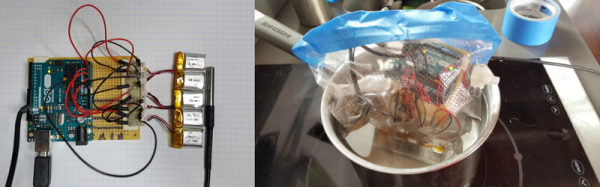
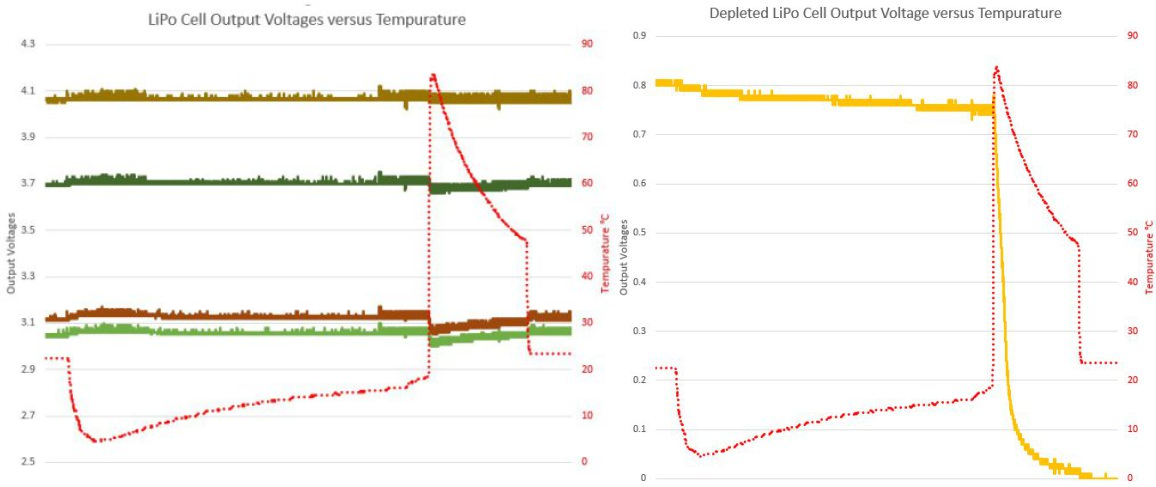
[Josh]’s process required molding plastic with the battery inside, and this meant heating the batteries up. After the fact, he noticed an unreasonably high failure rate in the batteries, and decided to test them out. He put the batteries, each in a different initial charge, into a plastic bag and tortured them all with ice and fire. (OK, boiling water.)

When the batteries got hot, their voltage sagged a little bit, but they recovered afterwards. And while the voltage sagged a little bit more for the batteries with lower initial charge, that’s nothing compared to the complete failure of the battery that entered the hot water with under 1V on it — see they yellow line in the graphs.

battery_voltages

There’s a million ways to kill a battery, and lithium batteries are known not to like being completely discharged, but it looks like the combination of deep discharge and heat is entirely deadly. Now you know.