2025 One-Hertz Challenge: A Clock Sans Silicon

Just about every electronic device has some silicon semiconductors inside these days—from transistors to diodes to integrated circuits. [Charles] is trying to build a “No-Silicon digital clock” that used none of these parts. It looks like [Charles] is on the way to success, but one might like to point out an amusing technicality. Let’s dive in to the clock!

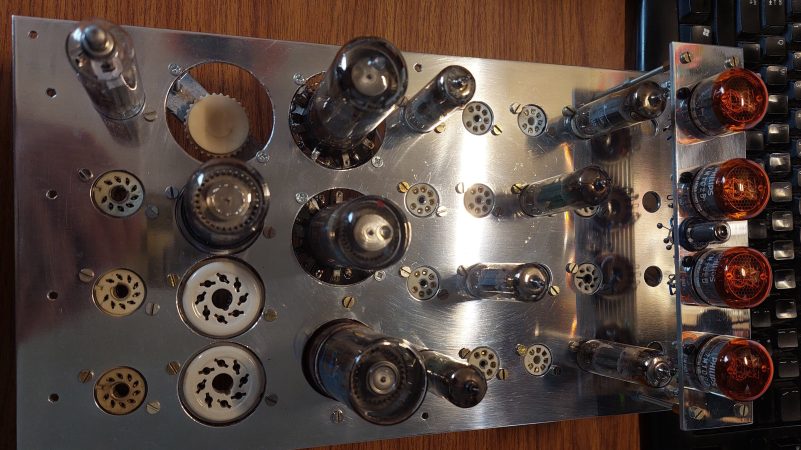
Instead of silicon semiconductors, [Charles] is attempting to build a digital clock using valves (aka tubes). More specifically, his design relies on seven dekatrons, which are the basic counting elements of the clock. By supplying the right voltages to the various cathodes of the dekatrons, they can be made to step through ten (or sometimes twelve) stable states, used as simple memory elements which can be used as the basis for a timepiece. [Charles] will set up the first dekatron to divide down mains frequency by 5 or 6 to get down to 10 Hz, depending on whether the supply is 50 Hz or 60 Hz. The next dekatron will step down 10 times to 1 Hz, to measure seconds. The next two will divide by ten and six to count minutes, while a further two will divide the same way to create an impulse per hour. A final dekatron will divide by 12 to count the hours in a day.

Naturally, time will be displayed on Nixies. While silicon semiconductors are verboten, [Charles] is also considering the use of some germanium parts to keep the total tube count down when it comes to supporting hardware. Also, [Charles] may wish to avoid silicon, but here’s the thing about tubes. They use glass housings, and glass is made of silicon.

Cheeky technicalities aside, it’s a great project that promises to create a very interesting clock indeed. Progress is already steaming along and we can’t wait to see the finished product. We’ve seen dekatrons put to good use before, too. If you’re cooking up your own practical projects with mid-century hardware, don’t hesitate to let us know!

2025 One-Hertz Challenge: Pokémon Alarm Clock Tells You It’s Time To Build The Very Best

We’ve all felt the frustration of cheap consumer electronics — especially when they aren’t actually cheap. How many of us have said “Who designed this crap? I could do better with an Arduino!” while resisting the urge to drop that new smart doorbell in the garbage disposal?

It’s an all-too familiar thought, and when it passed through [Mathieu]’s head while he was resetting the time and changing the batteries in his son’s power-hungry Pokémon alarm clock for the umpteenth time, he decided to do something about it.

The only real design requirement, imposed by [Mathieu]’s son, was that the clock’s original shell remained. Everything else, including the the controller and “antique” LCD could go. He ripped out the internals and installed an ESP32, allowing the clock to automatically sync to network time in the event of power loss. The old-school LCD was replaced with a modern, full-color TFT LCD which he scored on AliExpress for a couple of Euros.

Rather than just showing the time, the new display sports some beautiful pixel art by Woostarpixels, which [Mathieu] customized to have day and nighttime versions, even including the correct moon phase. He really packed as much into the ESP32 as possible, using 99.6% of its onboard 4 MB of flash. Code is on GitHub for the curious. All in all, the project is a multidisciplinary work of art, and it looks well-built enough to be enjoyed for years to come.

Continue reading “2025 One-Hertz Challenge: Pokémon Alarm Clock Tells You It’s Time To Build The Very Best”

2025 One-Hertz Challenge: It’s Hexadecimal Unix Time

[danjovic] came up with a nifty entry for our 2025 One-Hertz Challenge that lands somewhere between the categories of Ridiculous and Clockwork. It’s a clock that few hackers, if any, could read on sight—just the way we like them around here!

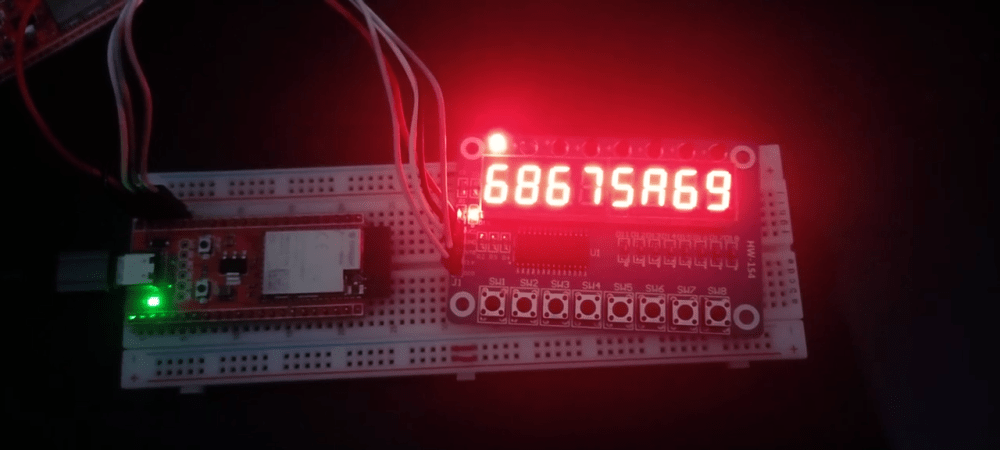
The clock is called Hexa U.T.C, which might give you an idea why this one is a little tricky to parse. It displays the current Unix time in hexadecimal format. If you’re unfamiliar, Unix time is represented as the number of non-leap seconds that have ticked by since 1 January 1970 at 00:00:00 UTC. Even if you can turn the long hex number into decimal in your head, you’re still going to have to then convert the seconds into years, days, hours, minutes, and seconds before you can figure out the actual time.

The build relies on an ESP32-S2 module, paired with a 7-segment display module driven by the TM1638 I/O expander. The ESP32 syncs itself up with an NTP time server, and then spits out the relevant signals to display the current Unix time in hex on the 7-segment displays.

It’s a fun build that your programmer friends might actually figure out at a glance. As a bonus it makes an easy kicking-off point for explaining the Year 2038 problem. We’ve featured other similar Unix clocks before, too. Video after the break.

Continue reading “2025 One-Hertz Challenge: It’s Hexadecimal Unix Time”

Shadow Clock Shows The Time On The Wall

What if you build a clock that displayed the time not just on its own, but in its shadows as well? [Lewis] from [DIY Machines] has done just that, with a nifty 3D-printed shadow clock build.

The clock itself, based on a design by [shiura], has a hollow rim inside which are the two hands which actually display the time. The hands appear to almost float inside the clock, a tricky visual effect of the design which instantly catches the eye. The trick is simple—the minute hand is physically attached to the outer rotor, which sets its position. Meanwhile, the floating hour hand pivots freely around the center of the clock, with a secret magnet within. This magnet is attracted to a complementary magnet in the hour rotor—as that rotor turns, the hour hand points at the magnets inside.

So far, it’s already a cool clock. The bonus feature is that [Lewis] realized this design could show an even larger clockface on the wall behind, merely by using its shadows. Thus, the clock features an LED light source which can project the clock’s shadows into a much larger display than the desktop timepiece itself.

As for the electronics, it’s straightforward stuff. An ESP8266 devboard runs the show, turning stepper motors and controlling addressable LEDs to make the clock do its thing. It also queries a network time server in order to ensure the displayed time is always accurate to the second.

We’ve featured some other excellent clocks over the years, like this incredible thermochromic build. Video after the break.

Continue reading “Shadow Clock Shows The Time On The Wall”

This Thermochromic Clock Is A Ray Of Sunshine

It’s never a bad time to look at a clock, and one could certainly do worse than this delightful Paper Sunshine Clock by [anneosaur]. The sun-ray display is an interesting take on the analog clock, and its method of operation is not one we see every day, either.

Reading the clock is straightforward: there are twelve rays divided into two segments. Once you figure out that this artful object is a clock, it’s easy enough to guess that the rays give the hours, and half-rays are half-hours. In the photo above, it’s sometime between nine o’clock and nine thirty. Our Swiss readers might not be terribly impressed, but a “fuzzy” clock like this is quite good enough much of the time for many people.

Even the flex PCB holding the resistors looks like a work of art.

The title gives away its method of operation: it’s thermochromic paint! The paint is printed onto a piece of Japanese awagami paper, which is pressed against a flexible PCB holding an array of resistors. Large copper pads act as heat spreaders for the resistors. For timekeeping and control, an Atmega328PB is paired with a DS3231MZ RTC, with a coin cell for backup power when the unit is unplugged. (When plugged in, the unit uses USB-C, as all things should.) That’s probably overkill for a +/-30 minute display, but we’re not complaining.

The Atmega328PB does not have quite enough outputs to drive all those resistors, so a multiplexing circuit is used to let the 10 available GIPO control current to 24 rays. Everything is fused for safety, and [anneosaur] even includes a temperature sensor on the control board. The resistors are driven by a temperature-compensated PWM signal to keep them from overheating or warming up too slowly, regardless of room temperature. The attention to detail here is as impressive as the aesthetics.

[annenosaur] has even thought of those poor people for whom such a fuzzy clock would never do (be they Swiss or otherwise) — the Paper Sunshine Clock has a lovely “sparkle mode” that turns the rays on and off at random, turning the clock into an art piece. A demo video of that is below. If you find this clock to be a ray of sunshine, everything you need to reproduce it is on GitHub under an MIT or CC4.0 license.

This is not the first thermochromic clock we’ve featured, though the last one was numeric. If you must have minute accuracy in a thermochromic analog clock, we’ve got you covered there, too.

Special thanks to [anneosaur] for submitting the hack. If you’ve seen (or made) a neat clock, let us know! You won’t catch us at a bad time; it’s always clock time at Hackaday.


A clock face is shown consisting of two rings of plastic, with backlighting behind one of the rings. There is red light at the one o’clock position, and blue light at the nine-thirty position. A black plastic arm is pointing to the three-thirty position.

A Concentric Clock With Multiple Modes

Most of us spend our lives within reach of a device that provides a clock, stopwatch, and a timer – you’re almost certainly reading this article on such a device – but there are fewer options if you want a screen-free clock. [Michael Suguitan]’s TOKIDOKI rectifies this situation by combining those three functions into a single, physical, analog clock face.

TOKIDOKI displays time by lighting the appropriate segments of two concentric rings of colored LEDs (Adafruit Neopixel rings); the inner ring indicates hours, while the outer ring displays minutes. There is one clock hand, and while it does indicate the passage of time in some situations, its main function is as a dial to control the clock’s different functions. The hand is connected to a Dynamixel XL-330 servo motor, which also serves as a position sensor. Winding the dial clockwise starts a countdown timer, with each successive full rotation switching to a larger unit of time (a fun/unsettling feature is that the largest chronometric unit is the user’s expected lifetime: 84 years). Winding counterclockwise either starts a stopwatch or sets an alarm, depending on how many full rotations you make.

A Raspberry Pi Pico running some MicroPython firmware manages the device and gets the current time from a local network. To soften the light’s quality, the LED rings are pointed backwards to provide back-lighting off of a recessed surface. The entire device is powered by USB-C, and is enclosed in a 3D-printed housing.

This project was designed as an experiment in minimal interfaces, and it certainly achieved that goal, though we imagine that it takes a bit of time to get used to using this clock. We always enjoy seeing innovative clocks here, from digital to analogue, and those that split the difference. Continue reading “A Concentric Clock With Multiple Modes”

A Close Look At The Mitxela Precision Clock Mk IV

Over on his secondary YouTube channel, [Jeff Geerling] recently demoed the new Mitxela Precision Clock Mk IV.

This clock uses GPS to get the current time, but also your location so it can figure out what time zone you’re in and which daylight savings time might apply. On the back a blinking diode announces the arrival of each second. A temperature-compensated crystal oscillator (TCXO) is employed for accurate time-keeping.

The clock can be folded in half, thereby doubling as a clapperboard for movie makers. The dimming system is analog, not pulse width modulation (PWM), which means no visible flashing artifacts when recording. It is highly configurable and has USB connectivity. And it has not one but two ARM microcontrollers, an ARM STM32L476, and an ARM STM32L010. If you’re interested, you can pick one up for yourself from [Mitxela]’s shop.

Toward the end of his video [Jeff] does some navel gazing, thinking about what might be required if future versions of the clock wanted to get down into precision at the nanosecond level. Do you arrange it so the light arrives at the viewer’s eyeball at the right time? Or do you update it on the clock at the right time and let the viewer know about it after a minuscule delay? Philosophical preponderances for another day!

We should add that we’ve seen plenty of cool stuff from [Mitxela] before, including the Euroknob and these soldering tweezers.

Continue reading “A Close Look At The Mitxela Precision Clock Mk IV”