Printing Custom Whistles For Everyone At Your RepRap Conference

When [Josef Prusa] speaks at a conference extolling the virtues of 3D printing, he likes to give out printed objects to show off the possibilities home-brew fabrication. A favorite of [Prusa] are whistles – they’re functional and show off exactly what a 3D printer can do. Printing out hundreds of whistles is a job for a factory and not a printer, so [Prusa] decided to customize each whistle with the initials of a conference attendee.

When [Prusa] was asked to attend the INFOTRENDY conference in Bratislava, he had a small audience (only 150 people) and a list of all the attendees a week before hand. It was the perfect scenario to whip up a Python script to generate the models for a whistle with the initials of each attendee emblazoned on the side.

The WhistleGen code is up on [Prusa]’s GitHub ready to print out custom whistles for your next conference. While the capabilities of WhistleGen are limited to just two letters of text, we’re sure someone will figure out a way to automate the generation custom conference badges very shortly.

See the example he sent us after the break.

Continue reading “Printing Custom Whistles For Everyone At Your RepRap Conference”
Zen Rock Garden Table Uses Magnets And Sand

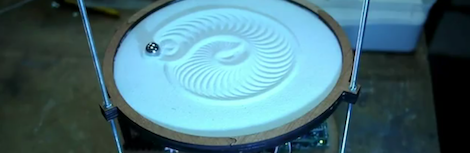
[Nick] is working on a prototype of a coffee table sand plotter that draws patterns in sand a lot like a zen rock garden.

[Nick]’s zen rock garden uses a magnet to draw a ball bearing across the sand in interesting patterns. The build uses 3D printed gears and laser cut parts to rotate the table around and move the magnet along a radius of the circle. During the first test of the prototype, the ball bearing jerked around but this problem was solved by adding a piece of foam under the sand. Power is supplied through a slip ring in the base, and the table is controlled through Bluetooth.

Speaking of magnet-and-ball-bearing zen coffee tables, we ran across this video of a more professional-looking prototype that was the basis for a successful Kickstarter campaign. Like [Nick]’s prototype, the entire build relies on magnets and a ball bearing to move sand around in patterns. Because this zen table uses an XY axis instead of [Nick]’s polar setup, drawing logos is a lot easier math-wise, lthough it doesn’t look quite as cool as a circular rock garden.

After the break you can see these zen rock garden coffee tables in action.

Continue reading “Zen Rock Garden Table Uses Magnets And Sand”

Cheap And Easy Linear Supported Rail

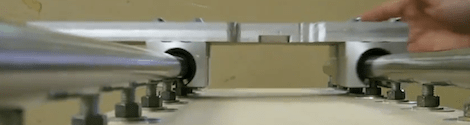
Some of the very largest – and coolest – CNC machines use supported linear rail for their movement axes. For any home tinkerer trying to reproduce these supported rails, the problem of cost comes up very quick; these rails can run over $100 for just a few feet. [Michael] came up with a great way to build his own supported rail so he can build his very large CNC router.

There aren’t many tools needed to build [Michael]’s rail. He put a 90° notch in a 2×4 to support his 25mm rail, and clamped it down with a piece of plywood. After drilling a 5/16″ hole every 12 cm, he tapped these holes out to receive 3/8″ threaded rod. Yes, we also hate the mix of metric and imperial units in that description, but the results speak for themselves.

The now-supported rail was mounted to a piece of MDF with a few bolts and washers. MDF isn’t the most dimensionally stable material, so [Michael] will be covering the whole thing in a coat of epoxy very soon. Now, he’s one step closer to his gigantic CNC gantry router.

You can check out [Michael]’s demo video after the break.

Continue reading “Cheap And Easy Linear Supported Rail”

Putting QR Codes In Copper

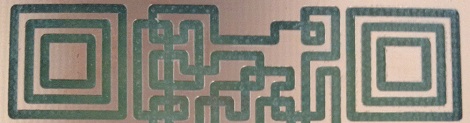
Former Hackaday contributor [mikeysklar] has been trying to etch a QR code into a sheet of copper. Although his phone can’t read the CuR codes he’s made so far, he’s still made an impressive piece of milled copper.

The biggest problem [mikey] ran into is getting Inkscape to generate proper cnc tool paths instead of just tracing a bitmap image. He’s got the CNC part of his build under control, but he still can’t find a QR code reader that will register his work.

We’re no stranger to QR codes here at Hack a Day, and it’s very possible the only thing that could be stopping [mikey]’s QR code from being read by a phone is the contrast of the image. We’re thinking a little bit of printer’s ink forced into the non-copper part of the PCB would make the QR code register. Since [mikey] already has a very nice negative etching of his QR code, he could easily use his new board as a printing plate, making infinite paper copies of his copper-based QR code.

If you’ve got any ideas on how [mikey] can get his QR code working, post them in the comments.

A Six-year Adventure Into The World Of CNC Fabrication

Hackaday doesn’t always get the entire back story of a build. The usual assumption is that someone decided to build something, and with just a little bit of effort the project makes it into the Hackaday tip line. This doesn’t do justice to the builder, with skills honed after years of practice and experience. A 200-word summary is deceiving, and makes everything look almost too easy. [Michal] decided to buck that trend and sent in his half-decade long adventure of becoming one of the best micro-scale machinists we’ve ever seen.

In 2006, with years of robots made out of hot glue and cardboard behind him, and the quality of 3D printers not up to his exacting specifications, [Michal] snapped. He sunk the better part of $3000 into a Roland MDX-15 desktop mill. After several months of futzing about with acrylic sheet, [Michal] came across the wonderful machining properties of modeling board.

Determined to do something useful with this modeling board, [Michal] started looking into resin casting. Casting in resin is a common technique in the artist and model maker communities to mass produce small plastic parts. After getting his hands on eight liters of polyurethane resin, [Michal] made a useful part guiding the direction his skill set would grow in the coming years.

After years of experimenting with techniques, materials, and mediums, [Michal] eventually honed his craft and was able to finally start building real robots. These projects were a far cry from the cardboard and milk jug contraptions made earlier in his career. [Michal] was now producing incredibly precise gear assemblies with accuracies within 0.002 mm.

You may remember [Michal] from his robot with pivoting wheels we showcased last week. He got a lot of email from people wanting to know how to start delving into his unique blend of artistry, engineering, and craftsmanship. The good news is you can now learn from his mistakes, so a planetary gearbox shouldn’t take more than a few months to finish.

Wooden CNC Touch Probe

diy-touch-probe

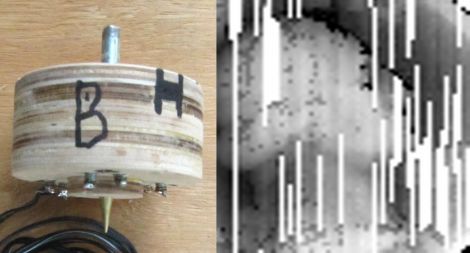
[Gary] sent a few pictures of his latest project our way via Flickr, which we thought a few of you CNC owners might be interested in. He has been working with his CNC machine a lot lately and decided it was about time he built a touch probe for his rig.

His initial goal was to use the touch probe to ensure his CNC table was perfectly level, but we’re thinking it will be helpful for a lot of different projects in the future. [Gary] says he was really looking to put together a proof of concept device, but that things worked out so well he had to share.

His probe seems to work very well, even without the fit and finish of others we’ve seen in the past. The body of the probe itself was built using several layers of quarter inch plywood, housing three sets of two screws. The screws are wired together in order to form a closed circuit when the brass probe is inserted. When the probe makes contact with a solid object, the circuit is broken, and the coordinates of the probe’s head are recorded.

Though [Gary] admits that he was not super careful when it came to building the probe, we think the results speak for themselves. For a first iteration its scanning abilities are pretty impressive – we can’t wait to see version 2.

CNC’d Business Cards Will Definitely Get You Noticed

cnc-business-card

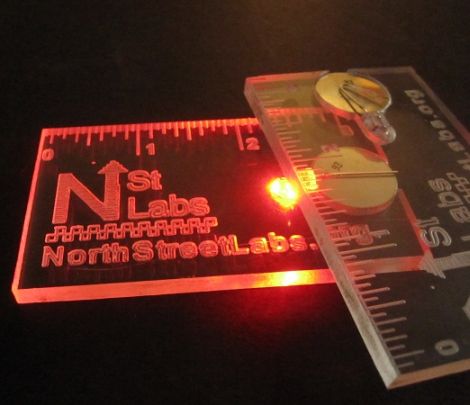
The guys over at North Street Labs were bored, so they figured why not go ahead and built a CNC machine just for kicks. While they haven’t put up build details on the CNC just yet, they do have some newly milled business cards to show off just how well the machine works.

Part ruler, part LED throwie, we think their new business cards look great. Milled out of thin acrylic sheeting, their cards feature the North Street Labs logo and URL along with 1/32” ruler markings along the top. The card is also fitted with space for a button cell battery and RGB LED, which illuminates the entire card nicely from the side.

They say that the cards take about 5 minutes apiece to make, which is not bad at all. At $0.50 a pop, the cards are not nearly as cheap as those made from cardstock, but when you’re looking to impress what’s a couple of quarters?

Continue reading to see a short video of their CNC-milled business cards in action.

Continue reading “CNC’d Business Cards Will Definitely Get You Noticed”