Gene Therapy Aims To Slow Huntington’s Disease To A Crawl

Despite the best efforts of modern medicine, Huntington’s disease is a condition that still comes with a tragic prognosis. Primarily an inherited disease, its main symptoms concern degeneration of the brain, leading to issues with motor control, mood disturbance, with continued degradation eventually proving fatal.

Researchers have recently made progress in finding a potential treatment for the disease. A new study has indicated that an innovative genetic therapy could hold promise for slowing the progression of the disease, greatly improving patient outcomes.

Continue reading “Gene Therapy Aims To Slow Huntington’s Disease To A Crawl”

Simple Fluorometer Makes Nucleic Acid Detection Cheap And Easy

Back in the bad old days, dealing with DNA and RNA in a lab setting was often fraught with peril. Detection technologies were limited to radioisotopes and hideous chemicals like ethidium bromide, a cherry-red solution that was a fast track to cancer if accidentally ingested. It took time, patience, and plenty of training to use them, and even then, mistakes were commonplace.

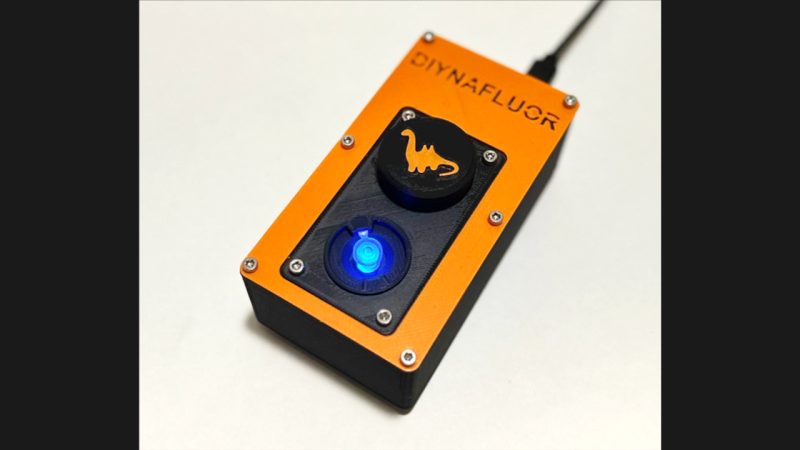
Luckily, things have progressed a lot since then, and fluorescence detection of nucleic acids has become much more common. The trouble is that the instruments needed to quantify these signals are priced out of the range of those who could benefit most from them. That’s why [Will Anderson] et al. came up with DIYNAFLUOR, an open-source nucleic acid fluorometer that can be built on a budget. The chemical principles behind fluorometry are simple — certain fluorescent dyes have the property of emitting much more light when they are bound to DNA or RNA than when they’re unbound, and that light can be measured easily. DIYNAFLUOR uses 3D-printed parts to hold a sample tube in an optical chamber that has a UV LED for excitation of the sample and a TLS2591 digital light sensor to read the emitted light. Optical bandpass filters clean up the excitation and emission spectra, and an Arduino runs the show.

The DIYNAFLUOR team put a lot of effort into making sure their instrument can get into as many hands as possible. First is the low BOM cost of around $40, which alone will open a lot of opportunities. They’ve also concentrated on making assembly as easy as possible, with a solder-optional design and printed parts that assemble with simple fasteners. The obvious target demographic for DIYNAFLUOR is STEM students, but the group also wants to see this used in austere settings such as field research and environmental monitoring. There’s a preprint available that shows results with commercial fluorescence nucleic acid detection kits, as well as detailing homebrew reagents that can be made in even modestly equipped labs.

Nanobots Self Replicate

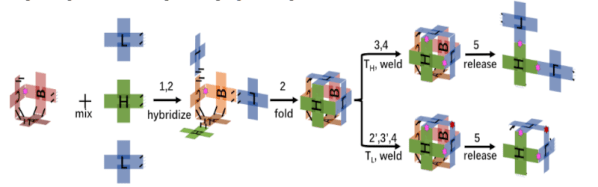
Hey, what if you could have a factory that makes robots that is run by… robots? This is hardly an original thought, but we are a long way from having an assembly line of C3POs self-replicating. On the other hand, animals — including humans — self-replicate all the time using DNA. Now, scientists are making tiny nanorobots from DNA that can assemble more DNA, including copies of themselves.

Assembling 3D structures with DNA has deep implications. For example, it might be possible to build drugs in situ, delivering powerful toxins only to cancer cells. Another example would be putting DNA factories in diabetes patients to manufacture the insulin they can’t.

Continue reading “Nanobots Self Replicate”

Hackaday Links Column Banner

Hackaday Links: July 30, 2023

A couple of weeks ago, we noted with interest that the space shuttle Endeavour (OV85) would be set up as a full-stack launch configuration display, complete with external fuel tank and solid rocket boosters. We predicted that this would result in some interesting engineering, not least of which will be making the entire 20-story stack safe from seismic activity. Looks like we were right on all counts, with this story about the foundation upon which the display will stand, which has been under construction for quite a while now. The base has six seismic isolators that support the 2.4-m thick slab of reinforced concrete that will serve as a perch for the full stack. The 1,800-ton slab will be able to move a meter or so from its resting position during earthquakes. Or perhaps more accurately, the foundation will allow Los Angeles to move as much as it wants while Endeavour rides it out.

If like us you’re worried that seismic loads are vastly different than the loads the spacecraft was actually designed for, relax — it turns out that the flight loads are far in excess of predicted loads from seismic stress. The plan is to build the booster stacks first — the aft skirts, which will support the entire stack, were just bolted in place — then lift the external tank in place between the boosters, and finally hoist the actual orbiter into place. After the stack is complete, the rest of the building will be built around it. We’re really looking forward to seeing some video on this project.

Continue reading “Hackaday Links: July 30, 2023”

Open-Source LAMP Instrument Aimed At Clinicians And Biohackers Alike

Over the last few years, we’ve all been given a valuable lesson in both the promise and limitations of advanced molecular biology methods for clinical diagnostics. Polymerase chain reaction (PCR) was held up as the “gold standard” of COVID-19 testing, but the cost, complexity, and need for advanced instrumentation and operators with specialized training made PCR difficult to scale to the levels demanded by a pandemic.

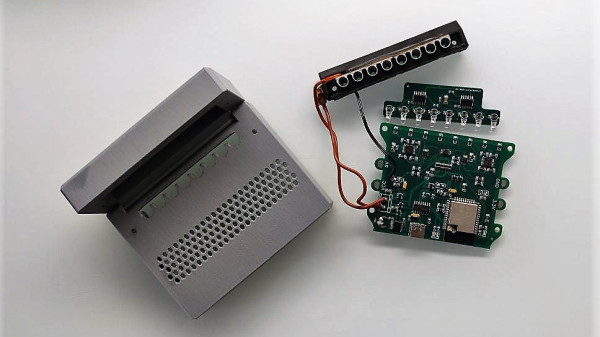
There are other diagnostic methods, of course, some of which don’t have all the baggage of PCR. RT-LAMP, or reverse transcriptase loop-mediated amplification, is one method with a lot of promise, especially when it can be done on a cheap open-source instrument like qLAMP. For about 50€, qLAMP makes amplification and detection of nucleic acids, like the RNA genome of the SARS-CoV-2 virus, a benchtop operation that can be performed by anyone. LAMP is an isothermal process; it can be done at one single temperature, meaning that no bulky thermal cycler is required. Detection is via the fluorescent dye SYTO 9, which layers into the base pairs inside the amplified DNA strands, using a 470-nm LED for excitation and a photodiode with a filter to detect the emission. Heating is provided by a PCB heater and a 3D-printed aluminum block that holds tubes for eight separate reactions. Everything lives in a 3D-printed case, including the ESP32 which takes care of all the housekeeping and data analysis duties.

With the proper test kits, which cost just a couple of bucks each, qLAMP would be useful for diagnosing a wide range of diseases, and under less-than-ideal conditions. It could also be a boon to biohackers, who could use it for their own citizen science efforts. We saw a LAMP setup at the height of the pandemic that used the Mark 1 eyeball as a detector; this one is far more quantitative.

Broken Genes And Scrambled Proteins: How Radiation Causes Biological Damage

If decades of cheesy sci-fi and pop culture have taught us anything, it’s that radiation is a universally bad thing that invariably causes the genetic mutations that gifted us with everything from Godzilla to Blinky the Three-Eyed Fish. There’s a kernel of truth there, of course. One only needs to look at pictures of what happened to Hiroshima survivors or the first responders at Chernobyl to see extreme examples of what radiation can do to living tissues.

But as is usually the case, a closer look at examples a little further away from the extremes can be instructive, and tell us a little more about how radiation, both ionizing and non-ionizing, can cause damage to biochemical structures and processes. Doing so reveals that, while DNA is certainly in the crosshairs for damage by radiation, it’s not the only target — proteins, carbohydrates, and even the lipids that form the membranes within cells are subject to radiation damage, both directly and indirectly. And the mechanisms underlying all of this end up revealing a lot about how life evolved, as well as being interesting in their own right.

Continue reading “Broken Genes And Scrambled Proteins: How Radiation Causes Biological Damage”

Logic Via DNA

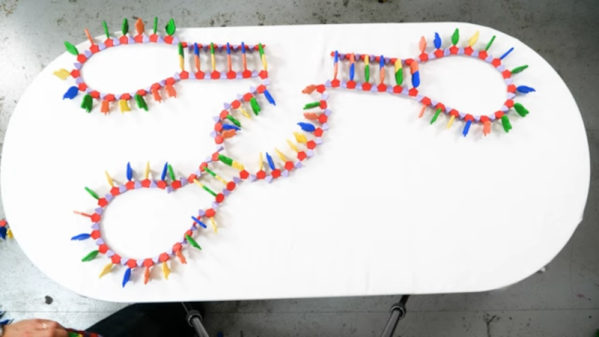
We often say you can make logic gates out of nearly anything. [Steve Mould] would agree as he just finished playing naughts and crosses (tic tac toe if you are an American) with a tray full of DNA. You can see the resulting game and how it works in the video below.

The use of DNA isn’t really significant as it simply implements a logic equation for each of the nine cells. So, for example, each cell is taken by an X (the DNA) only when certain other squares have been taken by O or not taken by O. So you essentially create an AND/OR gate using the state of each cell and its inverse.

Continue reading “Logic Via DNA”