Logic Via DNA

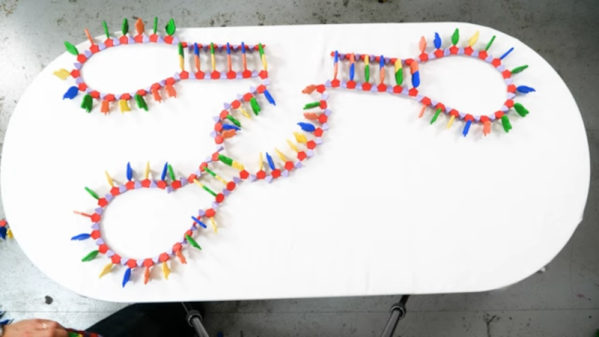
We often say you can make logic gates out of nearly anything. [Steve Mould] would agree as he just finished playing naughts and crosses (tic tac toe if you are an American) with a tray full of DNA. You can see the resulting game and how it works in the video below.

The use of DNA isn’t really significant as it simply implements a logic equation for each of the nine cells. So, for example, each cell is taken by an X (the DNA) only when certain other squares have been taken by O or not taken by O. So you essentially create an AND/OR gate using the state of each cell and its inverse.

Continue reading “Logic Via DNA”

Hacking The Wooly Mammoth

In case you can’t get enough Jurassic Park movies, you can look forward to plans a biotech company has to hybridize endangered Asian elephants with long-extinct wooly mammoths using gene splicing and other exotic techniques.

Expect a long movie, the team hopes to have calves after six years and we don’t think a theme park is in the making. The claim is that mammoth traits will help the elephants reclaim the tundra, but we can’t help but think it is just an excuse to reanimate an extinct animal. If you read popular press reports, there is some question if the ecological mission claimed by the company is realistic. However, we can’t deny it would be cool to bring an animal back from extinction — sort of.

We aren’t DNA wizards, so we only partially understand what’s being proposed. Apparently, skin cells from a modern elephant will serve as a base to accept extracted mammoth DNA. This might seem far-fetched but turns out the mammoth lived much more recently than we usually think. When they die in their natural deep-freeze environment, they are often well preserved.

Once the gene splicing is set up, a surrogate elephant will carry the embryo to term. The hope is that the improved breed would be able to further interbreed with natural species, although with the gestation and maturity times of elephants, this will be a very long time to bear fruit.

So how do you feel about it? Will we face a movie-level disaster? Will we get some lab curiosity creatures? Will it save the tundra? Let us know what you think in the comments.

DNA manipulation has gone from moon-shot-level tech to readily accessible in a very short amount of time. In particular, CRISPR, changes everything and is both exciting and scary on what it puts in the hands of nearly anyone.

Microfluidics For Biohacking Hack Chat

Join us on Wednesday, July 7 at noon Pacific for the Microfluidics for Biohacking Hack Chat with Krishna Sanka!

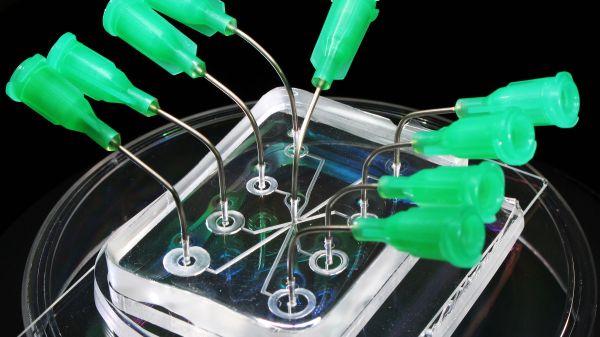
“Microfluidics” sounds like a weird and wonderful field, but one that doesn’t touch regular life too much. But consider that each time you fire up an ink-jet printer, you’re putting microfluidics to work, as nanoliter-sized droplets of ink are spewed across space to impact your paper at exactly the right spot.

Ink-jets may be mundane, but the principles behind them are anything but. Microfluidic mechanisms have found their way into all sorts of products and processes, with perhaps the most interesting uses being leveraged to explore and exploit the microscopic realms of life. Microfluidics can be used to recreate some of the nanoscale biochemical reactions that go on in cells, and offer not only new ways to observe the biological world, but often to manipulate it. Microfluidics devices range from “DNA chips” that can rapidly screen drug candidates against thousands of targets, to devices that can rapidly screen clinical samples for exposure to toxins or pathogens.

There are a host of applications of microfluidics in biohacking, and Krishna Sanka is actively working to integrate the two fields. As an engineering graduate student, his focus is open-source, DIY microfluidics that can help biohackers up their game, and he’ll stop by the Hack Chat to run us through the basics. Come with your questions about how — and why — to build your own microfluidics devices, and find out how modern biohackers are learning to “go with the flow.”

join-hack-chatOur Hack Chats are live community events in the Hackaday.io Hack Chat group messaging. This week we’ll be sitting down on Wednesday, July 7 at 12:00 PM Pacific time. If time zones have you tied up, we have a handy time zone converter.

[Featured image: Cooksey/NIST]

Sequencing DNA For Metagenomics

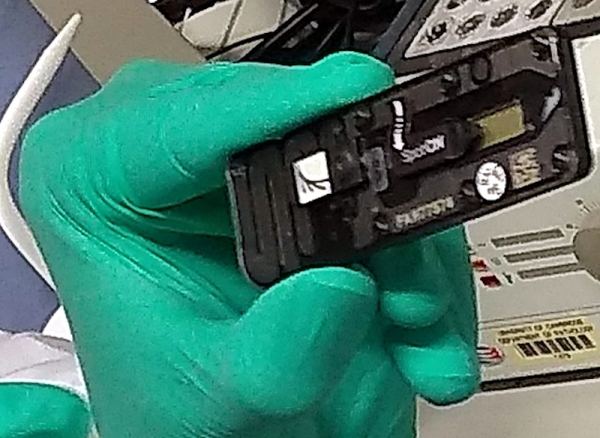
If someone brought you an odd piece of electronic hardware and you wanted to identify it, you’d probably look for markings on the outside first. If that didn’t work out, you might look under the cover and read some markings on the board or key components. However, in a tough case, you might dump the firmware and try to guess what the device is or what it does by examining the code that makes it run. That’s kind of what [Ciro] did. Wanting to determine the bacteria in a water sample led to using relatively inexpensive DNA sequencing hardware to look at the DNA present in the samples. This would have been a huge undertaking for a well-funded lab just a few short years ago. Now it just takes a USB device and some software.

Of course, inexpensive is in the eye of the beholder. The micropore sequencer costs about $500 and has a one-time use consumable cost of about $500, although that’s enough to process about 10 human genomes. The technology depends on using a small pore only large enough to pass one strand of DNA at a time. Blocks of nucelotides cause different amounts of electrical current to flow through the pore.

Continue reading “Sequencing DNA For Metagenomics”

Coronavirus Testing: CRISPR Technology Set To Streamline Viral Testing

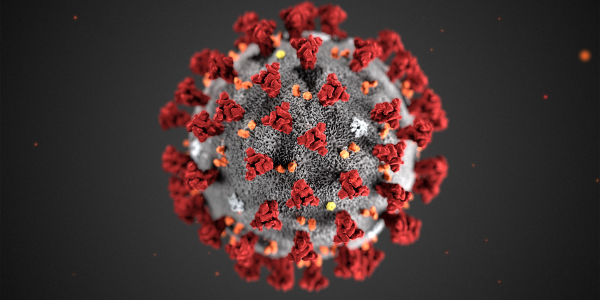
If we could run back 2020 to its beginning and get a do-over, chances are pretty good that we’d do a lot of things differently. There’s a ton of blame to go around on COVID-19, but it’s safe to say that one of the biggest failures of this whole episode has been the lack of cheap, quick, accurate testing for SARS-CoV-2, the virus behind the current pandemic. It’s not for lack of information; after all, Chinese scientists published the sequence of the viral genome very early in the pandemic, and researchers the world over did the same for all the information they gleaned from the virus as it rampaged around the planet.

But leveraging that information into usable diagnostics has been anything but a smooth process. Initially, the only method of detecting the virus was with reverse transcriptase-polymerase chain reaction (RT-PCR) tests, a fussy process that requires trained technicians and a well-equipped lab, takes days to weeks to return results, and can only tell if the patient has a current infection. Antibody testing has the potential for a quick and easy, no-lab-required test, but can only be used to see if a patient has had an infection at some time in the past.

What’s needed as the COVID-19 crisis continues is a test with the specificity and sensitivity of PCR combined with the rapidity and simplicity of an antibody test. That’s where a new assay, based on the latest in molecular biology methods and dubbed “STOPCovid” comes in, and it could play a major role in diagnostics now and in the future.

Continue reading “Coronavirus Testing: CRISPR Technology Set To Streamline Viral Testing”

Defense Department Funds Wearables To Detect COVID-19

As many countries across the globe begin loosening their stay-at-home orders, we’re seeing government agencies and large companies prepare for the lasting effects of the pandemic. A recent solicitation from the United States Department of Defense (DoD) indicates they are investing $25 million into wearable devices that can detect early signs of COVID-19.

Based on a few details from the request for project proposals, it looks like the DoD is targeting mostly companies in this particular solicitation, but have left the door open for academic institutions as well. That makes intuitive sense. Companies can generally operate at a faster pace than most academic research labs. Given the urgency of the matter, faster turnarounds in technological development are imperative. Nonetheless, we have seen quite a bit of important COVID-19 work coming from academic research labs and we imagine that battling this pandemic will take all the brilliant minds we can muster together.

It’s good to see the DoD join the fight in what could be a lengthy battle with the coronavirus.

Please feel free to read through the request for project proposals for more details.

So What Is Protein Folding, Anyway?

The current COVID-19 pandemic is rife with problems that hackers have attacked with gusto. From 3D printed face shields and homebrew face masks to replacements for full-fledged mechanical ventilators, the outpouring of ideas has been inspirational and heartwarming. At the same time there have been many efforts in a different area: research aimed at fighting the virus itself.

Getting to the root of the problem seems to have the most potential for ending this pandemic and getting ahead of future ones, and that’s the “know your enemy” problem that the distributed computing effort known as Folding@Home aims to address. Millions of people have signed up to donate cycles from spare PCs and GPUs, and in the process have created the largest supercomputer in history.

But what exactly are all these exaFLOPS being used for? Why is protein folding something to direct so much computational might toward? What’s the biochemistry behind this, and why do proteins need to fold in the first place? Here’s a brief look at protein folding: what it is, how it happens, and why it’s important.

Continue reading “So What Is Protein Folding, Anyway?”