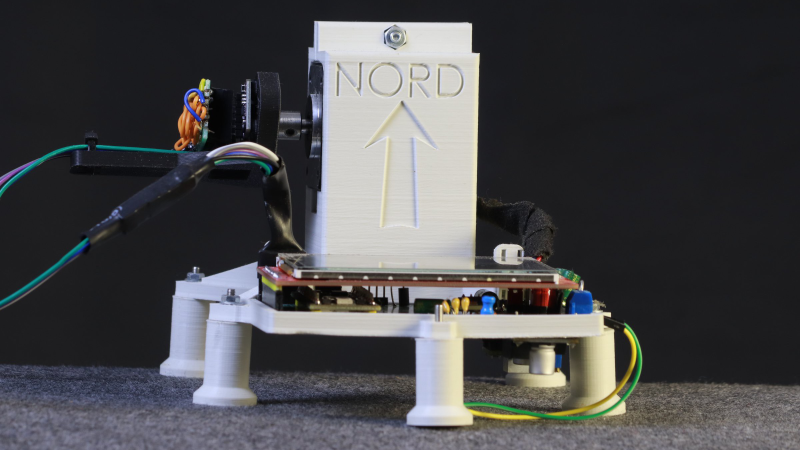
A 3D-printed assembly standing on short legs is visible. A portion extends upward with the word "Nord" sunk into it. Cables extend from one side of the upright portion, and a side view of a circuit board is visible at the front of the assembly.

Measuring Earth’s Rotation With Two Gyroscopes

We’ve probably all had a few conversations with people who hold eccentric scientific ideas, and most of the time they yield nothing more than frustration and perhaps a headache. In [Bertrand Selva]’s case, however, a conversation with a flat-earth believer yielded a device that uses a pair of gyroscopes to detect earth’s rotation, demonstrating that rotation exists without the bulkiness of a Foucalt pendulum.

[Bertrand] built his apparatus around a pair of BMI160 MEMS gyroscopes, which have a least significant bit for angular velocity corresponding to 0.0038 degrees per second, while the earth rotates at 0.00416 degrees per second. To extract such a small signal from all the noise in the measurements, the device makes measurements with the sensors in four different positions to detect and eliminate the bias of the sensors and the influence of the gravitational field. Before running a test, [Bertrand] oriented the sensors toward true north, then had a stepper motor cycle the sensors through the four positions, while a Raspberry Pi Pico records 128 measurements at each position. It might run the cycle as many as 200 times, with error tending to decrease as the number of cycles increases.

A Kalman filter processes the raw data and extracts the signal, which came within two percent of the true rotational velocity. [Bertrand] found that the accuracy was strongly dependent on how well the system was aligned to true north. Indeed, the alignment effect was so strong that he could use it as a compass.

In the end, the system didn’t convince [Bertrand]’s neighbor, but it’s an impressive demonstration nonetheless. This system is a bit simpler, but it’s also possible to measure the earth’s rotation using a PlayStation. For higher precision, check out how the standards organizations manage these measurements.
Earth’s Oxygen Levels And Magnetic Field Strength Show Strong Correlation

Time series of O2 (blue) and VGADM (red). (Credit: Weijia Kuang, Science Advances, 2025)

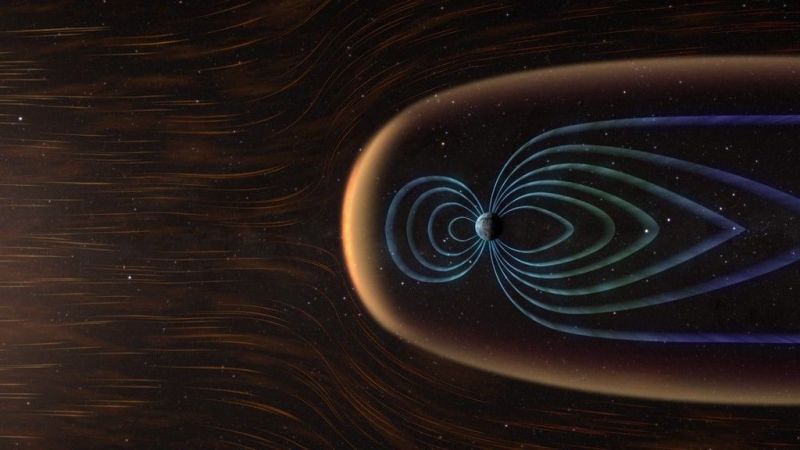
In an Earth-sized take on the age-old ‘correlation or causality’ question, researchers have come across a fascinating match between Earth’s magnetic field and its oxygen levels since the Cambrian explosion, about 500 million years ago. The full results by [Weijia Kuang] et al. were published in Science Advances, where the authors speculate that this high correlation between the geomagnetic dipole and oxygen levels as recorded in the Earth’s geological mineral record may be indicative of the Earth’s geological processes affecting the evolution of lifeforms in its biosphere.

As with any such correlation, one has to entertain the notion that said correlation might be spurious or indirectly related before assuming a strong causal link. Here it is for example known already that the solar winds affect the Earth’s atmosphere and with it the geomagnetic field, as more intense solar winds increase the loss of oxygen into space, but this does not affect the strength of the geomagnetic field, just its shape. The question is thus whether there is a mechanism that would affect this field strength and consequently cause the loss of oxygen to the solar winds to spike.

Here the authors suggest that the Earth’s core dynamics – critical to the geomagnetic field – may play a major role, with conceivably the core-mantle interactions over the course of millions of years affecting it. As supercontinents like Pangea formed, broke up and partially reformed again, the impact of this material solidifying and melting could have been the underlying cause of these fluctuations in oxygen and magnetic field strength levels.

Although hard to say at this point in time, it may very well be that this correlation is causal, albeit as symptoms of activity of the Earth’s core and liquid mantle.

Measuring Local Variances In Earth’s Magnetic Field

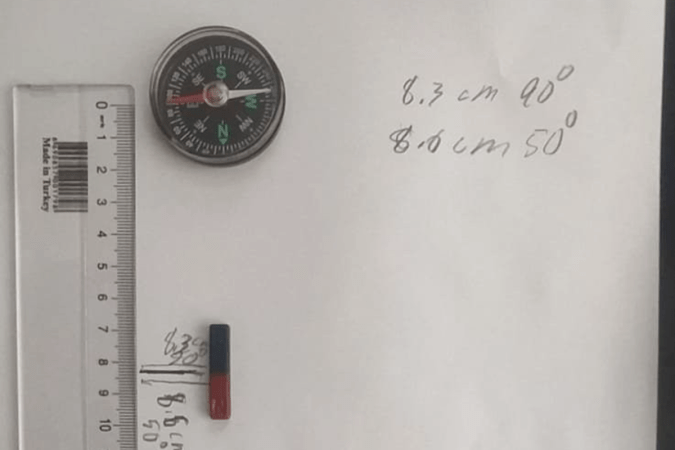
Although the Earth’s magnetic field is reliable enough for navigation and is also essential for blocking harmful solar emissions and for improving radio communications, it’s not a uniform strength everywhere on the planet. Much like how inconsistencies in the density of the materials of the planet can impact the local gravitational force ever so slightly, so to can slight changes impact the strength of the magnetic field from place to place. And it doesn’t take too much to measure this impact on your own, as [efeyenice983] demonstrates here.

To measure this local field strength, the first item needed is a working compass. With the compass aligned to north, a magnet is placed with its poles aligned at a right angle to the compass. The deflection angle of the needle is noted for varying distances of the magnet, and with some quick math the local field strength of the Earth’s magnetic field can be calculated based on the strength of the magnet and the amount of change of the compass needle when under its influence.

Using this method, [efeyenice983] found that the Earth’s magnetic field strength at their location was about 0.49 Gauss, which is well within 0.25 to 0.65 Gauss that is typically found on the planet’s surface. Not only does the magnetic field strength vary with location, it’s been generally decreasing in strength on average over the past century or so as well, and the poles themselves aren’t stationary either. Check out this article which shows just how much the poles have shifted over the last few decades.

Filming The Eclipse From 80,000 Feet

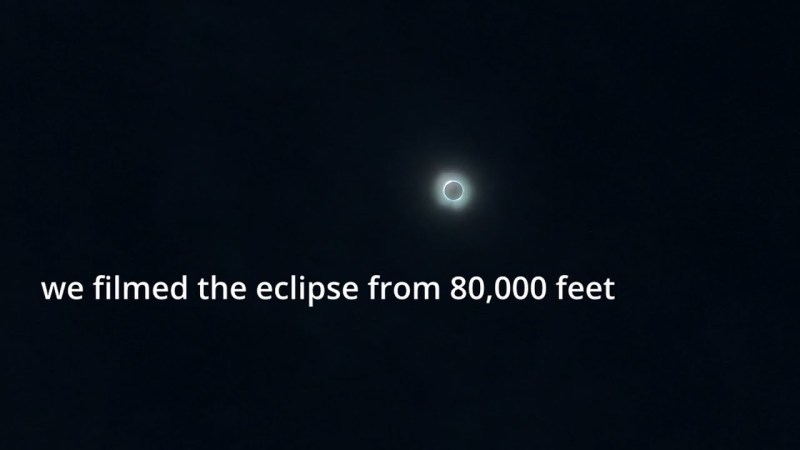
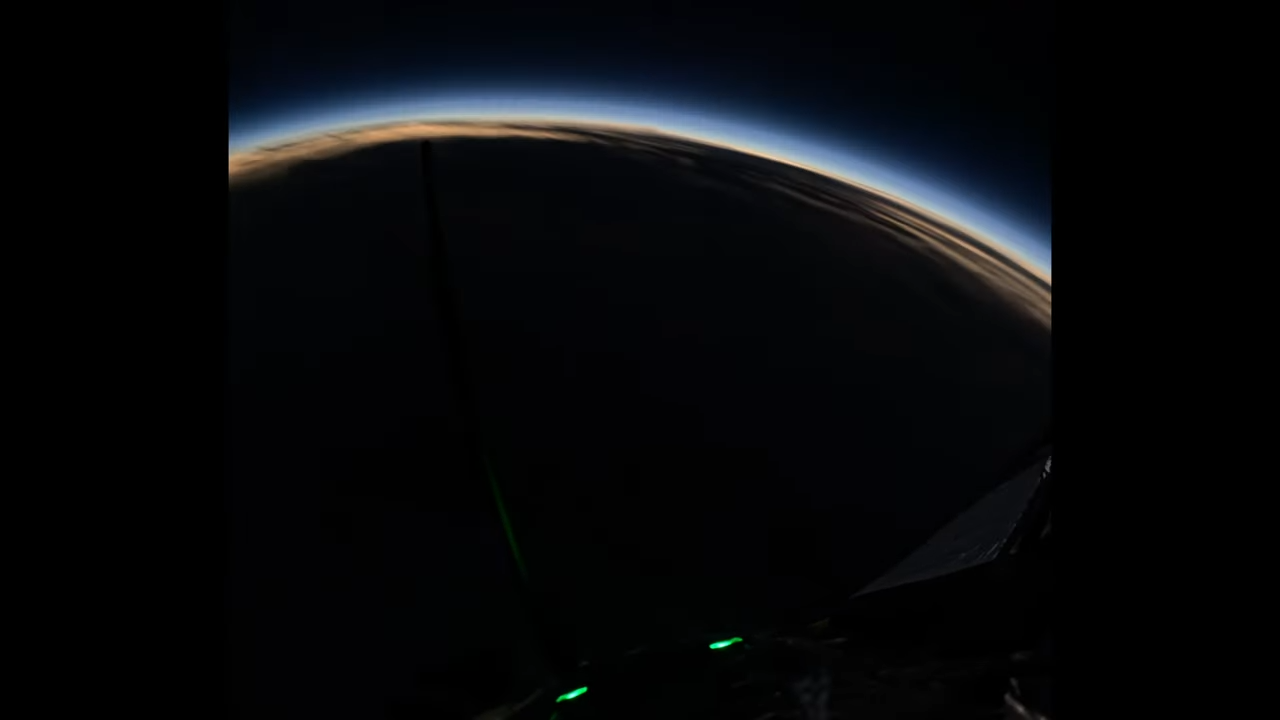
Watching an eclipse from the ground is pretty fun. Depending on where you live, you might even get a decent view. But what if you wanted a truly unique vantage point? You could replicate the work of [Tarik Agcayazi] and [kemfic], who set about filming the recent eclipse from an altitude of 80,000 feet.

That’s what the eclipse looks like from 80,000 feet.

The duo didn’t rent a high-performance aircraft from the US military. Instead, they relied on a high-altitude balloon carrying a glider with a camera payload. The idea was for the balloon to go up, and have the camera capture the eclipse. Then, it would be released so that it could glide back home in controlled flight. However, time constraints made that too hard. Instead, they simplified to a parachute recovery method.

The project video covers the development process, the balloon launch itself, and of course, the filming of the eclipse. High altitude balloon launches are stressful enough, but having a short eclipse as a target made everything even more difficult. But that just makes things more exciting!

The project builds on earlier work from the duo that we discussed back in 2017.

Continue reading “Filming The Eclipse From 80,000 Feet”

NASA Found Another Super Earth With Tantalizing Possibilities

Earth is a rather special place, quite unlike the other planets in the solar system. It’s nestled at the perfect distance from the sun to allow our water to remain liquid and for life to flourish in turn. It’s a rare thing; most planets are either too close and scorching hot, or too far and freezing cold.

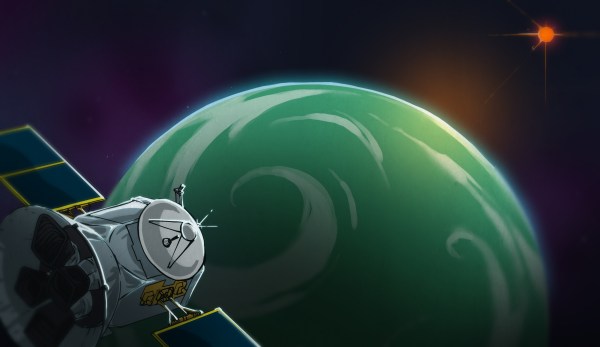
NASA is always on the hunt for planets like our own, and recently found a new super-Earth by the name of TOI-715b. The planet is larger than our own, but it’s position and makeup mean that it’s a prime candidate for further study. Let’s take a look at how NASA discovered this planet, and why it’s special.

Continue reading “NASA Found Another Super Earth With Tantalizing Possibilities”

Could Moon Mining Spoil Its Untouched Grandeur And Science Value?

It’s 2024. NASA’s Artemis program is in full swing, and we’re hoping to get back to the surface of the Moon real soon. Astronauts haven’t walked on the beloved sky rock since 1972! A human landing was scheduled for 2025, which has now been pushed back to 2026, and we’re all getting a bit antsy about it. Last time we wanted to go, it only took 8 years!

Now, somehow, it’s harder, but NASA also has its sights set higher. It no longer wants to just toddle about the Moon for a bit to wave at the TV cameras. This time, there’s talk of establishing permanent bases on the Moon, and actually doing useful work, like mining. It’s a tantalizing thought, but what does this mean for the sanctity of one of the last pieces of real estate yet to be spoilt by humans? Researchers are already arguing that we need to move to protect this precious, unique environment.

Continue reading “Could Moon Mining Spoil Its Untouched Grandeur And Science Value?”

Lego Orrery

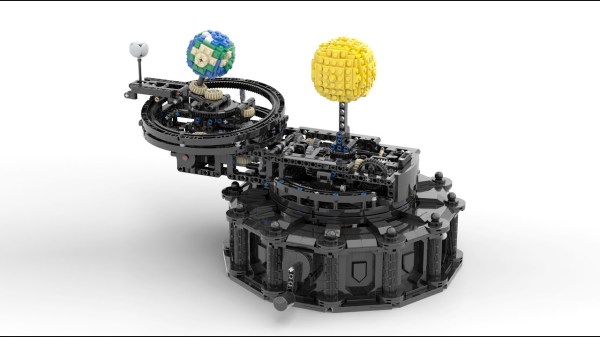
LEGOpunk Orrery Knows Just The Right Technics

Is the unmistakable sound of the shuffling of LEGO pieces being dug through burned into your psyche? Did the catalog of ever more complex Technic pieces send your imagination soaring into the stratosphere and beyond? Judging by the artful contraption in the video below the break, we are fairly certain that [Marian] can relate to these things.

No doubt inspired by classic orreries driven by clockwork, [Marian]’s LEGO Sun-Earth-Moon orrery is instead driven by either hand cranks or by electric motors. The orrery aims to be astronomically correct. To that end, a full revolution of a hand crank produces a full day’s worth of movement.

Solar and lunar eclipses can be demonstrated, along with numerous other principals such as the tilt of the earth, moon phases, tidal locking, and more, which can be found at the project page.

While classical orreries predate the Victorian era, there seems to be an almost inexplicable link between orreries and the Steampunk aesthetic. But [Marian]’s orrery brought the term “LEGOpunk” to mind. Could it be? Given that there are 2305 pieces and 264 pages of instructions with 436 steps, we think so!

We’ve covered just a few orreries in the past, from this somewhat simple laser cut orrery to this horrifically complex and beautiful thing hereContinue reading “LEGOpunk Orrery Knows Just The Right Technics”