Upload Firmware Over Ethernet

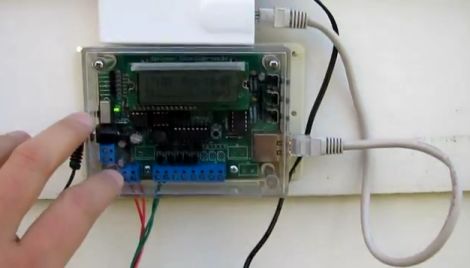
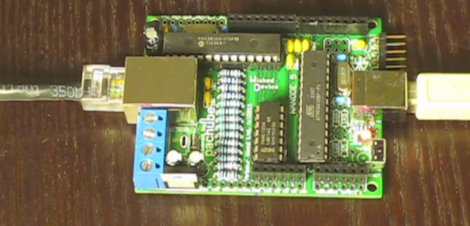
The team at Wicked Device has been working on working on a way to upload Arduino sketches over Ethernet for the Nanode and Arduino Ethernet boards. The team has gotten far enough along to show the world, and the new boot loader shows a lot of promise.

A new boot loader was needed to perform this magic. The boot loader sets up a TFTP with a server over DHCP or a static IP. An unmodified .hex file is downloaded from the server and the sketch starts up. The team is still working on a way to push new apps to the board over Ethernet, but that feature is expected to be completed sometime soon.

Booting over Ethernet isn’t a new idea – TFTP was proposed for this very purpose. Because Wicked Device’s Ethernet-enabled boot loader only works over a local connection and requires a press of the reset button, it should be considered an alpha build. That being said, the boot loader works as advertised, so check out the demo video after the break.

Continue reading “Upload Firmware Over Ethernet”

Stream Music Anywhere In Your House With These WiFi Speakers

wifi_speakers

[Rui] needed an easy way to play music in several different zones from one centralized location, but he didn’t want to run any new wiring in the process.

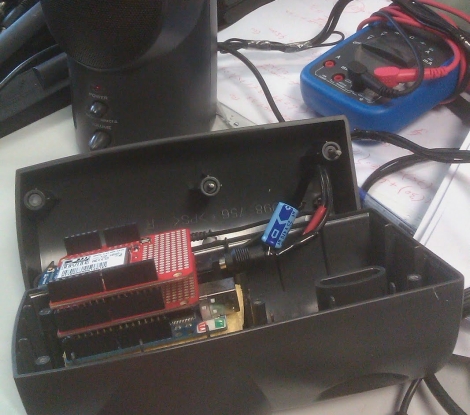
He figured that the best way to do this would be to stream his music directly to his speakers over Ethernet. Earlier this year, he put together a handful of Ethernet-connected speaker nodes using a few Arduinos equipped with both Ethernet and MP3 shields. To interface with these speaker nodes, he wrote an application utilizing VLC’s network streaming engine. This software monitors his network for newly attached speakers, adding them to his inventory automatically. He can choose to play music on any set of speakers using a multicast audio stream.

The setup was pretty slick, but what about locations that didn’t already have Ethernet drops? He thought of that too, revising his design just recently. The newest set of speakers he constructed ditches the Ethernet board for a Wifly shield, all of which he crammed inside the speaker cabinets. Now, he has the ability to stream music anywhere he’d like, no matter what sort of infrastructure is in place.

If you have a need to do this in your home, [Rui] has made his software available for free on his site, so be sure to grab a copy.

Continue reading to see a short video of the speakers in action.

Continue reading “Stream Music Anywhere In Your House With These WiFi Speakers”

Nanode: A Low-cost Network-enabled Arduino Ethernet Alternative

nanode_ethernet_enabled_arduino_board

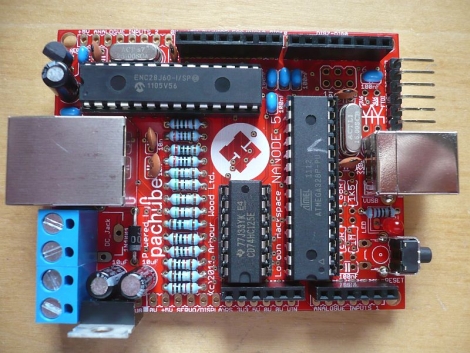
The folks over at Hackspace London have been working hard to create a “very low cost, open source, Internet connected platform on which others can develop their ideas”, which they have dubbed “Nanode”.

Essentially an Arduino with Ethernet networking on-board, the Nanode is armed with an ATMega 328 microcontroller along with all the other standard goodies you would expect from an Arduino-compatible device. The Nanode can be controlled with a web browser right out of the box, thanks to some custom Ethernet libraries. Additionally network of Nanodes can be easily configured to communicate with a “master” unit via a multidrop serial bus, allowing the device to be used for a wide array of distributed control tasks.

Obviously most of these features can be had in the form of an Arduino Ethernet board, or achieved by using an Ethernet shield. The Nanode is a touch cheaper than either option at $40 for a kit, and the native networking capabilities sound like they would be quite handy. That said, we are a bit bummed that it only has 10BaseT networking capabilities, though it is always nice to have options when it comes to choosing a microcontroller board.

[Thanks, TheHypnotist]

LAN-connected Washing Machine Lets You Know When Your Clothes Are Done

lan_connected_washing_machine_laundruino

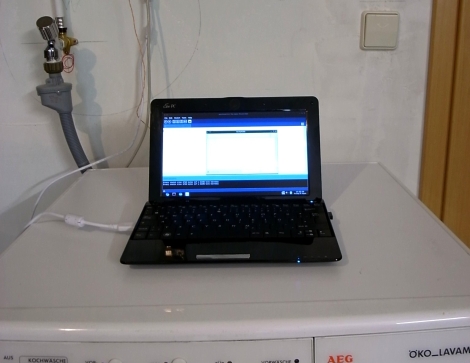
[Micha’s] washing machine is equipped with a rather inaccurate timer, so it is always difficult to estimate when the load will be finished. Since it is located in his basement, he hated having to check on the machine continually to know when his clothes were done. Instead of hauling up and down the stairs over and over, he decided to hack in an “end of cycle” notifier of his own.

The washer has an LED that lights when it is finally done doing its thing, so [Micha] removed the LED and soldered in two wires, which he then connected to his Arduino. When the washer is finished and the LED should be lit, the Arduino senses that the input has been pulled low, signaling the end of the cycle. The Arduino was hooked into his home network via an Ethernet shield, enabling him to monitor the process from the comfort of the nearest web browser.

It’s a clever implementation, and it sure saves him a lot of time trudging up and down the stairs. Nice job!

Making Structured Wiring Do Your Bidding

So you’ve just moved into a home that has cat5 running throughout. This is called structured wiring and is a great feature for a home. But what if the existing wiring doesn’t work the way you would prefer to setup your network? [Firestorm_v1] has a workaround that lets you reconfigure Ethernet without pulling new cables.

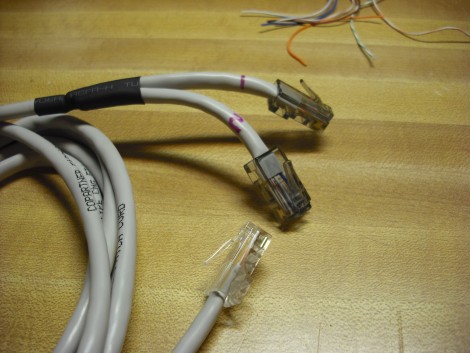
He’s making splitters out of patch cables. Often, Ethernet devices are not using all eight conductors in the cable. Unless you are using Gigabit Ethernet, or running Power over Ethernet, only four of the conductors in each run are being utilized. This means you can create twice as many connections without running new cable or using addition switches. Each splitter has three RJ-45 connectors on it. One of them hooks to the wired jack in the wall while the other two hook to two different devices. You’ll need a second splitter to use on the opposite end of the wall jack, usually this is where the router or switch is located, in order to separate the combined signals.

FabLab Helps The Developing World Set Up Long-distance Wireless Ethernet

The wooden frame seen above hosts a parabolic reflector making up one side of a wireless network link. This is a Fab Lab project called FabFi which uses common networking hardware to setup long-distance wireless Ethernet connections. It’s a bit hard to tell in the image above, but the reflector focuses radio waves on the antennae of a router we’re quite familiar with, the Linksys WRT54G. It’s held upside-down in an enclosure meant to protect it from the elements. The node above manages to complete a connection spanning 2.41 miles!

One of the core values of the project is to develop hardware that is easy to build with limited resources, then to make that knowledge freely available. Anyone who has the ability to download and print out the 2D design file can build a reflector for themselves. As we’ve seen in other projects, paper stencils and hand tools can handle this job with no need for a laser-cutter (which was used for the prototype). WRT54G routers are inexpensive and the project uses the open source firmware OpenWRT. They can be run from 12VDC power which means a car battery works when mains power is not an option. The system has been running in Afghanistan for two years and hardware failure is still in the low single-digits.

[Thanks das_coach]

Adding Persistent Memory And Ethernet To Vintage Arcade Machines

z80_bus_tapper

If you are a frequent reader, you are undoubtedly familiar with hacker [Sprite_tm]. He has been working with fellow members of the TkkrLab hackerspace to get things ready for their official grand opening on May 28th, and wrote in to share a project he recently completed to kick things off.

As part of their preparations, they have been stocking the joint with all sorts of hacker-friendly goodies including plenty of tools and Club Mate, as well as a vintage ‘1943’ arcade cabinet. The game is a group favorite, though every time the power is turned off, it loses all of the hard-earned high scores. [Sprite_tm] knew he could improve on the current paper-based score register, so he pulled the machine open to see what could be done.

He used an AVR to tap into the machine’s Z80 logic board, allowing him to read and write to the entirety of the game’s RAM whenever he pleased. This enabled him to keep tabs on the high scores, restoring them to memory whenever the machine is powered back on. The addition of the AVR also allowed him to add a TCP/IP interface, which is used to send high scores to Twitter whenever someone beats the previous record.

His modular bus tap can be used in all sorts of Z80-based hardware, so if you have some vintage equipment laying around, be sure to swing by his site for a more detailed look at the build process.