The Science Of Landing On An Asteroid

Exploiting the resources of the rock-strewn expanse of space between Mars and the outer planets has been the stuff of science fiction for ages. There’s gold in them ‘thar space rocks, or diamonds, or platinum, or something that makes them attractive targets for capitalists and scientists alike. But before actually extracting the riches of the asteroid belt, stuck here as we are at the bottom of a very deep gravity well that’s very expensive to climb out of, we have to answer a few questions. Like, how does one rendezvous with an asteroid? What’s involved with maneuvering near a comparatively tiny celestial body? And most importantly, how exactly does one land on an asteroid and do any useful work?

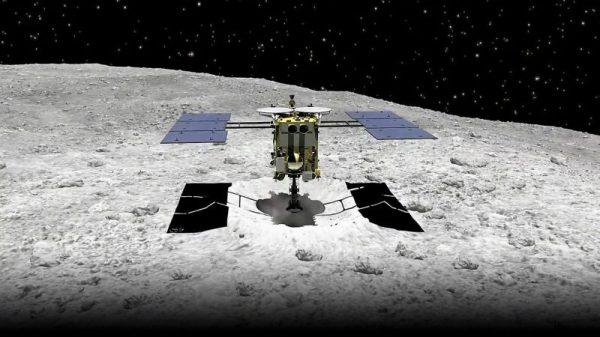
Back in June, a spacecraft launched by the Japanese Aerospace Exploration Agency (JAXA) finally caught up to an asteroid named Ryugu after having chased it for the better part of four years. The Hayabusa2 was equipped to answer all those questions and more, and as it settled in close to the asteroid with a small fleet of robotic rovers on board, it was about to make history. Here’s how they managed to not only land on an asteroid, but how the rovers move around on the surface, and how they’ll return samples of the asteroid to Earth for study.


Continue reading “The Science Of Landing On An Asteroid”

One Small Step For A Space Elevator

Space elevators belong to that class of technology that we all want to see become a reality within our lifetimes, but deep-down doubt we’ll ever get to witness firsthand. Like cold fusion, or faster than light travel, we understand the principles that should make these concepts possible, but they’re so far beyond our technical understanding that they might as well be fantasy.

Except, maybe not. When Japan Aerospace Exploration Agency (JAXA) launches their seventh Kounotori H-II Transfer Vehicle towards the International Space Station, riding along with the experiments and supplies for the astronauts, will be a very special pair of CubeSats. They make up the world’s first practical test of space elevator technology, and with any luck, will be one of many small steps that precedes the giant leap which access to space at a fraction of the cost will be.

Of course, they won’t be testing a fully functional space elevator; even the most aggressive of timelines put us a few decades out from that. This will simply be a small scale test of some of the concepts that are central to building a space elevator, as we need to learn to crawl before we can walk. But even if we aren’t around to see the first practical space elevator make it to the top, at least we can say we were there on the ground floor.

Continue reading “One Small Step For A Space Elevator”

Software Update Destroys $286 Million Japanese Satellite

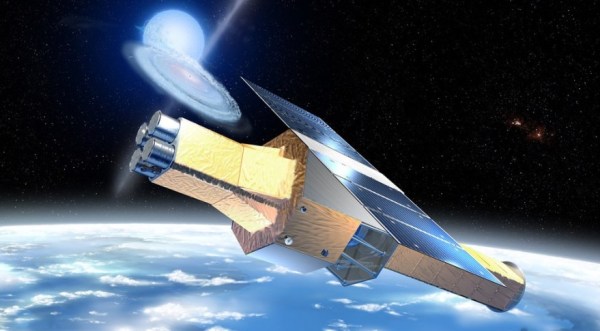
The Japanese X-ray telescope Hitomi has been declared lost after it disintegrated in orbit, torn apart when spinning out of control. The cause is still under investigation but early analysis points to bad data in a software package pushed shortly after an instrument probe was extended from the rear of the satellite. JAXA, the Japanese space agency, lost $286 million, three years of planned observations, and a possible additional 10 years of science research.

Hitomi, also known as ASTRO-H, successfully launched on February 17, 2016 but on March 26th catastrophe struck, leaving only pieces floating in space. JAXA, desperately worked to recover the satellite not knowing the extent of the failure. On April 28th they discontinued their efforts and are now working to determine the reasons for the failure, although a few weeks ago they did provide an analysis of the failure sequence at a press conference.

Continue reading “Software Update Destroys $286 Million Japanese Satellite”