Motorcycle Lighting Upgrade Ensures Other Drivers Know You’re There

led-brake-lights

[Pete Mills] recently bought himself a motorcycle, and as people are known to do, they start trying to scare him with gruesome stories of cycling accidents once they hear about his purchase. While he tries to shrug them off as people simply not minding their own business, something must have resonated with him, because he started tinkering with the bike’s taillight in order to ensure he was always seen by other drivers.

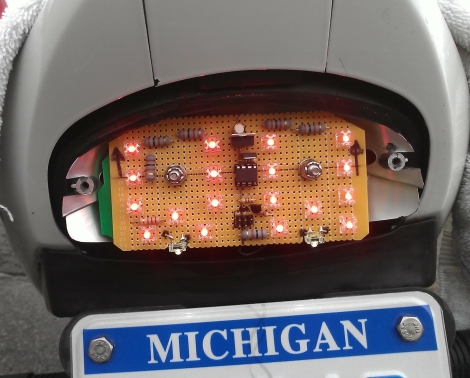
He swapped out his motorcycle’s incandescent taillight for a smart LED-based lamp that he constructed using perfboard. Not only does his new brake light feature ultra bright LEDs, but the onboard ATtiny85 rapidly flashes the lights each time he hits the brakes, making his presence impossible to miss. Before everyone starts with the claims of, “Flashing red lights are illegal!”, let’s all take a deep breath and read on.

We’ve seen these sorts of lights on the back of motorcycles for years, though being a careful guy, [Pete] wrote to the state of Michigan in order to ensure that his modifications won’t get him pulled over. He has yet to hear back, but in the meantime, he merely needs to start the bike with the brakes applied to trigger the ATtiny85 to run the lights in “normal mode.”

Continue reading to see a short demo video of his brake light mod in action.

Continue reading “Motorcycle Lighting Upgrade Ensures Other Drivers Know You’re There”
Arduino MIDI Sequencer Displays A Lot Of Data

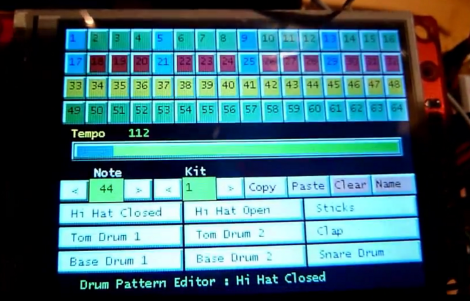
This Arduino MIDI sequencer has no shortage of ways to display loop info. The screen above is a touch-sensitive interface that acts as the user input. But if this screen is not visible, you can still see which tracks have activated samples for each beat and what effects are being used. That’s thanks to the collection of display boards which are shown in the video after the break.

The setup acts as the MIDI front end, relying on other hardware to generate the samples. It presents all of the options through several pages on the 320×240 touch screen display. The Ardunio Mega is responsible for monitoring the UI data, crafting and sending the MIDI commands, as well as updating the LED-based display boards. These include bar graphs for the various effects, a four row by sixteen pixel beat pattern display, and 7-segment displays to track the current location within the loop. All in that’s 368 LEDs driven by 18 shift registers.

Update: Link to a gallery can be found after the break as well.

Continue reading “Arduino MIDI Sequencer Displays A Lot Of Data”

This LED Table Really Ties The Room Together

led-matrix-table

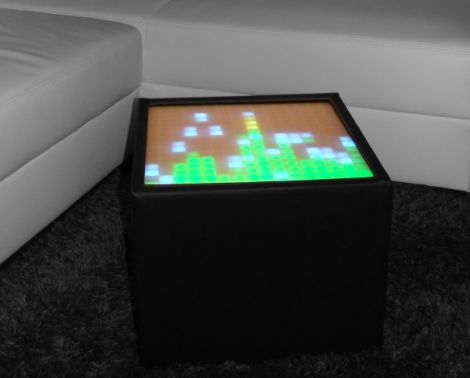
Along with quadrotors, and portable game consoles, one of the hacks we never get tired of seeing is an LED matrix table. [Christian Enchelmaier] wrote in to share his take on the ever popular pixelated furniture, which we think came out pretty well (Translation).

Instead of going for a full-sized coffee table, [Christian] decided to keep things on the smaller scale his first time out, opting for an ottoman/end table nstead. He constructed a 16×16 matrix using RGB LEDs, encapsulating each one in its own “pixel”, as is common with these builds. [Christian] uses an Atmega 128 to run the show, displaying the current time and date, temperature, music visualizations, games, images, along with short videos. He also outfitted the table with an IR receiver so that he can control the table’s display from afar.

As of right now, [Christian] doesn’t have any video of the table in action, but there’s plenty in the way of pictures scattered throughout his build log to keep you busy in the meantime.

Infrared Hides Code Combination On Geocache Puzzle

[AJ] and [Brian] are making sure the geocache challenges they set up take some ingenuity to solve. They’ve just rolled out a two-part cache which uses a code hidden in infrared light.  (Editor’s note from the far future: link wend dead.  Have a look in the Wayback Machine.)

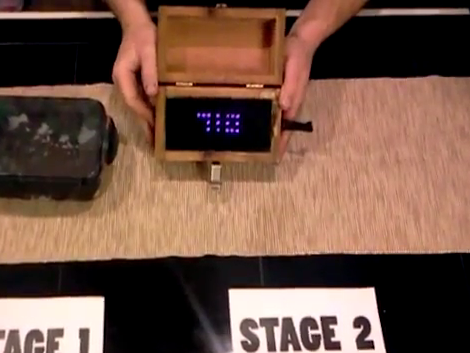
The first part of the cache is a box (the black one on the left) which contains a mysterious hand crank and a smaller box that has a combination lock on it. The second stage is the wooden box on the right. It’s got a hole in the side to receive the hand crank. This connects to the dynamo inside, letting you build up some electricity as it spins. Inside the case you’ll see two red lights blink as the crank is turned, but when you push the button on the outside of the box nothing will happen. That is, unless you’re looking through a camera which can pick up infrared light. The code (710 in this case) is displayed in an array of IR LEDs, and is used to open that combination lock. We wonder if there’s any clues about using a camera or if you have to figure this out on your own.

Don’t miss the video after the break for a full demo of the system.

Continue reading “Infrared Hides Code Combination On Geocache Puzzle”

CNC’d Business Cards Will Definitely Get You Noticed

cnc-business-card

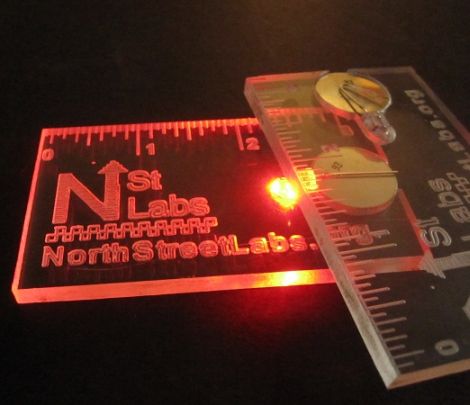
The guys over at North Street Labs were bored, so they figured why not go ahead and built a CNC machine just for kicks. While they haven’t put up build details on the CNC just yet, they do have some newly milled business cards to show off just how well the machine works.

Part ruler, part LED throwie, we think their new business cards look great. Milled out of thin acrylic sheeting, their cards feature the North Street Labs logo and URL along with 1/32” ruler markings along the top. The card is also fitted with space for a button cell battery and RGB LED, which illuminates the entire card nicely from the side.

They say that the cards take about 5 minutes apiece to make, which is not bad at all. At $0.50 a pop, the cards are not nearly as cheap as those made from cardstock, but when you’re looking to impress what’s a couple of quarters?

Continue reading to see a short video of their CNC-milled business cards in action.

Continue reading “CNC’d Business Cards Will Definitely Get You Noticed”

The Best LED Cube Build We’ve Seen

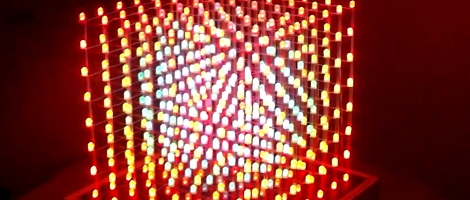
[Nick] wrote in telling us about the LED cube he built over the course of six months. He calls LED cubes ‘done to death,’ but [Nick] might be too humble. His 8x8x8 RGB LED cube is the best we’ve ever seen.

To start his build, [Nick] built a simple 4x4x4 cube as a proof of concept. The baby cube worked but the fabrication process got him thinking. Instead of building his monster LED cube in layers from the bottom up, he would need to build columns from left to right. After the construction of a jig, soldering eight panels of 64 LEDs, and buying a new soldering iron tip, [Nick] had a beautiful assembled LED cube. The only thing missing was the electronics.

Most of the LED cubes we’ve seen use the TLC5940 LED driver for hardware PWM, [Nick] decided to go with the simpler but more familiar STP16 chip. After hooking up his huge LED driver board up to a chipKIT Uno, the 80 hours of programming began.

In the end, [Nick] built the best LED cube we’ve seen (even though it isn’t the largest) and put together one of the best build logs in recent memory. Because no LED cube build is complete with out a video there’s an awesome demo after the break.

Continue reading “The Best LED Cube Build We’ve Seen”

Digital Speedometer With An Arduino

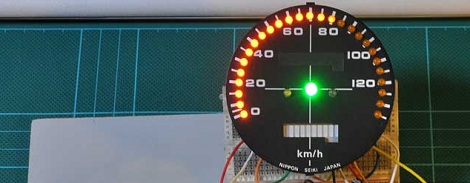
[Martyn] is restoring a 32-year-old Honda motorcycle, so when the ancient speedometer broke last year he thought it was prime time to start of a digital speedometer project. We’re loving the results so far, and would love seeing it on a nicely restored bike.

Instead of the relative horror of driving 40 LEDs with a single Arduino, [Martyn] bit the bullet and got a Maxim 7221 LED driver. Controlling 64 LEDs  over a three-wire interface simplified the board design somewhat, allowing [Martyn] to etch his own PCB with the toner transfer & HCl/H2O2 method. To actually power and control the entire circuit, [Martyn] used an Arduino loaded up with a program based  LedControl library makes programming the spedometer a snap.

Although the speedo works, [Martyn] says he isn’t proud of how it looks. We don’t mind – the candy colored jumpers add a nice flair to the project, and they’re hidden behind the face plate of the speedometer. We’re sure once he gets the neutral, high-beam, and warning indicators working with the LED bar array / tachometer, everything will look awesome.

via reddit