Halloween Hacks: A Haunted House Project For The Kids


light_up_haunted_house

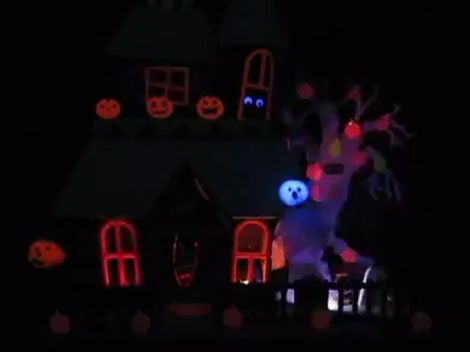
If the kids have been bugging you to get started with your Halloween decorating, [Dale] from BasicMicro has a neat and interactive project that’s sure to satiate their thirst for ghoulish fun.

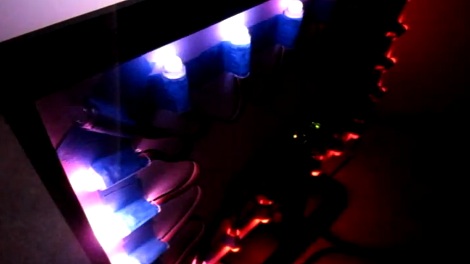
His wife was looking for some new decorations for this Halloween, so he took a quick trip to the craft store and found a DIY foam Haunted House kit. After convincing her to do the assembly, he outfitted the display with some Starlite RGB modules, which have all sorts of interesting lighting modes built in. When the lights are turned low, the house jumps to life, as you can see in the video below.

The construction and wiring are not an overly complex job, so it’s a great starting point for little minds and hands that are beginning to develop an interest in electronics. For those kids with a little bit of experience under their belts, the house could easily be modified to use servos to create swinging doors and shaking grave stones.

The limit is truly defined only by their imagination (and your electronics budget), so why not give it a try this weekend? We’d love to see what you and your budding hackers put together!

Continue reading “Halloween Hacks: A Haunted House Project For The Kids”
Slick Music Synchronized Light Show Uses UV LEDs And Water

music_synchronized_light_show

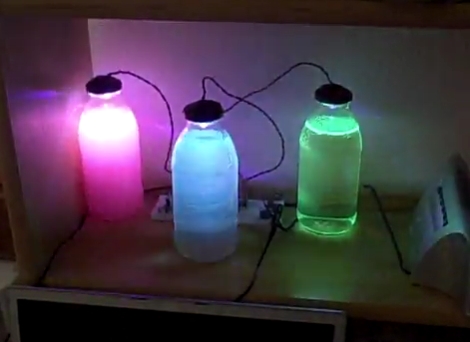
[mike6789k] wanted to spice up his dorm room, so he built a cool music synchronized light show that struck us as being very well thought out. We have seen similar music-based visualizations before, but they tend to be pretty basic, relying on volume more than actual audio frequencies to trigger the lighting.

[mike6789k] didn’t want to build “just another” synchronized light show, and his all-analog approach gives a true representation of the music being played instead of just flashing lights along with the beat. Using a trio of simple filters, he broke the audio signals down into three distinct frequency bands before being driven through a high gain transistor to power a set of LEDs.

We were pretty impressed at how bright the display was given that he is using UV LEDs, but the 1W diodes seem to have no problem lighting up the place when aimed through the UV-reactive water, as you can see in the video below.

If you’re looking to make something similar for your next party, the folks over at Buildlounge were able to wrangle a schematic out of [mike6789k], which you can find here.

Continue reading “Slick Music Synchronized Light Show Uses UV LEDs And Water”

Adalight: Ladyada’s Ambilight

The latest and greatest ambilight clone, the Adalight, comes from the fruitful mind and cluttered workbench of the sometimes Hack A Day contributor [Phil Burgess].

We’ve seen a few clones of the Philips ambilight tech, but [Phil] knocked this one out of the park. The hardware is a string of 12mm RGB LEDs connected to the Arduino of your choosing. After attaching the LEDs to the rear of the TV using anything from, “laser-cut acrylic to nothing more than a pizza box,” it’s on to the software.

The Processing sketch performs a series of screen captures and averages the pixels around the perimeter of the screen. Reportedly, Carl Sagan’s Cosmos looks fantastic with the Adalight but there might be a better option.

[Phil] used 25 LEDs on his Adalight, more than the usual 6-10 we see on other Ambilight clones. Check out the video after the break to see the Adalight in action.

Continue reading “Adalight: Ladyada’s Ambilight”

Repairing The Blue Canary In The Outlet By The Light Switch

blue_canary_in_the_outlet_by_the_lightswitch

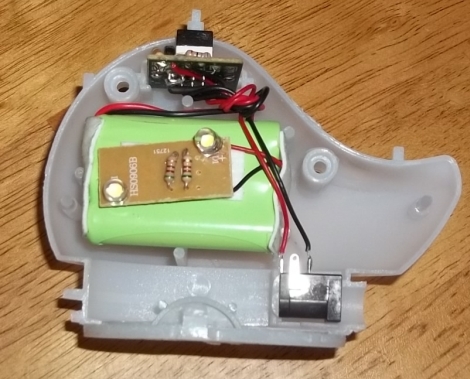
[Vince] and his wife are big fans of [They Might be Giants], so when they were perusing their local Target one evening and stumbled upon a blue canary nightlight, they bought it immediately. While the nightlight was easy for his toddler to use, the LEDs inside started to dim after about a month, and eventually they started flickering like mad as you can see in the video below. A battery swap didn’t remedy the problem, and instead of returning it, [Vince] decided to try fixing it himself.

After poring over the device’s simple circuit, he couldn’t figure out any reason why the nightlight would start behaving like it did. He did notice that a resistor was left out of the device, likely as a cost-cutting measure, so he added one in before replacing both of the nightlight’s LEDs.

With his simple tweak, the nightlight was better than new, saving him from what would likely be a string of annoying merchandise exchanges.

Continue reading “Repairing The Blue Canary In The Outlet By The Light Switch”

Amazing RGB POV Clock

rgb_pov_propeller_clock

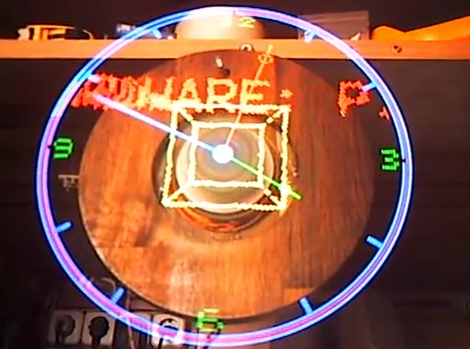
We’re no strangers to POV time pieces around here, but something about them never gets old. Whether they use a ring of LEDs to draw clock hands, or an intricately cut HDD platter to replicate LCD segments, we love seeing them. [David] sent in this hard drive POV clock built by a fellow named [Kly], and it’s just beautiful.

[Kly’s] “Propeller” POV clock is named as such due to the design of the circuit board. The board is mounted on the HDD spindle, rotating much like an airplane’s propeller. The construction details are sparse, but from what we can find, it is based around a PIC32MX microcontroller, which is used to control the 66 SMD RGB LEDs mounted on the circuit board.

As you can see in the video below, the tightly packed LEDs result in some pretty amazing visuals.

Aside from watching the video below, be sure to swing by his Youtube channel for a handful of videos showing RGB POV clock in action.

Continue reading “Amazing RGB POV Clock”

Interfacing With A PS/2 Keyboard

Anyone reading this post has undoubtedly used a keyboard. How they work, however, is a bit more complicated than “one button, one input.”  [PyroElectro] has a great tutorial about building a PS/2 keyboard interface with a 7-segment LED display (video after the break). The tutorial also includes quite a bit of theory behind it.

The system displayed below uses a PIC controller to display the letter or number pressed. A schematic of the whole project is given here as well as a detailed bill of materials.

As for how the PS/2 keyboard works, each keystroke is encoded into a binary number or “scan code”. Most of these codes are 8-bit, but some special symbols use a longer code. Although the article doesn’t fully address it, a very similar method can be used to send data back to the keyboard for such purposes as tuning on a “capslock” or “numlock” key. Although turning on a light is fun, we could see this being used as an expedient method to control a relay for automation purposes.

Continue reading “Interfacing With A PS/2 Keyboard”

ATtiny Hacks: DIY High-speed Photography LED Lighting Rig

ATtiny Hacks Theme Banner

diy_high_speed_photography_led_lighting

[Tom] wanted to try his hand at high-speed photography and needed some equipment to get things rolling. Not wanting to spend a ton of money on a lighting rig or trigger mechanism, he decided to build his own. In a three part series on his blog, he details the construction and testing of his high-speed setup along with the improvements and lessons learned along the way.

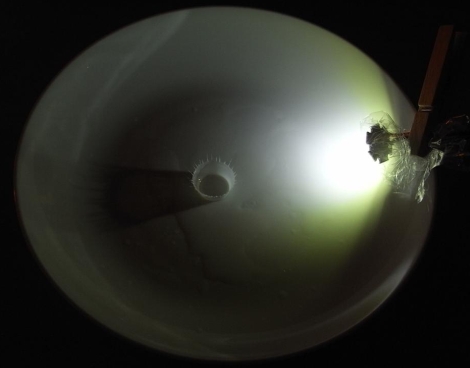
His adventures started out with a small off-brand Cree LED clone and an ATiny15L that was collecting dust in his workshop. He built a simple circuit that would trigger the LED to light his subject, which in [Tom’s] case was a bowl of milk. Rather than using a motion or sound trigger, he opted to mount a small piezo to the bottom bowl, firing the LED any time a droplet hits the bowl’s surface.

The pictures he took were decent, but he knew he could get better results. He purchased a new, more powerful Cree LED, and wrote a small terminal program that allows him to tweak his flash parameters using his laptop. The results he gets now are far better – in fact, he has a whole gallery of pictures you can check out.

If you want to delve into high-speed photography as well, all of the schematics and code can be found on his blog.