Looking Toward Christmas Decor By Learning About DMX

So Halloween finally arrived, we hope you had enough time to pull off your frightening feats in the way you had originally envisioned. Now it’s time again to look to the future and start planning this year’s Christmas decorations. Lights are always a popular theme, and this year you might want to look into DMX lighting controls and decide if that’s a route you want to take. [Akiba] has your back, he just put together a set of videos explaining the DMX lighting protocol and how to use it with an Arduino.

The thought here is that the Arduino can be used as a sort of DMX hub that is connected directly to a computer running open source controller hardware. It can send commands which the Arduino decodes, deciding whether to just pass them on to DMX compatible devices, or to do what it does best and control other hardware that is not normally accessible through the lighting command protocol. To the control program your four-dollar strand of LED lights looks no different from a thousand dollar stage light, making it cheap and easy to build your own entertaining holiday show right in your front yard. See the second video in this series after the break where [Akibo] details the hardware setup for his system. The other parts are available at the link above.

Be careful, this can be a consuming endeavor. Don’t believe us? Just look around and you’ll find no shortage of large DMX builds just for Christmas lights.

Continue reading “Looking Toward Christmas Decor By Learning About DMX”

Hackaday Links: October 28th, 2011

An accidental radial engine

Hack A Day’s very own [Jeremy Cook] was trying to figure out how to push four ‘arms’ out one at a time. What he came up with is a very nice model of a radial engine. Everything was cut on a CNC router and a motor from an air freshener provides the power.

Using a candle to produce light

[Chris] sent in his Candela Amplifier. It’s a Pentium 4 heat sink with a very bright Cree Xlamp LED attached to the base. A bunch of Peltier thermoelectric units are attached to the underside of the heat sink. Put the whole thing on top of a candle, and you can light a room. With a candle. Oh, he’s selling these, by the way.

Objectification and video games?!

We really feel sorry for our lady readers. Guys have so many choices for Halloween costumes, but just about every costume available for women can be reduced to, “Sexy [noun].” Whelp, here’s the Sexy Game Boy, just in time for Halloween. [kazmataz] gets a few bonus points because she went with the DMG-01. It’s better than Sexy Chewbacca, so she’s got that going.

Prototypable 32-bit uCs

[Ng Yong Han] wrote in to tell us about some newish 32-bit PICs that are floating around. The datasheet for the PIC32MX1xx/2xx chips is pretty interesting – USB support and an audio and graphics interface. Oh, they come in PDIPs for ease of prototyping as well. We haven’t seen much from the PIC microcontroller faction recently (Atmel is winning the holy war, it seems). Anybody feel like building something with these?

Makerbot dual extruder


[Lomo] at TU-Berlin is taking a class in rapid prototyping. He built a second print head for his department’s Makerbot Cupcake with a few other students. The result are pretty impressive, although from what we’ve seen, it’s generating the G-code that’s a pain in the butt.

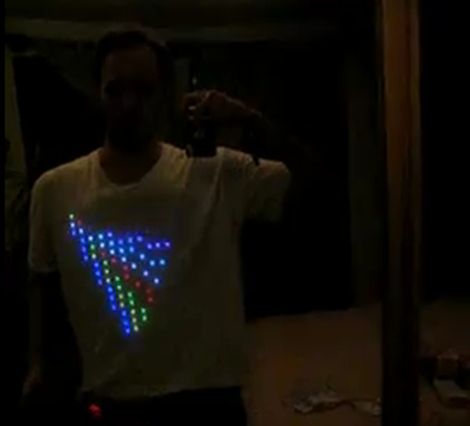
Huge Flexible LED Matrix Can Be Worn Almost Anywhere

lightbright_led_mesh

[Erik] has been keeping extremely busy with his latest project, a flexible RGB LED matrix that he calls “Project Light Bright”. The folks at BuildLounge tell us that this is the first entry they have received so far in their “Light Contest”, in which they are giving away a free laser cutter to the best entry.

[Erik] hand soldered ten 16×16 RGB LED panels together in order to build this display, and the results are awesome. The entire thing is controlled by a WiFi-enabled Beagleboard, which drives all of the panels and then some. The Beagleboard features embedded web and DNS servers, which allows it to act as a wireless AP, enabling him to control the display using any WiFi capable device. The Light Bright displays all sorts of predefined artwork, but [Erik] can also alter the display on the fly via his phone as well. The entire thing is powered by a reasonably sized LiPo battery pack that he keeps tucked away in his pocket, which allows the display to run continuously for about 20 hours.

Check out the video below to see a quick walkthrough of [Erik’s] Light Bright suit, then be sure to stop by his site for more videos, details and updates on the project.

Continue reading “Huge Flexible LED Matrix Can Be Worn Almost Anywhere”

Halloween Hacks: Flickering Jack-o’-lantern

The dollar store is always a great place to find some weird stuff, so when [jethomson] found a flickering Jack-o’-lantern, he thought it would make a great project for the 74xx logic competition.

Instead of using the flickering incandescent lightbulb that came with the blinking pumpkin, [jethomson] decided to rebuild a blinking circuit around a 74HC14 Hex inverting Schmitt trigger IC. The chip was used as a relaxation oscillator by adding a resistor and cap from the input to the ground. After a bit of component selection and some calculation, he had a red and blue LED blinking at 2,6,9, and 15 Hz.

The result is a seemingly random pattern of light that looks like a ghostly blue after image of the handheld Jack-o’-lantern. While it may not be one of the most complex builds for the 74xx competition, it gets points in our book for originality.

Although [jethomson] says his camera doesn’t pick up his project very well, he did post a video of the Jack-o’-Lantern in action. Check it out after the break.

Continue reading “Halloween Hacks: Flickering Jack-o’-lantern”

Halloween Hacks: A Haunted House Project For The Kids


light_up_haunted_house

If the kids have been bugging you to get started with your Halloween decorating, [Dale] from BasicMicro has a neat and interactive project that’s sure to satiate their thirst for ghoulish fun.

His wife was looking for some new decorations for this Halloween, so he took a quick trip to the craft store and found a DIY foam Haunted House kit. After convincing her to do the assembly, he outfitted the display with some Starlite RGB modules, which have all sorts of interesting lighting modes built in. When the lights are turned low, the house jumps to life, as you can see in the video below.

The construction and wiring are not an overly complex job, so it’s a great starting point for little minds and hands that are beginning to develop an interest in electronics. For those kids with a little bit of experience under their belts, the house could easily be modified to use servos to create swinging doors and shaking grave stones.

The limit is truly defined only by their imagination (and your electronics budget), so why not give it a try this weekend? We’d love to see what you and your budding hackers put together!

Continue reading “Halloween Hacks: A Haunted House Project For The Kids”

Slick Music Synchronized Light Show Uses UV LEDs And Water

music_synchronized_light_show

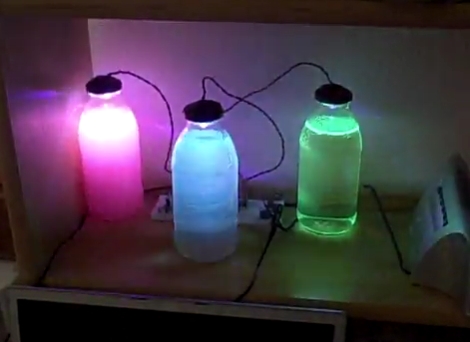
[mike6789k] wanted to spice up his dorm room, so he built a cool music synchronized light show that struck us as being very well thought out. We have seen similar music-based visualizations before, but they tend to be pretty basic, relying on volume more than actual audio frequencies to trigger the lighting.

[mike6789k] didn’t want to build “just another” synchronized light show, and his all-analog approach gives a true representation of the music being played instead of just flashing lights along with the beat. Using a trio of simple filters, he broke the audio signals down into three distinct frequency bands before being driven through a high gain transistor to power a set of LEDs.

We were pretty impressed at how bright the display was given that he is using UV LEDs, but the 1W diodes seem to have no problem lighting up the place when aimed through the UV-reactive water, as you can see in the video below.

If you’re looking to make something similar for your next party, the folks over at Buildlounge were able to wrangle a schematic out of [mike6789k], which you can find here.

Continue reading “Slick Music Synchronized Light Show Uses UV LEDs And Water”

Adalight: Ladyada’s Ambilight

The latest and greatest ambilight clone, the Adalight, comes from the fruitful mind and cluttered workbench of the sometimes Hack A Day contributor [Phil Burgess].

We’ve seen a few clones of the Philips ambilight tech, but [Phil] knocked this one out of the park. The hardware is a string of 12mm RGB LEDs connected to the Arduino of your choosing. After attaching the LEDs to the rear of the TV using anything from, “laser-cut acrylic to nothing more than a pizza box,” it’s on to the software.

The Processing sketch performs a series of screen captures and averages the pixels around the perimeter of the screen. Reportedly, Carl Sagan’s Cosmos looks fantastic with the Adalight but there might be a better option.

[Phil] used 25 LEDs on his Adalight, more than the usual 6-10 we see on other Ambilight clones. Check out the video after the break to see the Adalight in action.

Continue reading “Adalight: Ladyada’s Ambilight”