Open Hacker Conference Badge Project Needs Your Help!

[Aestetix] writes in to tell us that the OpenAMD (Attendee Meta-Data) project is working on a new revision of their hardware, to be debuted at CCC Camp this fall.

For the uninitiated, OpenAMD combines an Active RFID tracking system with social networking, and is completely open-source. You walk into the conference, put on the OpenAMD badge, and suddenly you can see yourself as a dot moving around on a map. Or you can log into the social networking site, create a profile, and watch as your personal information is pulled into the mesh, which then tells you talks you might like, people you might like, where those people are, and more. There’s even an open API where you can create your own ‘killer’ apps, which may include games or other interesting aggregates of the attendee information.

Continue reading “Open Hacker Conference Badge Project Needs Your Help!”
build_status_board

LED Build Monitor Helps Keep An Eye On Your Servers

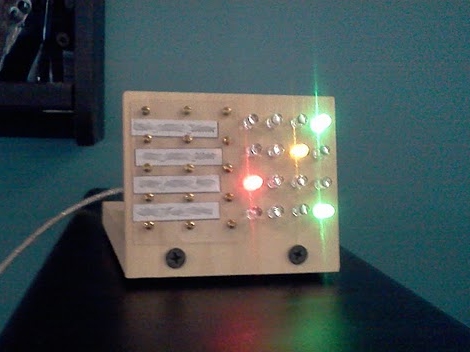
In his line of work, Hackaday reader [Pedantite] often has to monitor the build status of several continuous integration servers throughout the day. One afternoon, he got the idea to install a set of stop lights in the office in order to monitor the status of the servers, but filed it away as a “wouldn’t it be cool if…” project.

After some time had passed, he was bitten by the idea bug again and decided he would build a physical device to display the status of his build processes. This time around, he brainstormed on a smaller scale and the result is the “Indictron” you see above.

He built a simple LED board made up of four rows of four LEDs to display the build processes. Different LEDs are lit depending on the project’s current build status as well as the results of the previous build. The board uses an ATmega88, and interfaces with a compiler watchdog application using a virtual USB package made specifically for AVR micro controllers.

The end result is a simple, yet useful status board that “just works”. He does not seem to have code or schematics posted on his site at the moment, but we’re pretty sure he would share them upon request.

If you’re interested in a bit more of [Pedantite’s] work, check out his “Good Times” parental timer we featured last week.

Webcam Images Processed And Played Back On LED Display

[Mathieu] has bee working to refine the code running on an LED matrix, and added some neat display tricks along the way. He wanted to make the display directly addressable from a computer. The 96×64 bi-color LED display is powered by an Atmel FPSLIC and already used double-buffering. Enabling a PC to write directly to one of the buffers was not too hard, requiring just a bit of optimization to get the timing right. From the look of the video after the break, he nailed it.

The video feed is generated from a webcam stream using Matlab to process each image. Just 50 lines of code captures a frame, sizes it appropriately, converts the result to black and white for edge detection, then finishes the job by compressing image data for transmission to the embedded processor. We’d like to say it’s easier that it sounds but we’re pretty impressed with this work. The display manages about 42 Hz with the current setup.

Continue reading “Webcam Images Processed And Played Back On LED Display”

Reverse Engineering LED Vodka Bottle Displays

wireless_led_marquee

When [Tyler] heard about the LED matrix display that Medea Vodka was building into their bottles, he immediately wanted to get his hands on one. Who could blame him? Someone had finally combined two things we love dearly: booze and LEDs.

He struggled to find a bottle at any of his local stores for the longest time, but was absolutely stoked when he finally came across one of their reps promoting the brand while he was out shopping.

Once he got home, he pulled the display off the bottle and began poking around to see what made it tick. The display is made from a flexible PCB, and attached to the bottle with some clear elastic film. It is powered by two CR2032 batteries and controlled by a PIC16F chip, which pulls stored messages from a small Atmel EEPROM.

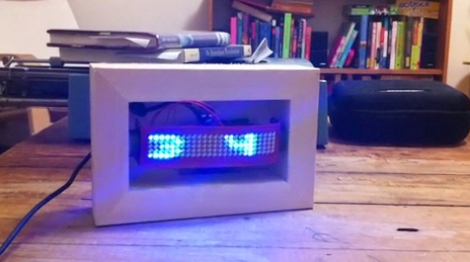
Once he figured out how to control the LED matrix, he uploaded his own fonts and added a LINX wireless module to remotely send messages to the board. He mounted it in a wooden frame and now uses it as a simple marquee display.

If you have one of these displays hanging around your house, be sure to swing by his site for schematics of his wireless interface board as well as the code he uses to drive the marquee. You can check out a video of the display in action there as well.

Retrofitting LCD Projectors With High-powered LEDs

highpower_led

[Devon] recently repaired a handful of Phillips LCD projectors which he was quite excited to use. The only problem is that he didn’t want to mess with replacing the bulbs after every 2000 hours of use at $100 apiece. He was pretty confident that he could find a better way to drive the projectors, so he disassembled them once more and started looking around for bulb replacements.

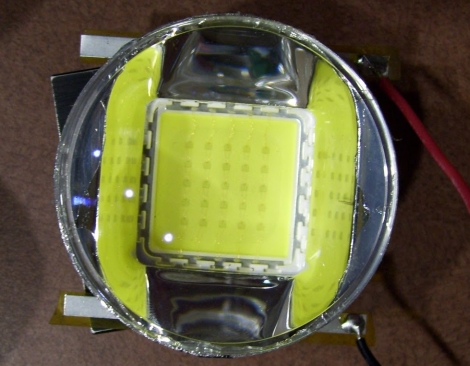
He figured that a high-powered LED would do the trick, so he ordered a handful of parts and went about his first retrofit. Using his oscilloscope, he found that the control board pulses the high voltage board when the projector is powered on, and continues to pulse a signal until the machine is turned off. At this point, the HV board powers down the bulb.

He created a small circuit using a PIC that is used to interpret the initial pulse from the control board as well as watch for the steady “heartbeat” pulses that occur while the projector is powered on. This board is used to control the driver board for the high-powered LED he purchased.

His bulb replacement works well as far as color fidelity is concerned, but is not nearly as bright as he hoped for. He has plans to source some far brighter LEDs or automobile HID lighting in the very near future, and we look forward to seeing if he can match the brightness of the original bulbs.

Snuggle Up With The Softer Side Of Hacking

led_quilt

Not all hacks need to be made up of servo motors, wireless radios, and PIR sensors. Sometimes hacking has a softer side, of which [Katie] reminds us with her latest creation.

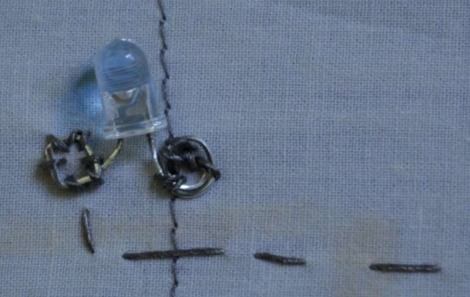
Her LED quilt incorporates 64 hand-sewn LEDs, all of which were painstakingly attached with conductive thread. The same thread was used in a sewing machine to build the conductive grid that powers the LEDs. One half of the circuit was sewn into the front of the quilt in the form of 8 rows, while the columns are sewn into the back side. All of the rows and columns meet in the corner of the quilt, where they are attached to a Lilypad Arduino using simple metal snaps.

The LED matrix panel was then tested, then sewn into an actual quilt. The finished product looks completely innocuous until lit up, as you can see in the video below. We think it would make a great nightlight replacement for a child, especially if programmed to display soothing light patterns.

[via Make]

Continue reading “Snuggle Up With The Softer Side Of Hacking”

Converting The BlinkM Into The World’s Tiniest Arduino

blinkm_arduino

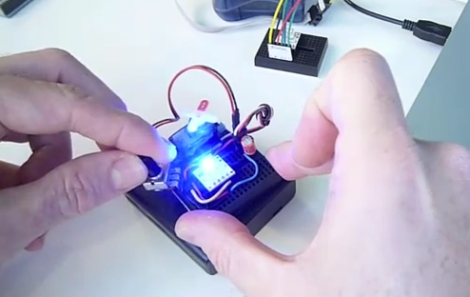
The BlinkM “Smart LED” is a great little device on its own accord. It allows for complete control of its RGB LED using a built-in microcontroller, enabling the user to do a wide array of things that normally require PWM to accomplish. At just over half an inch square, this little device might also be the smallest Arduino on the market.

The BlinkM packs an ATiny85 micro controller, which allows it to be flashed with the Arduino bootloader thanks to the people over at the [High-Low Tech group at MIT]. They did some tweaking of the Arduino IDE configuration files and incorporated some core library code created by [Alessandro Saporetti] to get the job done – all of which is available on their site.

Once the code is uploaded to the BlinkM, you essentially have a micro Arduino running at 8MHz with a built in LED and 2 I/O lines (5 if you snip off the LED). It’s a great device to have on hand if you feel like a full-fledged Arduino would be overkill in your project.

Stick around to see a video tutorial of the reflashing process.

Continue reading “Converting The BlinkM Into The World’s Tiniest Arduino”