Update: Most Interesting Game In 64 Pixels

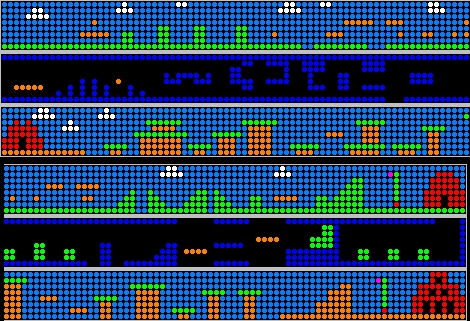
[Brad] has continued working on the Super Pixel Bros game. We saw a glimpse of this a few months ago but he’s added a lot since then. The game now has enemies; one type is similar to Bullet Bill, another type drops from the sky and walks toward you, kind of like a Goomba. Game play is quite responsive and it’s amazing what he has accomplished with such low resolution. In the video after the break [Brad] mentions that a friend is working on sound effects for jumps and block breaking. We’re assuming that the audio track in the background is already coming from the LEDBOY speaker.

Which reminds us, if you haven’t checked out the hardware, do so now. That enameled wire mess makes us shudder just a bit. There many be a kit version coming that will save you the point-to-point soldering madness. If that’s part of the fun for you keep an eye out for the forthcoming release of the hardware schematics.

Continue reading “Update: Most Interesting Game In 64 Pixels”
Arduino Helps You Ski Copper

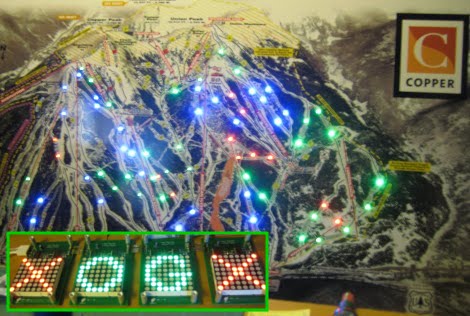
[Dwight’s] been working on a long-term project to add a status board for the ski runs at Copper Mountain ski resort. The board will feature an 8×8 LED module for each run that displays a green O for open trails, a green G for groomed trails, and a red X for closed trails. He’s also got a status board with LEDs embedded in a trail map.

The system relies on SPI for each LED module. An Arduino Mega uses a Xbee module to pull down XML data wirelessly and display it on this board. Since the trail report is already available online it’s just a matter of parsing the data in a useful way.

He’s not quite done with the whole thing yet, but keep an eye out for it if you are planning to ski Copper Mountain.

[via Tom’s Guide]

Putting On A Show In The Rain

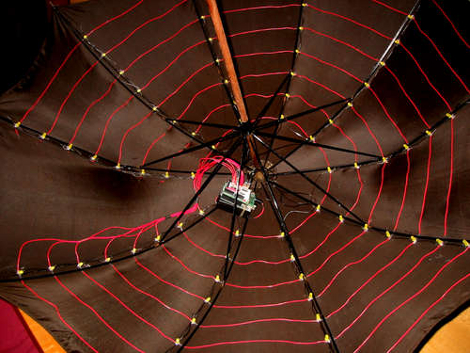
Let’s face it, walking around in the rain sucks. [Matth3w] is trying to add a little whimsy to an unpleasant experience by adding an LED matrix to his umbrella. The array contains 80 LEDs that are individually addressable. This is a mutiplexed array that relies on a MIC2981 source driver for the eight rows (or rings in this case), with the ten columns handled by the Arduino. The effect is quite nice as you can see in the video after the break. Now that he’s proven this works, you might want to etch your own PCB in order to get rid of the Arduino board and prototyping shield, making it easier to waterproof the control circuitry. This would make a nice addition to your illuminated umbrella stock.

Continue reading “Putting On A Show In The Rain”

RGB Display Development

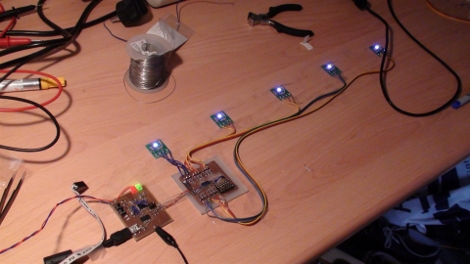
[SeBsZ] tipped us off that he’s working on a display using RGB LEDs. He’s etched some nice surface mount controller boards to carry the ATmega8 microcontroller and NXP PCA9635 drivers. This setup uses the I2C bus to address each expansion board of 5 LED modules. Theoretically this hardware would allow for 638 RGB modules but because of power and refresh rate issues he’s set his sights on reaching somewhere between 100-125, a total of about 25 expansion boards.

There’s not a ton to show off yet. But we expect big things from the project. Partly because one of his goals is to generate a display that can be rolled up and easily moved, and partly because his large-scale light bulb displays are so impressive. Take a look at the video of his 60-bulb unit after the break.

Continue reading “RGB Display Development”

Guerilla Theater Hits Two Wheels

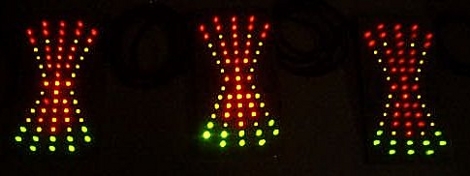
[Tom] wanted to take the show on the road so he added lights to his bike using theater grade control hardware. The picture above shows three tail lights comprised of 195 LEDs. Built on perf-board, a DMX512 controller can display several patterns on each module. The lighting technician (bike pilot) controls the patterns through a series of switches on the handlebars. There’s several pages of details posted including schematics and firmware. This would bring a little extra fun the next time you ride in a Critical Mass event.

Know Your Resistors… Tell The Time

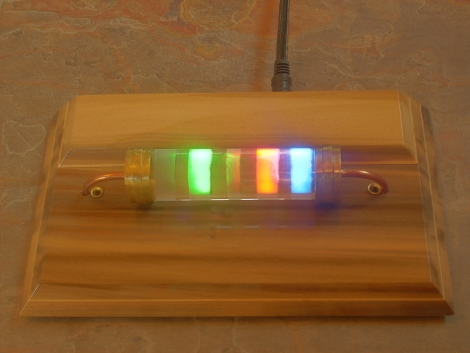
[Darren] built a clock that uses a resistor to display the time. Well, it really uses a model of a resistor. This extremely tardy entry in the Hackaday design challenge houses all of the electronics on a PCB the size of a business card. Four RGB LEDs shine up through holes in the wooden base to light bands on an acrylic tube. The colors correspond to the values used in the Resistor Color Code. In the picture above the clock is displaying 5:26 (that’s supposed to be a red band but the camera didn’t pick it up too well). The band in the center fades up over 60 seconds to signify AM, and down to show PM.

It may be late, but it’s a clever design. It looks sleek and it uses no buttons for an interface. [Darren] sourced the LEDs themselves as light sensors to display the date, and enter time setting mode.

Home Made Small Form Factor LED Projector

[youtube=http://www.youtube.com/watch?v=mQ8Kq2wLrf0]

[Newtonn2] dropped a tip in our inbox this morning that made us quite happy. This is a step by step build of a small form factor LED based projector. While the size may not get some of you too excited at first, those of us who have built projectors before know that home made ones are usually quite large. This one is roughly the size of the small office projectors you would see in a large retailer.  He’s using a 30 watt LEd for the light and we didn’t notice a lumen measurement anywhere, but it looks bright enough to be watchable. Pictures usually turn out dark, so in person, the projection probably looks more bright and crisp. Now he just needs to find a high definition LCD that size.