Paper Tape Drive For A Live Performance Music Box

Music is a mystery to some of us. Sure, we know what we like when we hear it, but the idea of actually being able to make it baffles us. And the idea of being able to build new instruments to create it, like this paper-tape programmable music box (YouTube, embedded below), is beyond impressive.

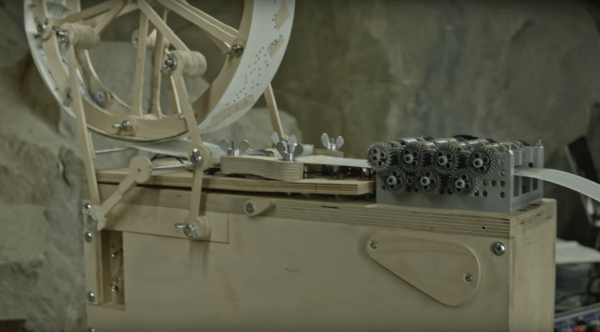
You’ll no doubt remember [Martin Molin] of the group “Wintergatan” and his astounding marble madness music machine. This instrument is on a much more modest scale and is centered around an off-the-shelf paper tape music box. But the cheap plastic drive gears kept failing under performance conditions, so [Martin] headed to what appears to be his cave-based workshop and started grinding. He prototyped a new paper drive from Lego Technics, and while it worked, it needed help to pull the paper. What followed was an iterative design process that culminated in a hybrid of plastic and metal Technic parts that drive the paper reliably, and a musical instrument that’s much more than just a tinny wind-up music box. Hear it in action below with another new instrument, the Modulin, which sounds a little like a Theremin but looks like – ah, just watch the video.

The build video hints at more details to come, and we’re hoping for a complete series like that for the marble machine. We’d also love to see details on the Modulin too – if there ever was a hacked musical instrument, that’s it.

Continue reading “Paper Tape Drive For A Live Performance Music Box”

3D Mouse Drives Robot Arm

You’ve built the perfect robotic arm. How do you drive it? If you are [angrymop] you interface a 3D mouse from 3DConnexion via a few microcontroller boards. The Spacenavigator mouse is a staple anywhere professional CAD people are working, and it looks like it is a natural fit for a robot arm.

According to [angrymop], the Raspberry Pi can read the mouse’s commands via /dev/hidraw (that’s the raw human interface device). Each motion generates two lines of output. Each line has a unique identifying byte and values corresponding to the axis positions.

The Raspberry Pi then uses an SPI interface to talk to an ARM microcontroller and that drives the servos. The arm (the robot arm, not the processor) itself is well done, made from Lego Technic parts and common RC servos. Not that this is the most amazing thing we’ve ever seen built from Technic, but it is still pretty impressive.

You have to wonder if other 3D controllers might be useful for controlling robot arms or how the Spacenavigator would do controlling a bigger, more capable arm. Then again, maybe this arm would be the right size to build something inspired by Escher.

Continue reading “3D Mouse Drives Robot Arm”

Lego Flip-dot Display

We don’t need to mention that flip-dot displays are awesome. They use no power except in transitions, are visible on even the brightest of days, and have a bit of that old-school charm. So then it stands to reason that the flip-dot display that [AncientJames] made out of LEGO is awesome-plus. Heck, it even spells out “awesome”.

Continue reading “Lego Flip-dot Display”

Lego Technic Mechanical Seven Segment Display

TeemingColdDiplodocus

Here’s a rather mesmerizing piece of Lego genius, displayed as a .GIF for your enjoyment. It’s a 7-segment display that is completely mechanical!

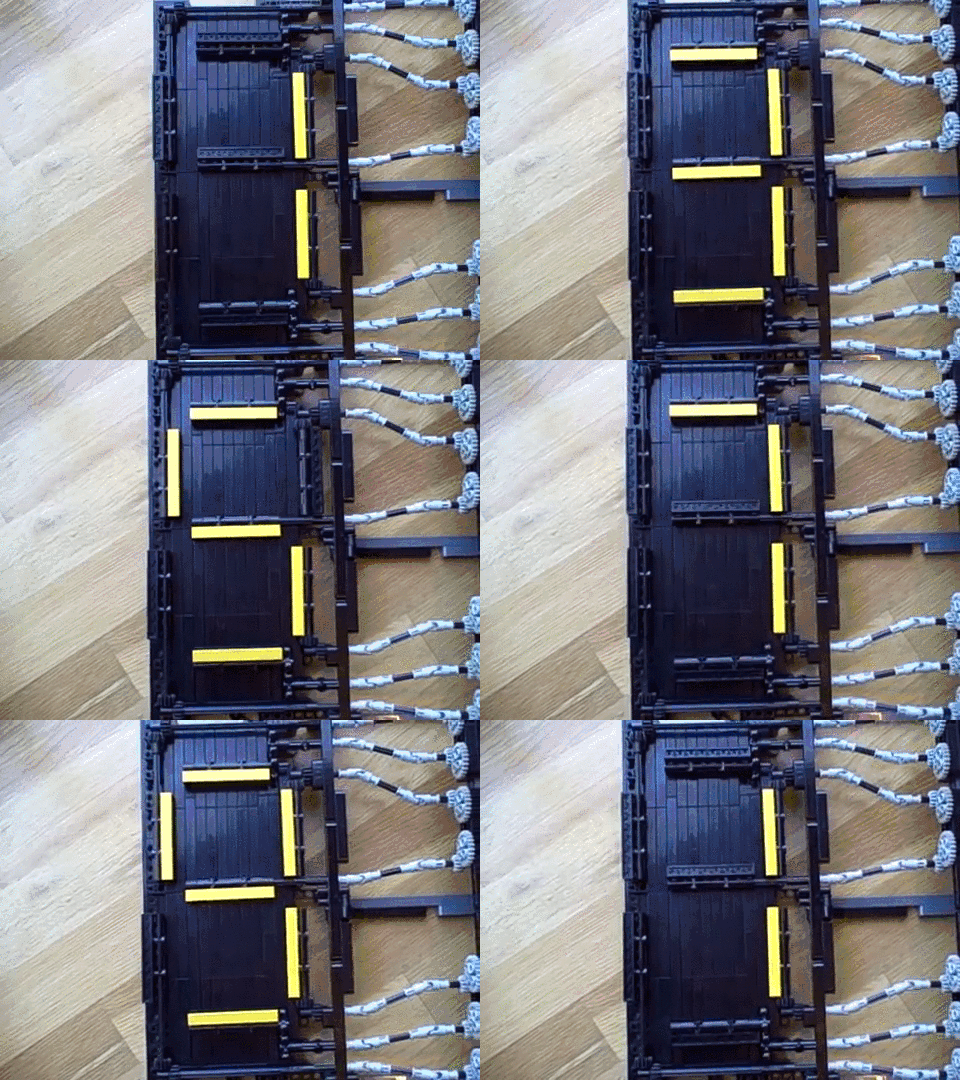
Built by [aeh5040], this beauty features 7 separate linkages that control each display segment. It’s powered off of a single motor which rotates a cylinder covered in small protrusions, similar to how music boxes work. As the cylinder rotates, the protrusions knock the main drive gears back and forth, flipping each segment between the ON and OFF states through a series of axle joints and bevel gears.

It makes rather satisfying sounds too!

Continue reading “Lego Technic Mechanical Seven Segment Display”