Portable Bench Supply Carries Around 10 Amp-hours Of Juice

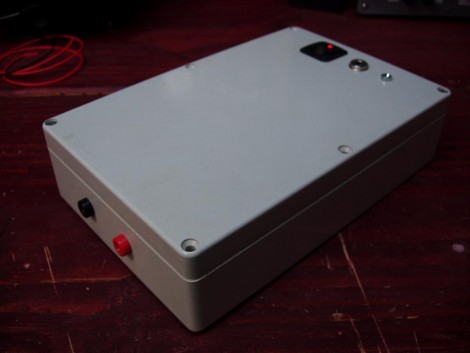
[Punish3r] wanted to have power for prototyping on the go. What he came up with is this little thing above. Inside you’ll find common components that let the unit provide 10 amp hours of current with a 12V 500mA output.

The storage capacity is provided by a dozen Lithium batteries. These 3.7V cheapies are wired in parallel behind a protection board. For charging and discharging, a Sparkfun LiPo charger board was used, taking care of all the work necessary to top off the batteries using a wall-wort. The final piece in the puzzle is a boost converter that provides the regulated 12v connected to the red and black banana plug receivers on the bottom of the case.

This is very much a plug-and-play design… just make sure you hook the parts up correctly and you’re up and running. We would love to see a roll-your-own boost converter circuit that include a switch or dial that lets you select common PSU voltage levels. If you’re going to the trouble to make your own board you might as well incorporate the charging circuit at the same time.

[Thanks Paul]

Electric Scooter Sings As It Travels

[youtube=http://www.youtube.com/watch?v=MaQuRnZYKPc]

This scooter has been fitted with a three-phase induction motor. It reminds us of the sound effects from vehicles in the Jetsons. Right now they’re using lead-acid batteries and get about 15 miles of range from one charge. Once they switch over to lithium polymer they calculate the range will be closer to 45 miles due to the reduced weight and increased capacity. Not bad for $600 in parts, and we’d bet it’s both faster and more stable than the one-wheeled-wonder we saw last week.

Malware Posing As Change.gov

change

PandaLabs has identified a botnet running a malware campaign impersonating president-elect Obama’s website. The front page of the site features a sensational story titled “Barack Obama has refused to be a president”. Clicking the link will download the malware and make the target’s machine part of the botnet. They’re using fast-flux to assign the malicious domains to the massive number of compromised nodes that are hosting the actual site. The team has contacted the domain name registrar in China to get the domains removed. Using a sensational headline is not new to malware; it’s how the Storm Worm got its name.

[via lithium]