Making A Better Kitchen Scale Out Of Junk Parts

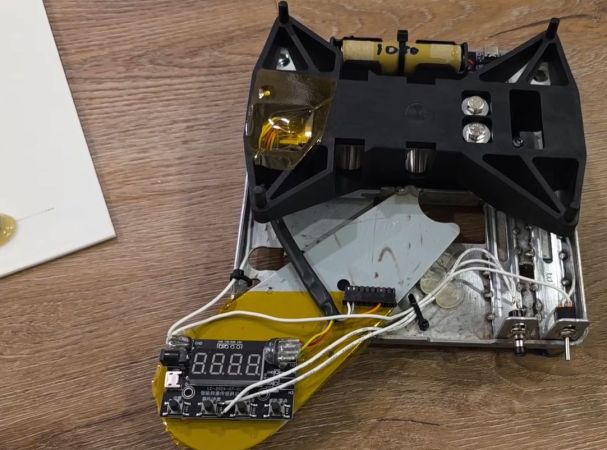
Kitchen scales are plentiful and cheap, but their accuracy and measuring speed often leave a lot to be desired. In particular the filtering out of noise can make small changes a nightmare because adding a little bit of weight slowly can result in the result never updating. This frustrated [Mark Furneaux] enough that he dug up the load cell and metal base of a scrapped laboratory scale and added a strain gauge amplifier to build a better kitchen scale around it.

The only purpose-bought part was an HX710-based strain gauge amplifier module for $7 with LED display, with the metal base getting some metal bits welded onto it to hold said module as well as a push button and toggle switch. Existing wiring from the load cell was wired into the HX710 module, with power provided from a single 18650 Li-ion cell. This was paired with the standard TP4056-based module and its protection IC.

Ultimately the entire assembly looks very much bodged together, with plentiful zip ties, hot glue and messy welding, but it’s hard to deny that it seems to work well. A plastic cutting board makes for a good surface for the items being weighed, and measured drift across the range was about 200 mg, while the amplifier module updates the output in real-time so that you can see even the smallest changes and noise.

Even if you’re not lucky enough to have such a nice load cell and base kicking around, strain gauges are everywhere, and you can absolutely hack an existing (kitchen) scale to be better with some custom hard- and software.

Continue reading “Making A Better Kitchen Scale Out Of Junk Parts”
A wooden platform for a litter box

Track Your Cat’s Weight Through This Internet-Connected Litter Box

With feline obesity on the rise, keeping track of your cat’s weight is an important part of keeping them healthy. However, a weighing session can be anything from a routine job to a painful procedure, depending on your cat’s temperament. [Andy]’s cat Ellie is one of those who dislike being weighed, so in order to track her weight without drama [Andy] got creative and built an internet-connected weighing platform for her litter box.

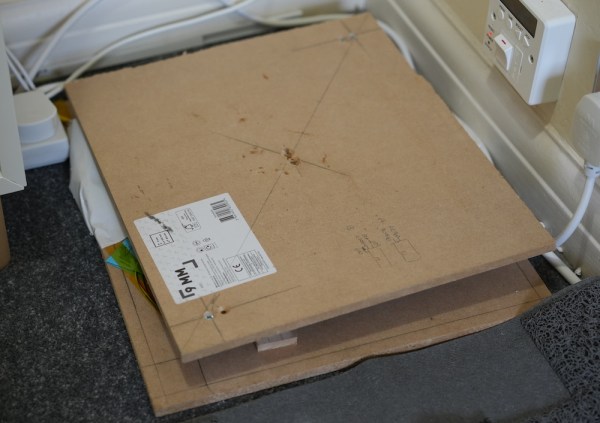
The platform consists of two pieces of MDF held apart by two load cells, which are hooked up to an ESP8266. The ESP reads out the load cells and reports its findings to the Adafruit IO platform through its WiFi connection, sending updates to [Andy] whenever litter box use has been detected. The cat’s weight can be simply calculated by subtracting the weight of the unused litter box from the weight measured when it’s in use.

A smartphone pop-up message from an IoT litter boxGetting reliable readings from the load cells was a bit of a challenge, since the measured weight fluctuated wildly as Ellie moved around the litter box. A combination of waiting for the readings to settle and using timeouts to discard the effect of brief movements resulted in reasonably stable measurements. The resolution was even good enough to measure the difference in litter weight before and after use. We’re not sure what’s the practical value of knowing how much your cat poops each time, but if the data is there you might as well log it.

[Andy] also imagines smart-home features of the IoT litter box: for example, he could run an air purifier or send in the Roomba after heavy usage. This is not even the first internet-connected litter box we’ve featured; we’ve seen one connected to the Thingspeak platform, as well as one that sends poop alerts through Twitter. If you’re not around to clean up the mess, an automatic fume extractor might come in handy.

Continue reading “Track Your Cat’s Weight Through This Internet-Connected Litter Box”

Build A Wi-Fi Smart Scale

There are plenty of ways to monitor changes in your weight. You can get a vague idea from the fit of your pants or the notch on your belt. But anyone who’s serious about getting or staying in shape must step on the scale to get the cold, hard truth in pounds or kilograms.

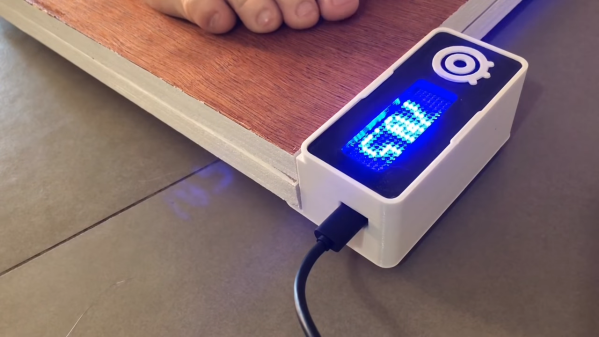
Instead of just buying one, [igorfonseca83] decided to burn a few calories and build his own smart scale that uses IFTTT to send weight data to his fitness tracker. It’s made from four 50kg load cells that are sandwiched between two pieces of plywood. An HX711 sensor module reads the load cells, and a FireBeetle ESP8266 uploads the data to Adafruit IO. His weight is simultaneously displayed on a FireBeetle LED matrix.

We applaud [igorfonseca83]’s efforts to make this an easy, educational project that anyone can replicate. The instructions are great, the pictures are clear, and there’s even a CAD animation of all the pieces coming together. Jog past the break to see the build video, and weigh in down below.

Continue reading “Build A Wi-Fi Smart Scale”