DIY Synth Takes Inspiration From Fretted Instruments

There are a million and one MIDI controllers and synths on the market, but sometimes it’s just more satisfying to make your own. [Turi Scandurra] very much went his own way when he put together his Diapasonix instrument.

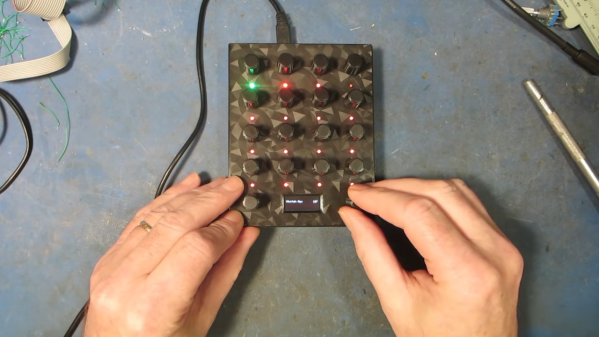
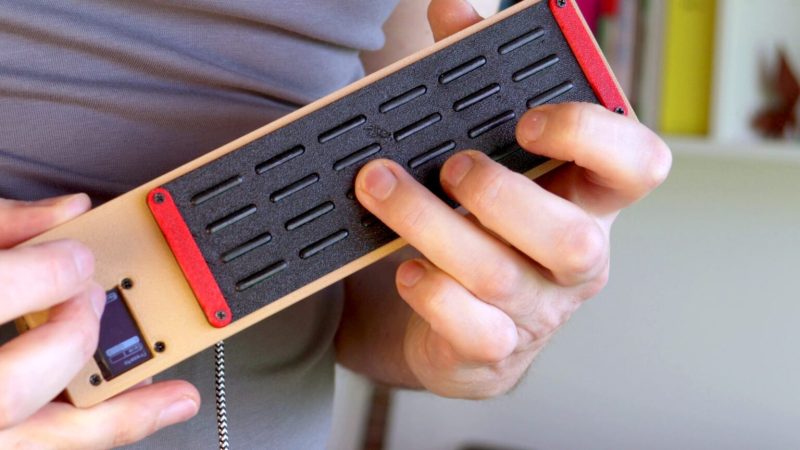
Right away, the build is somewhat reminiscent of a stringed instrument, what with its buttons laid out in four “strings” of six “frets” each. Only, they’re not so much buttons, as individual sections of a capacitive touch controller. A Raspberry Pi Pico 2 is responsible for reading the 24 pads, with the aid of two MPR121 capacitive touch ICs.

The Diapasonix can be played as an instrument in its own right, using the AMY synthesis engine. This provides a huge range of patches from the Juno 6 and DX7 synthesizers of old. Onboard effects like delay and reverb can be used to alter the sound. Alternatively, it can be used as a MIDI controller, feeding its data to a PC attached over USB. It can be played in multiple modes, with either direct note triggers or with a “strumming” method instead.

We’ve featured a great many MIDI controllers over the years, from the artistic to the compact. Video after the break. Continue reading “DIY Synth Takes Inspiration From Fretted Instruments”

A Touchscreen MIDI Controller For The DIY Set

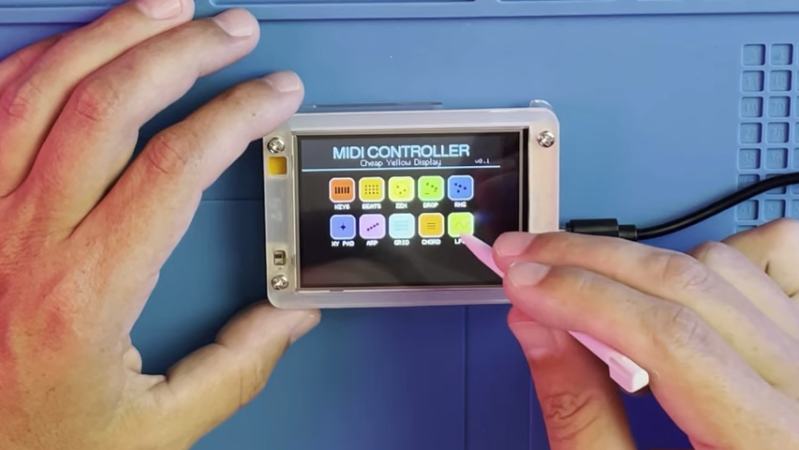
MIDI controllers are easy to come by these days. Many modern keyboards have USB functionality in this regard, and there are all kinds of pads and gadgets that will spit out MIDI, too. But you might also like to build your own, like this touchscreen design from [Nick Culbertson].

The build takes advantage of a device colloquially called the Cheap Yellow Display. It consists of a 320 x 240 TFT touchscreen combined with a built-in ESP32-WROOM-32, available under the part number ESP32-2432S028R.

Continue reading “A Touchscreen MIDI Controller For The DIY Set”

The synth in question in its acrylic case.

DIY Polyphonic Synth Sings In 8-Part Harmony

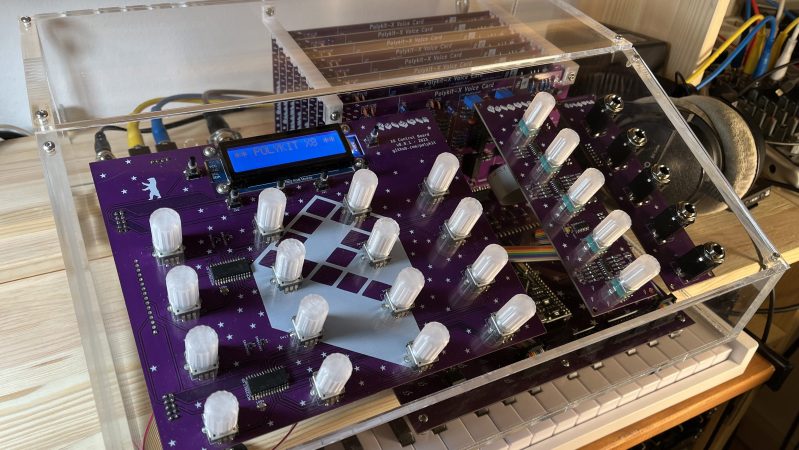
There’s just something about an analog synthesizer. You’d think that for electronic music, digital sampling would have totally taken over by now, but that’s really not true. The world of analog synths is alive and well, and [Polykit] has a new, open-source polyphonic synthesizer to add to the ever-growing chorus of electronic instruments.

The analog part is thanks to the eight identical voice cards that plug into the machine’s mainboard: each one has a voltage controlled oscillator to generate tones, an envelope generator, multiple voltage-controlled amplifiers, and even a pole mixing filter which is also, yes, voltage controlled. Each voice card outputs stereo, and yes, there are controllable mixing circuits for left and right output.

All that voltage control means a lot of lines from digital-to-analog converters (DACs), because while this is an analog synth, it does have a MIDI interface, and that means that a microcontroller needs to be able to speak voltage. In this case, the brains are an ATmega2560. Instead of stacking the board with enough expensive DACs to interpret the MCU’s digital signals, [Polykit] is instead is using some clever tricks to get more work out of the one DAC he has. Some things get tied together on all eight voices, like the envelope parameters; other values are run through a demultiplexer to make the most possible use of the analog lines available. Of course that necessitates some latching circuitry to hold the demuxed values on those lines, but it’s still cheaper than multiple high-quality DACs.

It’s a well-thought out bit of kit, down to the control panel and acrylic case, and the writeup is worth reading to get the full picture. The voice cards, main board and control board all have their own GitHub repositories you can find at the bottom of the main page. If you’re into video, [Polykit] has a whole series on this project you might want to check out on Makertube; we’ve embedded the first one below.

If you want to get your toes wet in the wonderful world of synthesizers, this library of seventy synths is an amazing place to start, because it has great simple projects.

Thanks to [Polykit] for the tip!

Continue reading “DIY Polyphonic Synth Sings In 8-Part Harmony”

A Childhood Dream, Created And Open Sourced

Some kids dream about getting a pony, others dream about a small form factor violin-style MIDI controller. [Brady Y. Lin] was one of the latter, and now, with the skills he’s learning at Northwestern, he can make that dream a reality — and share it with all of us as an open source hardware project.

The dream instrument’s name is Stradex1, and it’s a lovely bit of kit. The “fretless” neck is a SoftPot linear potentiometer being sampled by an ADS1115 ADC — that’s a 16-bit unit, so while one might pedantically argue that there are discreet frets, there’s 2^15 of them, which is functionally the same as none at all. Certainly it’s enough resolution for continuous-sounding pitch control, as well as vibrato, as you can see at 3:20 in the demo video below. The four buttons that correspond to the four strings of a violin aren’t just push-buttons, but also contain force sensors (again, sampled by the 16-bit ADC) to allow for fine volume control of each tone.

A few other potentiometers flesh out the build, allowing control over different MIDI parameters, such as what key [Brady] is playing on. The body is a combination of 3D printed plastic and laser-cut acrylic, but [Brady] suggests you could also print the front and back panels if you don’t happen to have a laser cutter handy.

This project sounds great, and it satisfies the maker’s inner child, so what’s not to love. We’ve had lots of MIDI controllers on Hackaday over the years — everything from stringless guitars  to wheel-less Hurdy-Gurdies to say nothing of laser harps galore — but somehow, we’ve never had a MIDI violin. The violin hacks we have featured tend to be either 3D printed or comically small.

If you like this project but don’t feel like fabbing and populating the PCB, [Brady] is going to be giving one away to his 1000th YouTube subscriber. As of this writing, he’s only got 800, so that could be you!

Continue reading “A Childhood Dream, Created And Open Sourced”

Rediscovering Microsoft’s Oddball Music Generator From The 1990s

There has been a huge proliferation in AI music creation tools of late, and a corresponding uptick in the number of AI artists appearing on streaming services. Well before the modern neural network revolution, though, there was an earlier tool in this same vein. [harke] tells us all about Microsoft Music Producer 1.0, a forgotten relic from the 1990s.

The software wasn’t ever marketed openly. Instead, it was a part of Microsoft Visual InterDev, a web development package from 1997. It allowed the user to select a style, a personality, and a band to play the song, along with details like key, tempo, and the “shape” of the composition. It would then go ahead and algorithmically generate the music using MIDI instruments and in-built synthesized sounds.

As [harke] demonstrates, there are a huge amounts of genres to choose from. Pick one, and you’ll most likely find it sounds nothing like the contemporary genre it’s supposed to be recreating. The more gamey genres, though, like “Adventure” or “Chase” actually sound pretty okay. The moods are hilariously specific, too — you can have a “noble” song, or a “striving” or “serious” one. [harke] also demonstrates building a full song with the “7AM Illusion” preset, exporting the MIDI, and then adding her own instruments and vocals in a DAW to fill it out. The result is what you’d expect from a composition relying on the Microsoft GS Wavetable synth.

Microsoft might not have cornered the generative music market in the 1990s, but generative AI is making huge waves in the industry today.

Continue reading “Rediscovering Microsoft’s Oddball Music Generator From The 1990s”

Digital Guitar Of The Future Has No Strings

Electric guitars are great, but they’re just so 20th century. You’d think decades of musicians riffing on the instrument would mean there are no hacks left in the humble axe. You’d think so, but you’d be wrong. [Michael], for one, has taken it upon himself to reinvent the electric guitar for the digital era.

Gone are the strings, and the frets have vanished as well. The neck of this guitar is one long custom PCB, looking very sleek with black solder mask. Gold pads serve as touch sensors to give tone data over i2c (from unspecified touch sensing chips) to the Amtel Mega 32u4 at the heart of the build.

With no strings, strumming won’t work, so a laptop-style touchpad serves instead. That means every user interaction with this guitar is with capacitive touch sensors talking i2c. The X and Y coordinates of the touch, along with pressure are sent to the processor over the i2c bus, triggering an interrupt and offering quite a bit of opportunity for sound control.

Said sound control is, of course, done in MIDI. This lets the guitar control a whole variety of synths and/or software, and of course [Michael] is using more futuristic-sounding synths than a pack of guitar samples. That said, what exactly goes on with the MIDI controls is left frustratingly vague. Obviously fretting provides note selection, but does the touchpad just send a “note start” command, or are the X, Y and pressure data used in interesting ways? Is there multitouch support? The video doesn’t say.

How, exactly, the obviously-plastic body of the guitar was manufactured is also left unsaid. Is it a large resin print? SLS? It looks injection-molded, but that makes no sense for a one-off prototype. On the other hand, it looks like he’s selling these, so it may very well be an injection-molded production case we’re seeing being assembled here, and not a prototype at all.

For all the video leaves us wanting more information, we can’t help but admit the end product both looks and sounds very cool. (Skip to the 4:50 mark in the embedded video to hear it in action.) The only thing that would improve it would be a hurdy-gurdy mode. Thanks to [Michael] for the tip, and remember  we want to hear tips about all the weird and wonderful hacked-together instruments you make or find on the web.

Continue reading “Digital Guitar Of The Future Has No Strings”

OpenMIDIStomper Makes Sure Your Gear Does What Your Foot Says

If you’re a solo musician, you probably have lots of gear you’d like to control, but you don’t have enough hands. You can enlist your feet, but your gear might not have foot-suitable interfaces as standard. For situations like these, [Nerd Musician] created the OpenMIDIStomper.

The concept is simple enough—the hardy Hammond enclosure contains a bunch of foot switches and ports for external expression pedals. These are all read by an Arduino Pro Micro, which is responsible for turning these inputs into distinct MIDI outputs to control outboard gear or software. It handles this via MIDI over USB. The MIDI commands sent for each button can be configured via a webpage. Once you’ve defined all the messages you want to send, you can export your configuration from the webpage by cutting and pasting it into the Arduino IDE and flashing it to the device itself.

We’ve featured some great MIDI controllers over the years, like this impressive parts bin build.

Continue reading “OpenMIDIStomper Makes Sure Your Gear Does What Your Foot Says”