Midi Piano Instructor

[youtube=http://www.youtube.com/watch?v=i7AfiCQQ4nE]

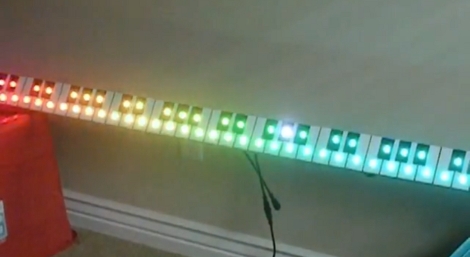
The MIDI piano instructor is a tool aimed at those who wish to learn to play piano, but don’t want to take lessons. The LED bar mounted above the keys lights up to show you exactly what key to press and when. We’ve seen this available in some electronic keyboards for some time, but this unit would be able to fit any standard sized keyboard.  Check the page for schematics and pictures.

[via Flickr]

Robo-vibe

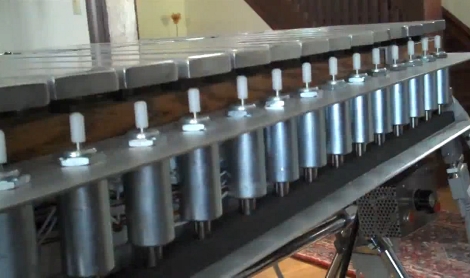
What sounds like a sex-toy is actually the reason these musicians haven’t been practicing. Marv is the MIDI actuated robotic vibraphone built by [Tim O’Keefe], [Michael McIntyre], and [Brock Roland]. Every key has a solenoid positioned below it. The beauty here is that other than four small holes used for mounting, the vibraphone hasn’t been altered at all. The solenoids are positioned on the outside edges of the instrument but there’s also a hidden secret. A set of dampers have been installed between the two ranks of keys. These are used to stop dampen ringing keys after the note should have stopped.

These guys have exhibited some beautiful craftsmanship. Check out the videos after the break and if you have the chance, see Marv in person at BarBot 2010. If you do attend that robot extravaganza don’t miss your chance to enjoy a breast-pump actuated cocktail.

Continue reading “Robo-vibe”

Guitar Hero As An Instrument Or Midi Controller

[youtube=http://www.youtube.com/watch?v=azfgasnWtW0]

[Robert] wrote a program using Max/MSP that lets him make music with his guitar hero controller. There’s another video after the break where he walks through the various features but here’s the gist of it. This works on Mac and Windows and allows a sort of ‘live play’ or midi mapping mode. In the midi mode each key can be configured to do your bidding. His example uses the pick bar to scroll through different samples and the green button the play them or the red button to stop.

The live mode us much more involved. In the software you choose the type of scale and the key you’d like to play in. This makes up for the controller’s lack of enough frets to make it a chromatic instrument and these settings can be adjust from the controller. There is an up-pick offset that makes the upward movement of the pick bar a different note than the downward movement. The motion control can also be used as an input. He demonstrates pitch bending and cutoff using that method.

This looks like a lot of fun. He needs to team up with [Joran] to add drums to the mix, forming a much more creative rock band than you can buy in the store.

Continue reading “Guitar Hero As An Instrument Or Midi Controller”

ProtoDeck – MIDIBOX Based Controller

[Julien] let us know about his ProtoDeck. A MIDIBOX based controller for Ableton Live using a Big Max for live patch interface.

One thing that we have seen is less and less hacks for are MIDIbox projects. It is no wonder, considering now a days we have touch screen and multiple other interfaces and sound creation tools – MIDI almost seems like a dying art.

The ProtoDeck uses 87 pots, 90 buttons, and 81 RGB LEDs all controlled by 2 PIC 18F4620s. [Julien] says his main goals where to have lots of color and buttons. We think he succeeded.

RFID Meets Open Sound Control

Have you been working on a MIDI controller that uses RFID to identify and control different instruments? No? Neither have we but now we’re going to have to look into it. That’s because [Martin.K] has done a lot of the work for us. His nfOSC package links an RFID reader to the Open Sound Control library.

In the video after the break we see [Martin] placing RFID tags onto a Touchatag reader. With each addition, his software triggers a tag add event that OSC picks up and translates to a midi event; in this case it adds a new instrument to the mix. Can this be used to relieve musicians from staring at computer screens during performances? What if there was a small shelf in front of you? As you happily play your electric Didgeridoo, small items with RFID tags on them can be added or removed from that shelf to change the samples that are triggered when toiling away on that sonic weapon. This should be fun!

Continue reading “RFID Meets Open Sound Control”

Shadow Buttons

This art installation uses buttons made of light. A projector fills up the walls and ceiling of a room while a webcam monitors the pattern for changes. When the luminosity of a given area changes due to a shadow, a midi event is triggered. The software that controls the system is written in C# and uses the Emgu CV library to handle the image processing. In the video after the break you can see that creating shadows with your hands prompts changes in the image as well as the sound.

Continue reading “Shadow Buttons”

Subcycles: Multitouch Music Controller

[vimeo=http://vimeo.com/7000376]

Subcycles is a sound controller application that [Christian] is using on the third multitouch display that he built. The screen is a sheet of acrylic in an aluminum frame. The image is rear projected onto an area covered with Digiline dispersion film. As with other projects that use the Community Core Vision package, a PS3 eye camera captures the touch information.

This build does a great job of including the audience in what the musician on stage is doing. [Chris] points out that the sight of artists staring at laptops on stage is becoming more and more common. The ‘Minority Report’-like interface that Subcycles uses makes not just for interesting music, but for an added visual reinforcement to the live part of the performance.

[Thanks Mark]