Chiptune Instrument From NES

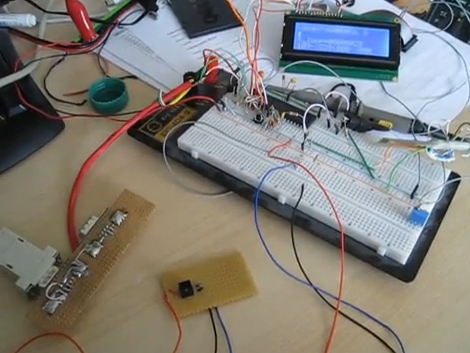
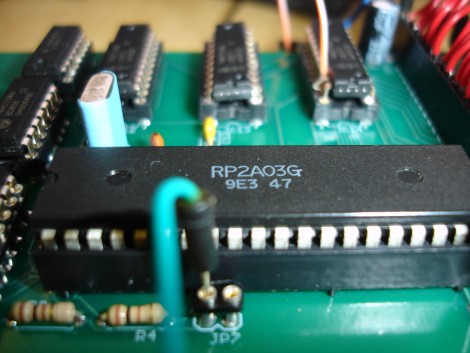
[Jarek Lupinski] wanted an instrument that would let him play chiptunes live, without a need for pre-programming a cartridge for playback during a concert. His preferred hardware is an original Nintendo Entertainment System because of its familiar nostalgic sound. After picking up a lot of 5 broken NES units he set out to build a midi-compliant device.

The five NES units he bought had nothing wrong with them other than the 70-pin cartridge connector. He fixed them all, then de-populated the board on one and tried to build out a circuit on a breadboard. After much trial and error, forum searching, and conversations with others who were familiar with the hardware he got the circuit working. He’s posted a schematic and had a board fabricated which takes the transplanted chips and transforms them into an instrument. Check out the test notes being played by an Arduino Mega after the break.

Continue reading “Chiptune Instrument From NES”

Single String Servo Electric Guitar

its a catchy tune!

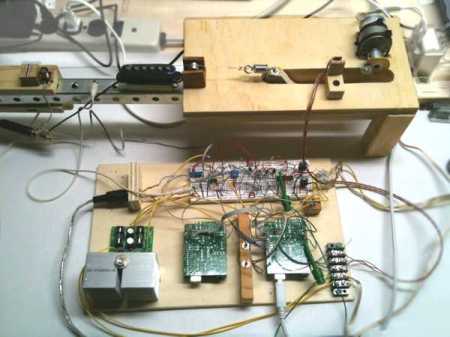
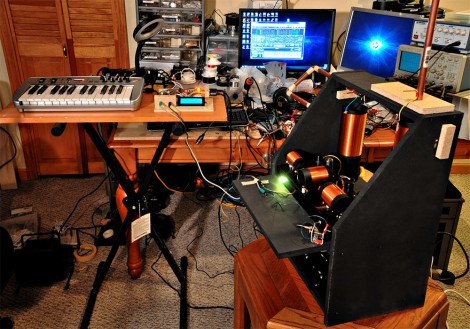
Ah, we love musical hacks that actually play music.  [Mike Baxter] is back again with a new servo electric guitar. This one, called the physical string synthesizer, and has only one string.  He’s using two Arduinos to control the unit. One to change the midi file to a note within the string’s limits and the second to actually control the servo. It seems like that could be simplified a little bit, but we’re pretty sure his end goal was to build an instrument quickly, not learn to be a circuit ninja. Last time we saw Mike Baxter, he had built a servo electric guitar that used a keypad for control. You can see a video of the single string one after the break.

Continue reading “Single String Servo Electric Guitar”

Homebrew Firmware Upgrade For VCI-100 Turntable Controller

We love hacks that take quality products and make them better. This enhanced firmware for the VCI-100 is a great example of that. In a similar fashion as the Behringer hack, [DaveX] reverse engineer the firmware for the device and figured out a few ways to make it better. It improves the scratch controller and slider accuracy to use 9-bit accuracy from the ADC readings, which in the stock version were being shifted down to 7-bits. There’s also a few LED tricks they call Disco Mode. They’re selling a “chip” that you need to flash the firmware but from what we can see it’s simply an RS232 converter so you might be able to figure out how to work without that part. We’ve embedded a demo of firmware version 1.4 after the break.

Continue reading “Homebrew Firmware Upgrade For VCI-100 Turntable Controller”

Firmware Hacking On Behringer Midi Devices

A new project called the Unofficial Behringer Control Development Kit lets you tweak or completely replace the firmware on the popular devices. The proof of concept demo shows a custom message scrolling on the 4-character 7-segment display but you can do with the device is only limited by how well you can code for the ARM processor inside. Development takes place using the GNU ARM toolchain but don’t worry, you don’t have to crack the case open to program the chip. The BCR2000 and BCF2000 models supported by the project both run bootloaders that allow firmware updates via midi commands. There’s even a recovery mode if you screw something up. Just make sure you have a direct midi connection for recovery, the USB port won’t work for that purpose. If you need a shove to get you started there’s a nice little example file in the repository.

[Thanks Bjonnh]

Massive MIDI Station Ditches The Monitor

[youtube=http://www.youtube.com/watch?v=8WQU-Lrm3D8]

Who need’s a touch screen when you’ve got 800 inputs each backlit with an RGB LED? This impressive controller was built by Ander for use in his performances. He did it with the intent to get rid of the computer monitor in his setup. We think there’s something to be said about that. It seems weird to go to a performance and see the artist staring at a screen the whole time. Unfortunately we don’t have too many details about the hardware but we can tell you that he’s using Ableton Live on the software side of things.

DMX Keyboard Display

This keyboard display has an RGB LED for each key that is addressable through the common stage lighting protocol, DMX. The project video, seen after the break, does a good job of walking us through the concept. By using a MIDI to DMX converter box [John] can show MIDI signals coming from a keyboard on the appropriate key of the display. By further monkeying with the firmware in the converter box he shows a plasma effect on the whole keyboard, making the corresponding light for each pressed key pop out in bright white. Jump to about 3:45 to hear and see “Sweet Child o’ Mine”.

This isn’t the first time [John’s] been caught with a slew of blinking lights. He helped create the giant LED Christmas tree that brightened up our holiday.

Continue reading “DMX Keyboard Display”

Kaossilator On The Cheap

We recently stumbled on a way to turn a regular laptop into a poor man’s Kaossilator. Using the touchpad of your laptop, some PureData software, Touchpad2MIDI and a couple custom patches, [zenpho] has set everyone up to create that crazy electronic music that kids listen to these days.

But what was that? You cant afford a whole laptop, and need to make this happen on an even tighter budget? Oh, we’ve got your back. Using just the trackpad and an Arduino, [Bastiaan] has created a basic PS2 to Arduino to USB link which can be parsed by your favorite language of choice into a working MIDI interface. Good news for all the lazy hackers out there, he’s planning on swapping out the Arduino for a Teensy, and making a real USB to MIDI interface.