Motion Sensing Minecraft Creeper Will Scare The Pickaxe Offa’ya

[Chris] Writes in to tell us about his motion sensing, Arduino powered Creeper.  As if these buggers were not frightening enough in game, [Chris] had to go and make the closest (legal) real world facsimile.  The Creeper utilizes an Arduino Uno with a wave shield to playback creeper noises, PIR sensor to detect victims, and an RC car as a motorized cart. The creeper sits and waits for a signal from the PIR detector, when it sees motion the RC remote is triggered, Creeper noises played and (we assume) panic ensues.

We might have forgone the entire RC part of the toy car and found the H-bridge motor controller, but using the RC remote has potential. The whole triggering mechanism can be placed remotely allowing the Creeper to jump out from some kind of cover.

Not enough Minecraft? Check out some our other Minecraft projects if you are interested in more tree-punching goodness.

A video of the creeper in action is available after the jump!

Continue reading “Motion Sensing Minecraft Creeper Will Scare The Pickaxe Offa’ya”
Kinect + Minecraft Trifecta

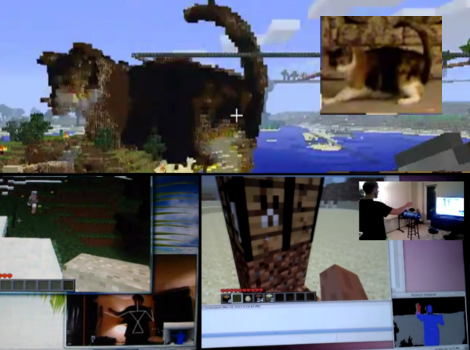
Today we have a special treat, three projects combining the “fastest selling consumer electronics device”, Kinect, and the “fastest selling indie java game that once kept us from sleeping for an entire weekend”, Minecraft!

[Sean Oczkowski] writes in to tell us about his efforts to play Minecraft with Kinect using no more than the OpenKinect Java wrapper on Ubuntu.  The code was written in about 4 days with some help from Wikipedia.  Using  histograms to locate the player in the field of view, the script calculates the center mass of the body and defines interactions for the limb occupying that quadrant of the screen. [Sean] does an excellent job of running through the whole process as well as the decisions made along the way. The whole thing is a bit like running in place, and we can’t imagine the flailing that will occur during the inevitable creeper encounter.

Next we have  [Wade McGillis] with his award winning Minecraft Kinect Controller. [Wade] provides source code and executables at his site. This version of control uses skeletal tracking data to sense the user’s gestures. This still involves holding your hands out like a zombie but it is a bit more versatile as one can pass their arms in front of their own body.

Finally [Nathan Viniconis] has been doing some very interesting work using the Kinect to import giant three dimensional models into the game world. [Nathan] then goes the extra mile and animates the figures! Check out the video below for the really impressive results. We here at Hackaday feel that this is the most appropriate use of this technology, and may begin building gigantic statues of ourselves on public servers.

Check out the the tricrafta (minefecta?) of videos after the jump!

Continue reading “Kinect + Minecraft Trifecta”

Controlling Real Objects Using Minecraft

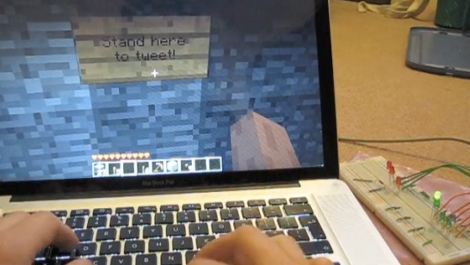
Most augmented reality takes images of the real world and superimposes virtual data on top of them. [Michael Winston Dales] went a different direction, using the virtual world of Minecraft to control objects in the physical world. In the video after the break you can see him use switches that he built inside the game to turn the LEDs pictured above on and off. You’ll also notice that in-game sign instructing a player to stand in one spot to Tweet. Since Minecraft is written in Java there are some mods that allow you to hook onto in-game events. [Michael] does just that, triggering his own scripts to send data to an Arduino, or use a Twitter API. Now this something that should be used with the Minecraft ALU. It takes the sandbox method of gaming to a new place, doesn’t it?

Continue reading “Controlling Real Objects Using Minecraft”

yo dog, we heard you liked simulations

16 Bit ALU In Minecraft

We love games here but we don’t often get a reason to write about them. This, however, is worth mentioning. The indie hit Minecraft is eating the entire internet right now. The game itself is hit and miss amongst our staff, but this project is unanimously accepted as awesome. [Theinternetftw} has created a simulation of the ALU section of a 16bit processor.  He can set it in motion and run around watching as the states change. This is part of an even bigger project to create the entire processor as shown in the book “The Elements of Computer Systems“.

For those that are wondering how long it took him to place all of those pieces, he actually imported most of it from another program. You can get more details on how they pulled this off in this forum thread. Be sure to catch the video after the break.

Continue reading “16 Bit ALU In Minecraft”