Sparkfun Recognized For Their Growth

The Denver Business Journal has recognized Sparkfun Electronics as the 2nd fastest growing company in the Denver area (in the $17.5-$46million class). This is fantastic news, not only for Sparkfun, but for Open Source Hardware.  Sparkfun is the worlds largest manufacturer of open source hardware, located right in the middle of the country, Boulder Colorado.

Not only has Sparkfun grown immensely in open source hardware products, they’ve also put together several educational systems like their tutorial section as well as their “learn at sparkfun” system. Way to go sparkfun!

Parallax Shows Love For Open Source: GCC + Propeller

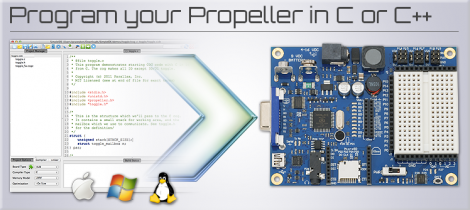
Parallax has done something that is unthinkable for most microcontroller manufacturing companies. They’ve decided to throw their support behind an open source toolchain based on GCC. That’s right, instead of fighting to get your code compiling on a platform whose example code uses crippleware, you can actually download, compile, and start using this toolchain without code size restrictions or other unfavorable limitations.

Why does this matter? One example that comes to mind is ChibiOS and the STM32F0-Discovery board. We’ve been playing around with that board recently and found out that the Atollic 8k code-size limitation prevents you from debugging ChibiOS. So you either pony up the registration fee, or go though at least a little pain (a lot depending on your skill level) to move to an open source solution. Here that’s not going to happen because you start with a GCC option from the word ‘Go’.

So join us in a round of applause for good decisions. Bravo Parallax! This Beta test targets the P8X32A Propeller chip but we hope it’s so popular that the rest of the line gets its own support.

[Thanks Devlin via Adafruit]

Open Source Graphics Card

Even though NVidia and ATI have been open-source friendly for a while now, there still isn’t a true open-source graphics card. [Anton] and [Per] are trying to fix that by building his own graphics card around an FPGA. The project is called ORSoC, and it’s available on opencores.com.

The guys are building the ORSoC graphics card around a Digilent Atlys FPGA dev board. So far, he can draw lines, textured triangles, bitmap or vector fonts, and throw a few 3D meshes up on the screen. This project isn’t intended to run advanced OpenGL or Steam on Linux, but for all the work that into this graphics accelerator, it’s an amazing piece of work.

There are a few demos after the break; a cube rotating in 3D and a demo drawing and translating polygons and a few textures. The ORSoC is a bit slow, but that’s an artifact of the build not being optimized for the FPGA the team is using. If you’d like to test this graphics card, there’s a Git available. As a bonus you don’t even need an FPGA to play around with this project. There’s also a software emulation of all the functions. Very neat.

Continue reading “Open Source Graphics Card”

[Phil Torrone] Interviews [Bunnie Huang] About Chumby And More

Over at Make, [Phil Torrone] has done an interview with [Bunnie Huang]. [Bunnie] has been a major contributor to the pages of Hackaday as far back as we can remember. He started in 2002 hacking X-boxes and sharing his findings with the world. It is this sharing that makes [Bunnie] stand out. He has always shared all his findings and pushed for open source wherever it would fit. We recently discussed how Chumby, a project to which [Bunnie] contributed is coming to an end. In this interview, he talks about what the future holds for himself and how he plans to spend his time. Most interestingly, he plans on spending a year just building things he’s wanted to see built. Be sure to check out the interview to see what he’s already accomplished.

Open Sourcing Everything… There’s An App For That

What happens if you’re a prolific developer and decide to release all of the source code from your work? Well, you should get a huge pat on the back from all interested parties. And so we say thank you to [Hunter Davis] for releasing the source code for his 70+ Android apps. But just making the decision isn’t the end of things, you’ve got actually get the code out there. And herein lies the hack. Instead of archiving and posting all of those projects he wrote a script to crawl, init, and push his projects to Github automatically.

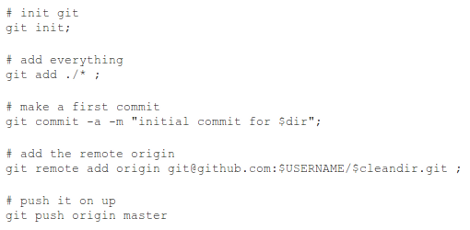
This process is made pretty easy because of the Github API. Looks like he used version 2 for his script but you’ll want to check out version 3 if you’re looking to write your own script. His script takes the API key and username as command line arguments, then traverses his local source tree. Along the way it uses some text manipulation to sanitize the directories for use as the name of the repository. Once that’s established it steps into the directory, creates a repository, adds and commits all the files, then pushes them to Github.

Following [Hunter’s] example makes it really easy to share your code. We hope more will follow suit, putting their work out there for others to learn from and build upon.

We’ve seen some hardware hacks from [Hunter] as well. He did a bunch involving the ZipIt, as well as some work with playing games with a Dockstar.

[via Reddit]

Birdwatching Meets A Computer-Controlled Water Cannon, Awesomeness Ensues

squirrel turret

Sure, squirrels may bother the average home owner, but few have attempted as creative a way to control them as this automated water turret. Check out the video after the break to see how this was accomplished, but if you’d rather just see how the squirrels reacted to getting squirted, fast forward to around 16:00. According to [Kurt] he was sure this would be his solution, however, his conclusion was that “squirrels don’t care.”

As for the presentation, it’s more about how to use [OpenCV], or Open Source Computer Vision. It’s quite a powerful piece of software, especially considering that something like this would cost thousands of dollars in a normal market.  An Arduino is used to interface the computer’s outputs to the real world and control a squirt gun. If you’d rather not program something like this yourself, you could always simply use a garden hose as someone suggests just after the video. Continue reading “Birdwatching Meets A Computer-Controlled Water Cannon, Awesomeness Ensues”

Brewtarget: Open Source Homebrewing

[youtube=http://www.youtube.com/watch?feature=player_embedded&v=BEdkZIUkvA4]

Several of us here at Hackaday Brew our own beer. Needless to say, we got a little excited when we saw members of the open source community building a brew tracking system. Brewtarget is an open source tracking system that you could download right now and begin tracking and building your recipes. It looks like there is a fairly active development group working on it and even a feature request form that seems to be filling up. Maybe we overlooked it, but there doesn’t seem to be an existing feature list. We look forward to seeing where this project goes.

Brewtarget implements BeerXML, which means it should also be compatible with Beershmith, a commercial application.

[via adafruit]