New, Inexpensive DSO Now Shipping

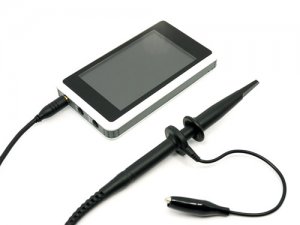
Seeed Studio’s line of hacker-friendly tools has expanded by one, they’ve announced that beta units of their DSO Quad oscilloscope are now available for shipping. The DSO Quad is about the size of a thick iPod yet packs impressive features such as two 72MSPS analog channels and a signal generator. By far the coolest ‘feature’ of the DSO Quad is that it’s completely open source.

DSO Quad is a pocket size four-channel digital oscilloscope designed “for common electronic engineering tasks.” It’s based on an ARM Cortex M3 that provides 72MSPS analog bandwidth on two channels with an integrated FPGA and a high speed ADC. In addition to the four data acquisition channels (two analog, two digital), the DSO Quad has a signal generator.  This lets you put out square, triangle, saw, and sine waves from 10Hz to 1MHz. An internal 2MB USB stick can be used to store sampled data, upgrade the firmware, or run custom programs. Since the device is still in beta, some of the software specifications aren’t firm, but if you’re looking for a relatively inexpensive ‘scope, this could be the one for you. Just bear in mind that for this pre-production run you’re not getting any documentation, so be prepared to be off the reservation and on your own.

Oscilloscope Thinks It’s A Video Monitor

There is nothing wrong with your television set. Do not attempt to adjust the picture.

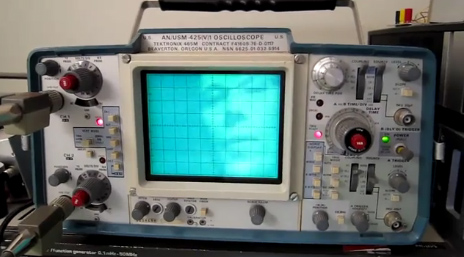
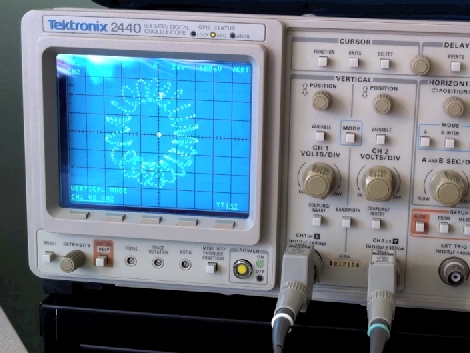
Where would we be if we listened to advice like that? [Eric] writes that with a fairly simple circuit, he’s able to split a composite video signal into its constituent X and Y ramp signals for display on his trusty Tektronix 465m. A LM1881 IC does the bulk of the heavy lifting. After running the signal through a few passive components, the generated ramp signals are ready for consumption by his venerable ‘scope. All that’s needed past that is some additional glue logic to invert the levels so the image shows up properly. The end result is a display that has an almost ethereal quality to it, like an old TV set or something out of the movie Brazil.

Hit the break to catch a video of the circuit in action.

Continue reading “Oscilloscope Thinks It’s A Video Monitor”

Adding Digital Storage To An Analog Scope

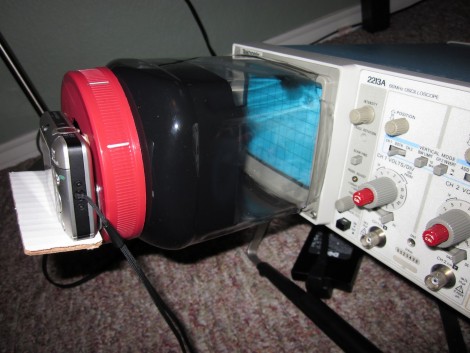
This is a hack in the finest sense of the term. It not only allows you to capture data from an analog oscilloscope for later analysis, but provides you with a great tool if you’re posting on the Internet about your projects. [J8g8j] used an empty cashew container to add a camera mount to the front of his scope. This is possible because the bezel around the display has a groove in it. A bit of careful measuring helped him make an opening that was just right.

You can see that the red cap for the jar holds the camera and gave him a bit of trouble in the original prototype. This version has a tray where camera sits, which replaces the Velcro with didn’t hold the camera level the first time around. He’s also painted the inside of the clear plastic to reduce glare on the oscilloscope readout. Black and white images seem to come out the clearest, but it can be difficult to make out the grid lines. The addition of LEDs to help them stand out is one of the improvements we might see in the future.

TV Oscilloscope

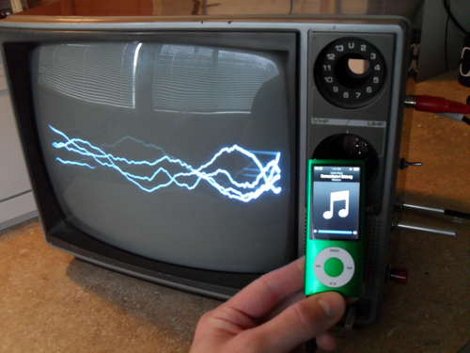
Need an oscilloscope? Want to see the music? Don’t have money, but do have a old TV? Then this TV to oscilloscope mod may be right up your alley. Now don’t go running off just yet, when you’re working inside of a CRT device you are exposed to mains current, high voltage, and high frequency, so extra care needs to be observed .

If you have your rubber welding gloves, and have discharged all your fat capacitors (including the CRT) its pretty much the same magic trick as couple we have previously featured. Patch an amplified input signal into the vertical deflection coil and let her go, but this instructable features much more detailed instruction, and photos so you have a much better chance of replicating this (not quite lab grade) potentially useful device.

Join us after the break for a short video.

Continue reading “TV Oscilloscope”

Giant Oscilloscope Music Display

oscilloscope_wall

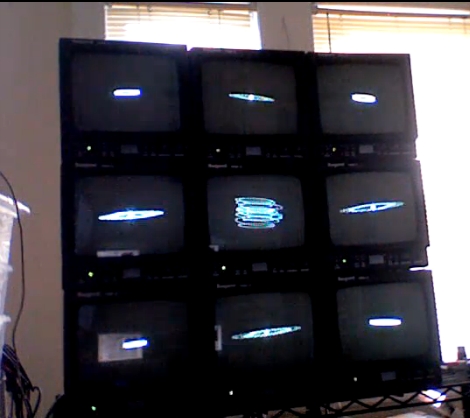
[Andrew] sent us a video of his home made oscilloscope wall, which he uses to visualize different audio tracks he has created. The wall is made up of nine old broadcast monitors he wired together in his studio. At first it appears that the monitors are split into two sets of four, with the center monitor running separately, but upon further inspection it looks as if he can control the display of each monitor independently.

We’re pretty sure he is not using an actual oscilloscope to generate the visuals, but rather visualization software that can approximate the output of an O-scope set in X-Y display mode. Though the screens run independently, it would be great to see all nine screens working in concert to display one large visualization. [Andrew] mentions that an high-def version is in the works, so perhaps we’ll see more features added in that iteration.

Stick around to watch a video of his oscilloscope wall in motion.

Continue reading “Giant Oscilloscope Music Display”

Reverse Engineering Shopping Cart Security

All this talk about 555 timers is causing projects to pop out of the woodwork like this one that reverse engineers a shopping cart security mechanism. The wheel seen above listens for a particular magnetic signal and when encountered it locks down the yellow cowl, preventing the wheel from touching the ground and making the cart very hard to move.

[Nolan Blender] acquired one of these wheels for testing purposes and he’s posted some details about the hardware inside. But the first thing he did was to put together some test equipment to help find out details about the signal that trips the mechanism. He connected a coil to an audio amplifier and walked around the market looking for strong signals. Once he found a few strong bursts with that equipment he grabbed an oscilloscope, hooked it to the coil, and made some measurements. He found an 8 kHz signal at a 50% duty cycle at 30 ms intervals (it would be hard to make a better case for why you need an oscilloscope).

With the specs in hand, [Nolan] grabbed two 555 timers, an audio amplifier, and a 200 turn antenna around a ferrite core to build his own locking mechanism. If you’re ever stopped short in the middle of the market, just look for the hacker at the end of the aisle holding the homemade electronics.

[Photo source]

[Thanks Colin]

Xprotolab: Oscilloscope And Xmega Development Board

Here’s a nice hands-on overview of the Xprotolab, a development board based around the AVR ATxmega32A4 microcontroller. The tiny DIP package includes an OLED display, four tactile switches, and it can be powered via a micro USB connector. The device ships ready to use as a two-channel Oscilloscope, but check out how small it is in the video after the break to decide if this will actually be useful for you. It’s not that it doesn’t have a lot of features, in fact it’s packed with them, but that screen is quite small for meaningful work. Still, at $35 it’s an inexpensive way to get your hands on the hardware and acquaint yourself with this line of microprocessors. Not that in order to flash new firmware you will need a PDI capable programmer. Continue reading “Xprotolab: Oscilloscope And Xmega Development Board”