Give KiCAD A Try. Here’s How

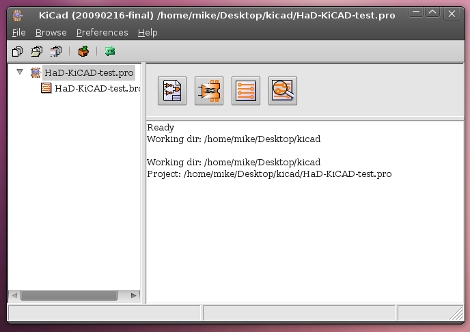
Up to this point we’ve used Eagle CAD as our exclusive PCB design and schematic layout tool. But [Brian] has inspired us to try something different thanks to his KiCAD tutorial.

KiCAD is an open source printed circuit board design tool. Since we like to rock the Linux here at Hackaday getting our hands on this was as easy as:

 sudo apt-get install kicad

The version in the Ubuntu 10.04 repositories is a bit older but seemed to work just fine. [Brian] jumps right in with one of our most dreaded tasks on Eagle, designing your own parts. He knows of a nice online tool for automatic KiCAD part generation and walks through the process of building a voltage regulator and importing it for use in your own personal library From there it’s off to layout a power supply schematic for a breadboard PSU. The lesson continues with board layer, as well as the process used for exporting data for PCB fab house. We think this tutorial works well if you’re already familiar with PCB layout using a different software package but it moves a bit fast if this is your first time.

KiCAD seems like a nice tool and we’ve heard from many advocates in the comments over the years. Look for our next PCB design to be on KiCAD as we just need to use it for a while before passing judgement.
Simple PCB Etchant Made From Chemicals You Can Put In Your Mouth

etching_test

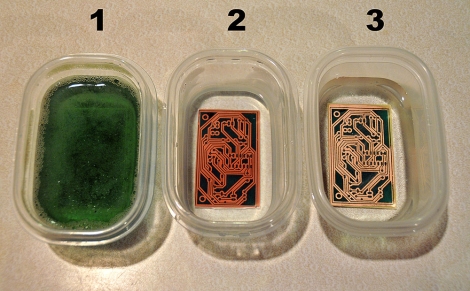
[Stephen] often finds the need to make his own PCBs at home, and when he got the urge to do some etching recently, he realized that he was fresh out of “Ferret Chloride and Bureaucratic Acid*.” Undeterred by his empty chemical cabinet, he poked around in his kitchen mixing together anything and everything that might have the ability to strip copper from a PCB.

Now, we don’t necessarily recommend this course of action, but it seems that he finally hit upon a winner. He discovered a formula that can be made at home from simple and safe household ingredients which does the job quite nicely. A fair warning however, standard ferric chloride disposal procedures need to be followed when using this solution.

If you want to know what he concocted in his kitchen as well as the chemistry behind it, you will have to visit his site, we won’t ruin it for you. You can however, see the solution at work in the video we have posted below.

*His joke, not ours

Continue reading “Simple PCB Etchant Made From Chemicals You Can Put In Your Mouth”

Direct To PCB Etch Resist Printing

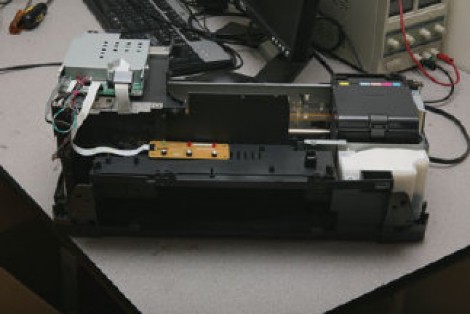
Here’s a step-by-step guide for printing etch resist directly to copper clad boards. Two methods of making printed circuit boards at home have long dominated as the favorites; using photo-resist, and the toner-transfer method. The latter involves printing board artwork on a laser printer and then ironing it onto the copper clad. We’ve seen some efforts to print toner directly to the copper, or to use ink to adhere toner and then heat fuse it, but this hack is the first one we remember seeing that uses an inkjet printer directly.

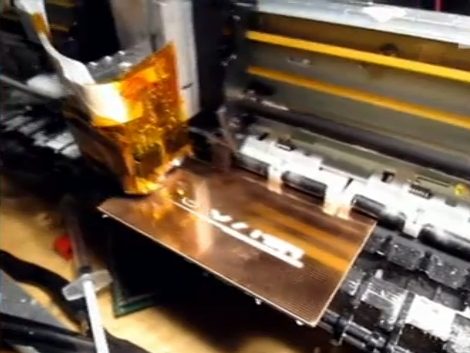
The best reason inkjet printing isn’t often used is do to the ink’s iability to protect copper from the etchant. This method uses MISPRO ink that is pigment based and will resist the acid. An Epson Stylus Photo R260 printer was chosen because you can get refillable printer cartridges which work with the ink, and they’re fairly easy to modify. In order to feed substrate through the device it needs some physical alteration to make room for the thickness of the material, and an ATtiny13 has been added to trick one of the sensors.

Unfortunately we didn’t find photos of the printed resist. But there is source code available for the tiny13 if you do give this a try.

[Thanks Pavlejo]

Three Digit Binary Clock

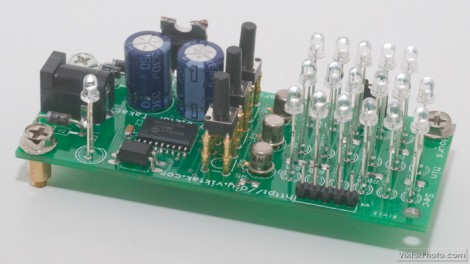
Here’s a three digit binary clock that [Viktor] designed. It uses a multiplexed display to drive one digit at a time with a PIC 16F628A. The video after the break shows it ticking away, display hours, minutes, and seconds in blue LEDs. You may be wondering why those LEDs are not flush to the board? [Viktor] took the project one step further than most binary clock projects, designing a PCB to fit into the enclosure of an old laptop PSU and then having the board manufactured. With options like DorkbotPDX groups orders its has become quite inexpensive to do this and it’s really good practice for when you need to design a highly complicated board for that super-fantastic project of the future.

Continue reading “Three Digit Binary Clock”

DIY PIC Development Board And Web Server

websd

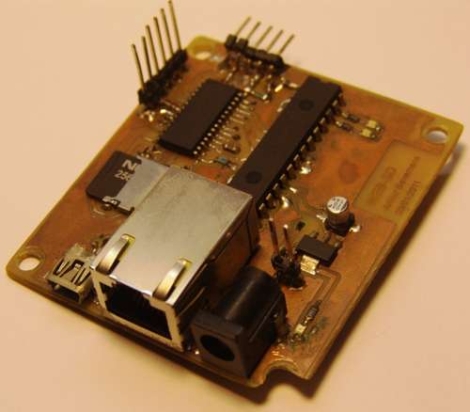
Inspired by a project featured here on Hack-a-Day, [arthurb] bought himself a PIC 24F and started experimenting once he learned the ins and outs of programming the chip. Using a breadboard and a nest of wires was fine for his first few projects, but as he advanced, he began to feel the need for a full-fledged development board. With a list of required features in mind he got to work, constructing a well thought out board as well as a handful of expansion boards that can be used for various other projects. His main development board includes Ethernet connectivity for use with his web server software, the ability to utilize an SD card for storage, and a USB port for programming. His expansion boards include a temperature sensor, a numeric touchpad, as well as a video output module. Overall it is a pretty impressive build, considering he had never programmed a PIC before starting this project. All of his boards are thoroughly documented, and he has included plenty of source code in hopes of helping other individuals just starting out in PIC programming.

You can see his web server in action here, but keep in mind that it is running off a PIC, so please be courteous in your usage.

Printable Wax As PCB Etch Resist

What if there were only two steps for making your own printed circuit board; print, etch? That’s what [Jeff Gough] has been working on and he presented the process in his talk at 27C3. In the first portion of the video after the break [Jeff] talks about various industrial PCB manufacturing processes in a depth you may not have heard before. We found it to be interesting but at about thirty minutes into the clip he begins the presentation of his modified printer. It’s an inkjet that can print wax onto copper clad board. The wax acts as a resist for chemical etchants, and provides very high resolution. He’s using a heavily modified print head, which brings to mind that diy piezo inkjet head which also has wax printing in its future plans. This certainly seems promising and if the process can be simplified it might do away with the toner transfer method.

Continue reading “Printable Wax As PCB Etch Resist”

DIY Clamp Helps With Surface Mount Soldering

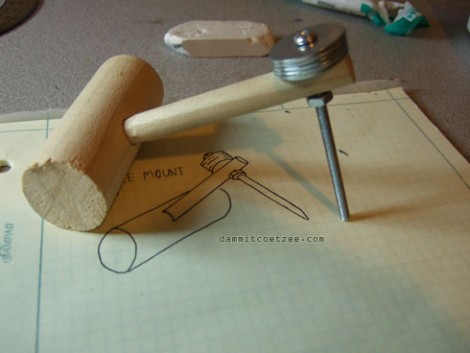
Hackaday writer [Gerrit Coetzee] built a simple clamp to aid in surface mount component soldering. This cheap, easily made device uses gravity to hold tiny components in place. The tip of the bolt is pointed, but gently like a ballpoint pen so as not to harm the components with a sharp tip. Roughly position your component, rest the tip of the clamp on its center, then nudge for final positioning. [Gerrit] also points out that this acts as a heat sink, helping to prevent damage to the component if you’re too lethargic with the soldering iron.

It seems like this device has been around in one form or another for quite a long time. But the best ideas do keep on popping up. Another nice tip to go along with this one is the use of a dowel when ironing during toner transfer for your PCBs.