Keeping Tabs On Your Tabby With A Camera And GPS

cat_eye_pictures_and_gps

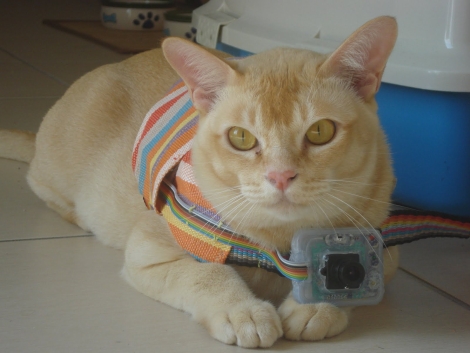
[Janis] has an outdoor cat that likes to roam all over the neighborhood. He was curious to see what he was up to all day, so he decided to build a small cat cam to document the feline’s comings and goings. After the cat returned one evening with a snail riding along on his back, [Janis] thought it would be pretty interesting to see where the cat was going as well.

He calls his creation “CatEye”, and it consists of a small JPEG color camera and GPS sensor, both of which are managed by what looks to be an ATMega328. The camera snaps pictures as the cat roams around, while the GPS sensor records its location throughout its travels. All of the data is stored on an SD card, making it easy to transfer the pics and .KML files back to his computer. A few clicks later, he can see everywhere his cat has been, using Google Earth.

It seems like a pretty interesting project, and we would love to see some schematics and code so that we can strap one of these on [Caleb] our cat to see where he’s been all day.
LED Wand For Light Painting Photography

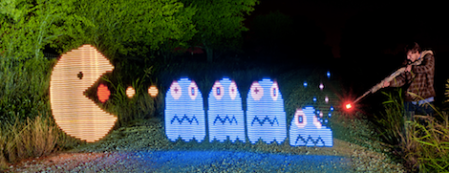
[Michael Ross] is a photographer who has been getting into light painting recently. He’s come up with his own RGB light wand to create some amazing images, and also written a very, very thorough tutorial (PDF warning) on how to build your own light wand.

The light wand is based on an Arduino Mega board and uses an RGB LED strip based on the HL1606 controller chip. We’ve covered these LED strips before, and they’re very easy to use with the requisite library. So far, [Michael] has built a 48-LED light wand and a 16-LED wand with a 6-position program selector, making it easy to do awesome single-exposure photos like this.

[Michael] creates his images in an Excel spreadsheet – rows are which LED to address and columns are units of time. The picture data is then copied and pasted straight from the Excel worksheet to the Arduino source code. This in itself is a pretty clever use of Excel.

Check out the how [Michael] creates one of his light paintings here.

Tesla Coil Bullet-time Photography

tesla_coil_bullet_time_photography

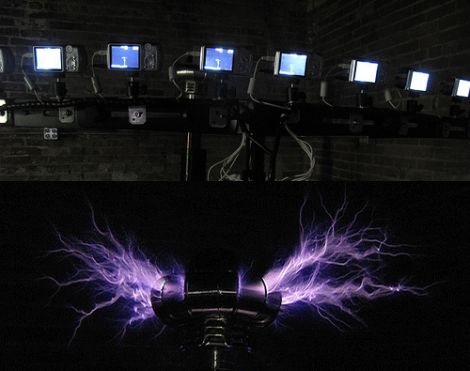
One thing we can all probably agree on is that Tesla coils are one part high-voltage electricity and two parts pure awesome. [Rob Flickenger] thinks so too, and he built a pretty nice one in his workshop some time ago. He took a bunch of pictures showing off the coil’s capabilities, but he thought that one photo taken from a single angle didn’t do much to relay just how fantastic it is to watch a Tesla coil in action.

Taking a cue from the Matrix movies, he bought a stack of Canon point and shoot cameras and constructed a bullet time rig in his workshop. In order to get the pictures just right, he flashed each camera with a customized version of the CHDK firmware that allowed him to trigger all ten shutters with a single button press. A few scripts help facilitate collecting all of the images for processing, after which he identifies the good shots and stitches them together. You can see the awesome results in the video below.

[via LaughingSquid]

Continue reading “Tesla Coil Bullet-time Photography”

DIY Softboxes Light Your Photos On The Cheap

diy_softboxes

Softboxes are often considered a must-have piece of equipment when doing any sort of portrait or studio photography. While they are not the most expensive photography accessory, they can be built far cheaper than you would pay for an off the shelf model.

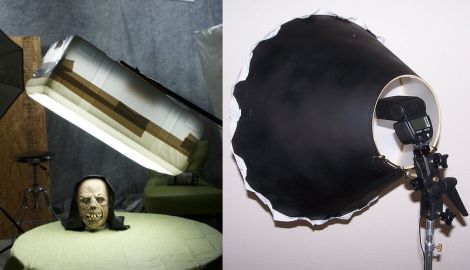
[Don] needed a softbox for his studio, and he ended up constructing a fairly nice one out of a styrofoam cooler. He mounted an outdoor light receptacle inside the cooler after laying down a reflective backing, bolting everything to a piece of plywood situated on the back of the cooler. He stretched some white cloth over the front to diffuse the light, and then mounted it on a light stand. You can see a video of the construction process below, as well as additional softbox-lit images on his site.

[Aud1073cH] had a similar need for a softbox, but went about his construction a bit differently. He grabbed a lampshade and a white dress shirt at a thrift store, stretching the shirt over the bottom opening before securing it with Velcro. He mounted the lampshade on a light stand, inserting his camera’s speed light through the smaller lampshade opening. As you can see in his photostream, the softbox does a great job at softening the shadows in his pictures.

Continue reading “DIY Softboxes Light Your Photos On The Cheap”

Build Your Own Panoramic Pinhole Camera

panoramic_pinhole_cam

While it seems that the digital camera is king, some people still love shooting with good old 35mm film – [Costas Kaounas], a high school teacher and photographer certainly does. He recently published plans for a great-looking 35mm pinhole camera over at DIY photography that we thought you might enjoy.

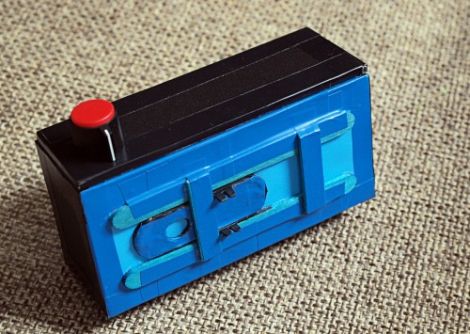
[Costas] put together a set of simple hand-drawn plans for the camera, that you can easily replicate with a bit of free time. The camera is built mostly from card stock, both in 1mm and 3mm flavors, also incorporating popsicle sticks and an aluminum can. The popsicle sticks are used to create a manual shutter for the camera, while the pop can is used to form the pinhole aperture.

It’s a pretty simple hack as you can see, with nary an electronic part to be found. It will take you a bit of time to construct however, since you’ll need to let the glue dry between certain steps.

Love it or leave it, you’ve got to admit that the panoramic shots it takes are pretty nice!

If we’ve piqued your interest in pinhole cameras, be sure to check out this Lego pinhole camera as well as this beer can pinhole camera.

[via Lifehacker]

Dino’s 2 Axis Camera Dolly

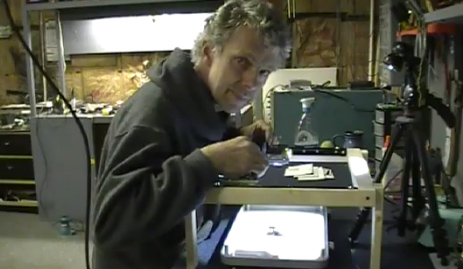
[Dino], who has become a regular face here on hackaday, sent us one of his weekly projects that we thought was pretty cool. He wanted to shoot some video of photographs to commemorate his late mother. The goal was to achieve the “Ken Burns Effect“, but in hardware instead of just doing it in software.  To do this, he built a 2 axis rig, very similar to many home made CNC machines we’ve seen. He used drawer rails and rollers and an old scanner for the parts.  We admit, at first glance we weren’t too impressed with the resulting effect. It is a bit shaky as he moves the camera and the zooms and slides don’t have that perfect smoothness that we have come to expect from modern video effects.  However, after a few minutes, it seemed so organic and pleasant that it won us over. This obviously isn’t what you would use for every project. This project, however, seems to fit perfectly.

If you still don’t like the effect, you could certainly find uses for this rig aside from video. You could use it (with backlight) for batch converting slides or other images to digital. It would work perfect as a 2 axis paper cutter. What other uses can you come up with for a 2 axis un-motorized frame?

You can watch the construction video after the break, and the result video on [Dino’s] page.

Continue reading “Dino’s 2 Axis Camera Dolly”

DIY Lightbox Repurposes Useless Scanner

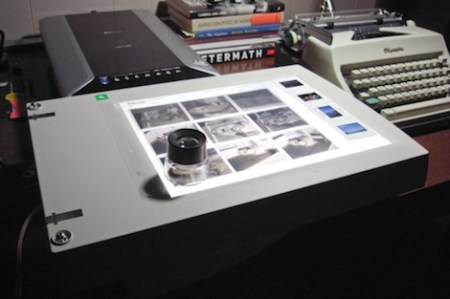
[James] didn’t like losing detail when scanning in photographic negatives, so he repurposed an old scanner and turned it into a lightbox.

The Flickr set of the build shows [James] installing a compact fluorescent bulb in the body of the scanner. Aluminum foil reflects the light, and the scanner glass is painted white for diffusion. [James] is quite happy with the result, and is amazed by the detail seen in the negatives under magnification instead of scanning.

We’re trying to figure out [James]’s though process in deciding to build a light box, and the best we can come up with is the hackaday mantra of, “Of course I can do that myself.” Even though he seems happy with his project, we’re wondering how hackaday readers would improve it. Maybe several dozen red, green, and blue LEDs to adjust the color temperature? Post your ideas in the comments.